
Share
Men's Health
Sleep
Women's Health
Mouth breathing during sleep: The silent wrecker
6 min read
Key takeaways
- Nasal breathing during sleep is the biological default. The nose filters, humidifies, and warms incoming air, produces nitric oxide (which dilates blood vessels and improves oxygen uptake), and generates a breathing pattern that supports better sleep architecture. Mouth breathing bypasses all of this.
- Chronic mouth breathing during sleep is associated with increased snoring, higher rates of obstructive sleep apnea, dry mouth and throat, worse sleep quality scores, and elevated inflammatory markers in the upper airway. For CPAP users, mouth breathing is one of the primary reasons for treatment failure; the air escapes through the mouth instead of pressurizing the airway.
- Most mouth breathing during sleep is driven by nasal obstruction: allergic rhinitis, deviated septum, nasal polyps, or chronic congestion. Treating the nasal obstruction treats the mouth breathing. The obstruction, not the mouth itself, is where to intervene.
- Mouth taping, applying a small piece of medical tape across the lips at sleep onset, is increasingly discussed as a behavioral intervention. The evidence base is limited but growing. For adults without untreated OSA, it is low-risk and may improve nasal breathing compliance overnight.
What the nose actually does
The nose is not a passive air tube. Nasal turbinates filter particulates and trap pathogens. The nasal mucosa humidifies and warms air before it reaches the lower airways, reducing irritation and water loss caused by dry-mouth air in the bronchi. The paranasal sinuses produce nitric oxide, a potent vasodilator and antimicrobial molecule, which is delivered to the lungs during nasal breathing, thereby improving oxygen extraction at the alveolar level.
Nasal breathing also creates resistance. That resistance is not a bug. The slightly slower, more controlled airflow through the nose produces a longer respiratory cycle that improves carbon dioxide tolerance and supports diaphragmatic breathing. Mouth breathing is faster, shallower, and chest-dominant, a breathing pattern associated with hyperventilation and sympathetic nervous system activation. Not ideal for sleep.
None of this works when you breathe through your mouth.
How to know if you are mouth breathing at night
Most people do not know they are doing it. The signals: waking with a dry mouth or throat; morning bad breath that resolves quickly after drinking water; a raw or scratchy throat on waking; excessive morning thirst; cracked lips. A bed partner who reports open-mouth sleep or snoring is another indicator. Some CPAP users experience persistent mask leakage despite proper fitting, often due to mouth breathing, which allows pressurized air to escape.
A simple home test: apply a small strip of paper tape loosely across your lips before sleep. If you consistently remove it during the night without remembering, nasal airflow is insufficient to maintain nasal breathing through the night. This is a signal to investigate nasal obstruction rather than simply tape harder.
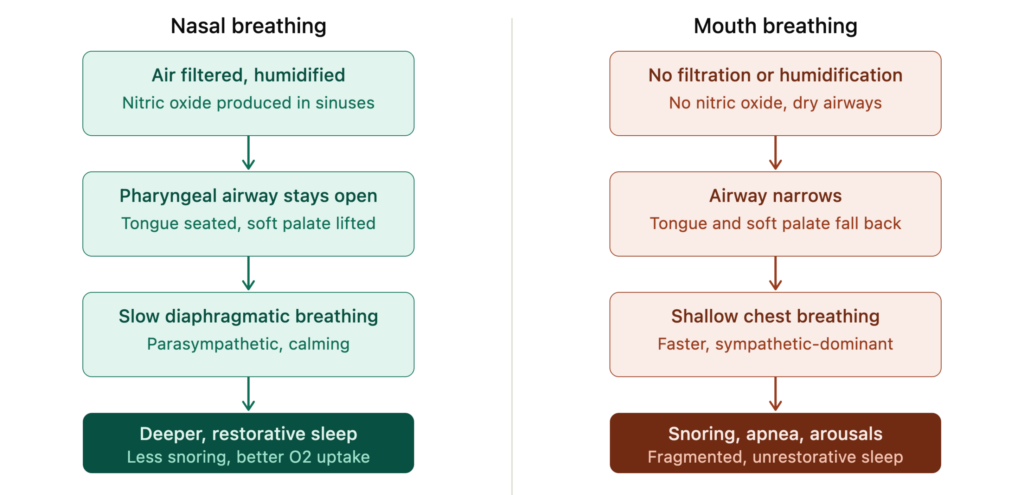
Nasal breathing maintains an open pharyngeal airway, produces nitric oxide in the sinuses, and supports slow diaphragmatic breathing. Mouth breathing lets the tongue and soft palate fall into the airway, bypasses every protective function of the nose, and shifts breathing to a faster, shallower, chest-dominant pattern that raises apnea risk. Source: Huang et al., Healthcare 2022 — The Impact of Mouth-Taping in Mouth-Breathers with Mild Obstructive Sleep Apnea: A Preliminary Study. CC BY 4.0.
Why it gets worse after 40
Allergic rhinitis, the most common driver of nasal obstruction in adults, does not reliably improve with age and, in some populations, worsens. Nasal mucosal atrophy and reduced ciliary function in older adults reduce the nose’s ability to clear secretions and maintain patent airflow. Upper airway muscle tone declines with age and with weight gain, making the pharynx more susceptible to the collapse that mouth breathing promotes.
The combination is predictable: more nasal congestion, less airway muscle tone, more mouth breathing, more pharyngeal collapse, more snoring and apnea. Adults who snored occasionally at 35 often snore significantly by 48, without dramatic weight change or structural change to explain it. Some of the progression is simply the compounding of these aging effects.
The CPAP connection
For CPAP users, mouth breathing is one of the most common reasons for inadequate treatment. CPAP works by pressurizing the airway through a sealed mask system. When air escapes through an open mouth, the pressure is lost, the therapeutic effect is negated, and the machine’s AHI data show residual events despite apparent compliance. Many CPAP users who report that the machine is not helping are mouth breathing throughout the night.
Solutions: a full-face mask (covers nose and mouth, eliminating mouth leak), a chin strap worn over a nasal mask (mechanically keeps the mouth closed), or mouth tape over the lips (softer intervention, effective when nasal airflow is adequate). The right approach depends on the degree of nasal obstruction and the patient’s tolerance for each option.
The Livium recipe
Tool. Address the nasal obstruction before anything else. A nightly nasal saline rinse (neti pot or squeeze-bottle rinse) before sleep reduces congestion and mucosal inflammation, improves nasal airflow, and measurably reduces allergic rhinitis symptoms. For allergic rhinitis, a daily nasal steroid spray (fluticasone or budesonide, available over the counter) used consistently for two to four weeks produces significantly better nasal airflow than antihistamines alone. For structural obstruction (deviated septum, polyps): an ENT evaluation identifies whether a surgical option is appropriate. External nasal dilator strips (Breathe Right-style) improve nasal airflow mechanically during sleep and are a reasonable non-pharmacological option for mild nasal congestion. Mouth tape for sleep, a micropore or purpose-made sleep tape applied loosely across the lips, is appropriate only when nasal airflow is adequate. Never tape the mouth of someone with untreated OSA.
Behavior. Keep the bedroom humid. Low humidity dries the nasal mucosa and increases congestion, particularly in winter with heating running. A room humidity of 40 to 60 percent supports nasal breathing and reduces nasal irritation. Sleep on your side rather than your back: supine sleep allows the tongue and soft palate to fall posteriorly into the airway, worsening both mouth breathing and snoring. Side-sleeping is the single highest-leverage positional change for improving nighttime airway patency. Avoid alcohol within three hours of sleep: alcohol relaxes upper airway musculature and dramatically worsens snoring and mouth breathing by reducing the pharyngeal tone that keeps the airway open.
Threshold. If nasal obstruction persists despite saline rinses, a nasal steroid spray, and allergen avoidance, see an ENT for a structural assessment. If mouth breathing persists despite clear nasal passages and you have not been tested for OSA: get a home sleep test. Mouth breathing during sleep is a significant risk factor for OSA. Treating the mouth breathing without ruling out OSA misses the larger problem.
| Intervention | Target | Evidence | Notes |
|---|---|---|---|
| Nasal saline rinse (nightly) | Congestion, mucosal inflammation | Strong | First-line; start here |
| Nasal steroid spray (daily) | Allergic rhinitis | Strong | 2–4 weeks for full effect |
| External nasal dilator strips | Mechanical nasal airflow | Moderate | Effective for mild congestion; no effect on OSA |
| Side-sleeping | Pharyngeal airway patency | Strong | Also reduces snoring and mild OSA severity |
| Mouth tape | Forces nasal breathing habit | Limited (emerging) | Only when nasal airflow is confirmed adequate; not for untreated OSA |
Plan of action
- Start a nightly saline nasal rinse before bed this week. It takes 90 seconds, costs almost nothing, and is the highest-evidence intervention for nasal congestion. Give it two weeks before evaluating whether additional interventions are needed.
- If you wake with a dry mouth or sore throat: try nasal dilator strips for a week. If that resolves the morning dryness, nasal congestion was the driver. If it does not, the cause is more central and may warrant an ENT visit or sleep study.
- Sleep on your side. If you roll onto your back during the night, a positional wedge pillow or the tennis-ball-in-a-pocket trick (sewing a tennis ball into the back of a sleep shirt) provides enough discomfort to prompt you to roll back without fully waking you.
- If you use CPAP and your compliance data shows residual high AHI or you still feel unrefreshed: ask your sleep physician specifically about mouth leak. A chin strap or full-face mask trial may resolve what seemed like CPAP failure. CPAP chin straps are a low-cost first test before committing to a new mask.
Table of Content

Know your body better.
Trusted By Thousands Daily







FAQs
Is mouth taping safe?
For adults with patent nasal airways and no untreated OSA, mouth taping with an appropriate tape (micropore surgical tape, not packing tape) is low-risk. The tape is applied loosely, creating resistance rather than a seal, so it can be opened with moderate effort. The risk is real in adults with significantly impaired nasal breathing or untreated OSA, where forcing nasal breathing can increase the work of breathing against obstruction. Do not tape without confirming that nasal breathing is functionally adequate.
Can myofunctional therapy help with mouth breathing?
Yes. Orofacial myofunctional therapy, structured exercises for the tongue, lips, and facial musculature, improves tongue posture and nasal breathing habits. Multiple studies show that it reduces AHI in mild-to-moderate OSA and improves nasal breathing in habitual mouth breathers. It is typically delivered by a speech-language pathologist or specially trained dentist. It is not a standalone OSA treatment for moderate or severe disease, but it is a meaningful adjunct for mild OSA and habitual mouth breathing.
Does mouth breathing during sleep cause cavities?
Yes. Mouth breathing dries saliva, which is the primary protective mechanism against oral bacterial growth and acid production. Reduced salivary flow during mouth breathing creates conditions favorable for Streptococcus mutans proliferation and enamel erosion. Adults who chronically mouth-breathe during sleep have higher rates of cavities, gum disease, and bad breath, independent of oral hygiene practices. Resolving the mouth breathing resolves the oral health consequences; treating the oral health consequences without resolving the mouth breathing is the long way around.
Legal Disclaimer
The content published on Livium Health is for informational and educational purposes only. Nothing on this site constitutes medical advice, diagnosis, or treatment. Always consult a qualified healthcare provider before making decisions about your health, including changes to medications, supplements, diet, or exercise.
Livium Health is not a medical practice and does not have a patient-provider relationship with its readers. We do not sell supplements, medications, or treatments, and we have no financial relationship with the products or services we reference.
While we work to ensure the information we publish is accurate and up to date, health and medical guidance evolves. We make no guarantees about the completeness or currency of any content on this site. Reliance on any information provided by Livium Health is solely at your own risk.
If you are experiencing a medical emergency, call 911 or your local emergency services immediately.
We may receive compensation, free products, or affiliate commissions for products mentioned in this post. Opinions are our own.