
Share
Men's Health
Thyroid Health
Women's Health
A higher TSH after 65 may not mean the same thing: Why thyroid ranges change with age
4 min read

Key takeaways
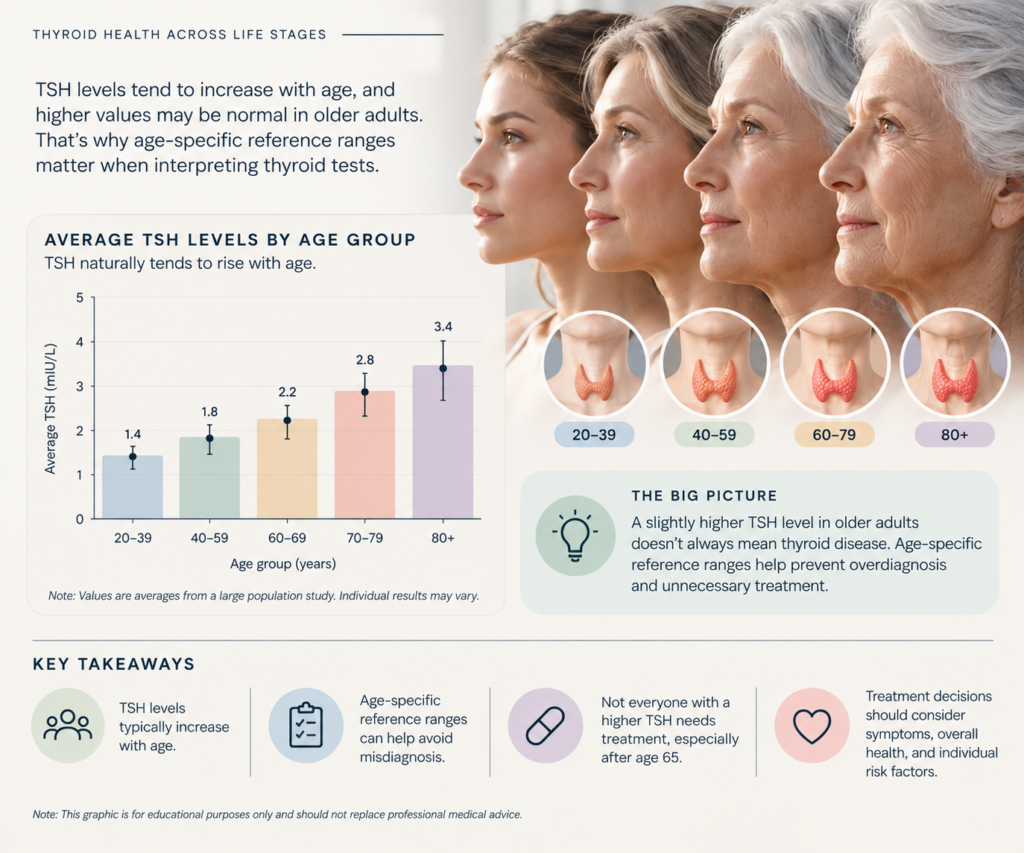
- TSH tends to rise with age, while free T3 tends to decline and free T4 may remain relatively stable.
- A 2026 analysis of adults aged 65 to 84 found the upper end of the TSH reference range increased, particularly in the oldest participants.
- Using one fixed adult cutoff can label some healthy older adults as having mild subclinical hypothyroidism.
- Age is context, not permission to ignore clearly abnormal thyroid results or symptoms.
The reference range is not a law of nature
A laboratory reference interval is built from a population. It is not a universal boundary where normal physiology suddenly becomes disease. That matters for TSH because its distribution shifts as people age.
If the same cutoff is applied to a 30-year-old and an 82-year-old, some older adults can be classified as mildly hypothyroid even though the value may fall within an age-appropriate population range.
The newest older-adult data shows the curve moving
A 2026 analysis from the Bunkyo Health Study examined 1,626 community-dwelling adults aged 65 to 84. After excluding people with medications, thyroid antibodies, or personal or family thyroid disease, 1,116 participants contributed to reference-range analysis.
TSH increased with advancing age, while free T3 declined. Free T4 did not show a significant age-related trend. The overall TSH reference interval in the selected older population was 0.49 to 5.56 mIU/L, with the upper limit rising particularly among adults 80 to 84.
A lab-results notebook can keep several years of TSH and free T4 values together, making a trend easier to see than one isolated result.
Mild subclinical hypothyroidism is where context matters most
Subclinical hypothyroidism means TSH is elevated while free T4 remains within range. The label covers a wide spectrum, from a barely elevated TSH that normalizes on repeat testing to persistent, larger elevations with autoimmune thyroid disease.
In the Bunkyo analysis, mild subclinical hypothyroidism was not uniformly associated with the geriatric conditions examined. That supports caution about converting every mild age-related elevation into disease.
A pill organizer is useful for people already taking prescribed medication, but it is not a reason to start levothyroxine simply because one number crossed a general adult cutoff.
Do not swing too far in the other direction
Age-adjusted interpretation does not mean thyroid disease stops mattering after 65. Overt hypothyroidism, clearly elevated TSH, low free T4, progressive changes, symptoms, medications, and thyroid autoimmunity still deserve evaluation.
Older adults can also be more vulnerable to overtreatment. Excess thyroid hormone can contribute to atrial fibrillation and bone loss, which makes precision important in both directions.
A medication reminder timer can support consistent dosing when treatment is prescribed, and a water bottle can simplify a morning routine without changing thyroid physiology.
Why this matters more as people live longer
A small shift in the reference interval affects many people when thyroid testing is common. Labeling an age-related TSH rise as disease can lead to years of medication and repeated dose adjustments.
The opposite risk is undertreatment of genuine disease. Better age-specific interpretation is about narrowing that gap, not simply moving the cutoff upward for everyone.
The Livium recipe
Tool. Look at TSH together with free T4, age, previous values, and symptoms.
Behavior. Repeat mild unexpected abnormalities when clinically appropriate before assuming they represent permanent disease.
Threshold. Markedly abnormal results, low free T4, or significant symptoms need medical assessment rather than age-based reassurance.
| Age-related pattern | 2026 study finding | Why it matters |
|---|---|---|
| TSH | Rose with advancing age | Fixed cutoffs may overdiagnose some older adults |
| Free T3 | Declined with age | Part of normal age-related pattern in population data |
| Free T4 | No significant age trend | Helps distinguish subclinical from overt disease |
| Overall older-adult TSH interval | 0.49-5.56 mIU/L | Population-specific, not a personal treatment target |
Source: Bunkyo Health Study, Journal of the Endocrine Society, 2026.
One number should not erase the trend
A TSH that has been stable near the upper end of range for years carries different information from a value that has climbed rapidly over several tests. Trends can reveal evolving autoimmune disease, medication effects, recovery from illness, or simple biological variability.
That is why old laboratory records are unusually valuable in thyroid care. A result gains meaning when you can see what came before it.
Reference intervals are population tools
Even an age-specific range cannot diagnose or clear an individual by itself. Reference intervals describe where most values fall in a selected population. They do not incorporate every person’s symptoms, cardiovascular history, medications, or autoimmune risk.
Use the range as one piece of evidence. The clinical question is whether the value reflects disease in this person, at this time.
Plan of action
- Keep thyroid decisions tied to repeatable laboratory and clinical evidence.
- Track changes over time instead of reacting to one isolated result.
- Tell clinicians about prescriptions, supplements, and major medication changes.
- Use urgent care for severe or rapidly changing symptoms rather than self-adjusting thyroid treatment.
Table of Content

Know your body better.
Trusted By Thousands Daily







FAQs
Does TSH normally rise with age?
Population studies show that TSH tends to increase with advancing age, particularly in older age groups.
Does a mildly high TSH always need treatment after 65?
No. Treatment depends on the degree and persistence of elevation, free T4, symptoms, antibodies, comorbidities, and individual clinical context.
Should older adults use a different TSH range?
Age-specific ranges are increasingly studied, but laboratories and guidelines differ. The result should be interpreted in context rather than self-reclassified.
Legal Disclaimer
The content published on Livium Health is for informational and educational purposes only. Nothing on this site constitutes medical advice, diagnosis, or treatment. Always consult a qualified healthcare provider before making decisions about your health, including changes to medications, supplements, diet, or exercise.
Livium Health is not a medical practice and does not have a patient-provider relationship with its readers. We do not sell supplements, medications, or treatments, and we have no financial relationship with the products or services we reference.
While we work to ensure the information we publish is accurate and up to date, health and medical guidance evolves. We make no guarantees about the completeness or currency of any content on this site. Reliance on any information provided by Livium Health is solely at your own risk.
If you are experiencing a medical emergency, call 911 or your local emergency services immediately.
We may receive compensation, free products, or affiliate commissions for products mentioned in this post. Opinions are our own.