
Share
Men's Health
Peptides
Women's Health
Can a peptide protect aging muscle? The myostatin experiment worth watching
4 min read

Key takeaways
- Myostatin acts as a brake on skeletal-muscle growth, making it an attractive target for sarcopenia and muscle-wasting therapies.
- A 2026 paper evaluated a synthetic peptide called Myoki across cell, animal, and human studies.
- In an 80-person randomized, double-blind, placebo-controlled clinical study, the authors reported improvements in muscle mass, walking speed, and grip strength after 12 weeks.
- The evidence is early, comes from a small study, and requires independent replication before Myoki should be treated as an established therapy.
Muscle has a biological brake
Skeletal muscle growth is not controlled only by protein intake and training. Myostatin is a signaling protein that restrains muscle growth, which makes the pathway an obvious drug target for sarcopenia and other muscle-wasting conditions.
The challenge is that increasing muscle size is easier to demonstrate than restoring strength, walking ability, independence, or durable function. Many experimental muscle drugs have stumbled on that distinction.
A 2026 synthetic peptide study reported both mass and function signals
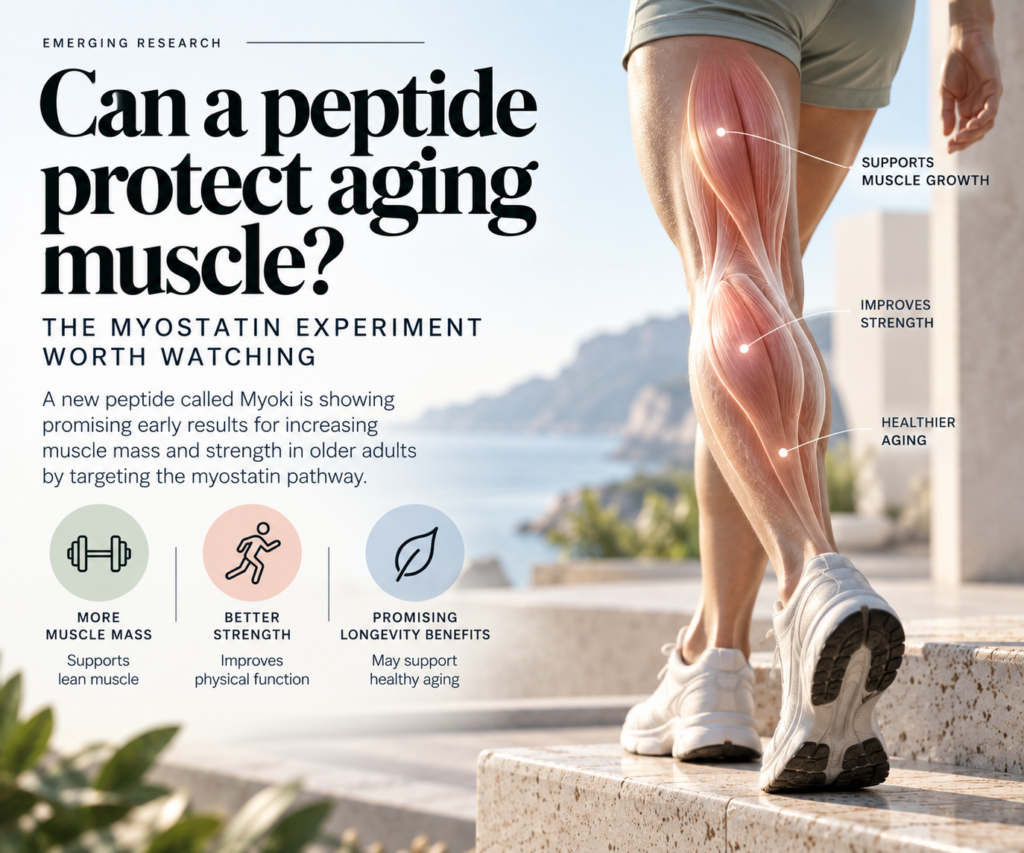
Researchers evaluated a synthetic peptide called Myoki in muscle cells, an accelerated-aging mouse model, and a randomized, double-blind, placebo-controlled human study involving 80 patients with muscle atrophy.
After 12 weeks, the authors reported improvements in muscle mass, walking speed, and grip strength alongside changes in serum markers. The peptide also showed myostatin-related effects in laboratory models.
A set of resistance bands remains a much more established way to provide muscle with a growth stimulus while experimental drug research develops.
This is promising precisely because function was measured
Muscle-drug development has repeatedly learned that more lean mass does not automatically produce more useful strength. Grip strength and walking speed therefore make the Myoki findings more interesting than a DEXA-only result.
But interesting is not the same as established. The trial was small and short, and the study authors were affiliated with the company developing the peptide. Independent replication matters.
A strength log can track repetitions, walking pace, and functional goals, while a shaker bottle can make adequate protein easier when appetite is limited.
The myostatin field is larger than one peptide
Researchers have explored monoclonal antibodies, ligand traps, follistatin-related approaches, gene strategies, and other myostatin or activin-pathway interventions. Results across muscle-wasting conditions have been mixed.
A 2026 review of emerging muscle-wasting therapeutics emphasized a recurring translation problem: favorable effects on muscle mass often fail to translate into meaningful improvements in mobility, fatigue, or patient-centered outcomes.
A water bottle supports training hydration, and an exercise timer can make short strength sessions easier to repeat.
What to watch next
The next useful evidence is not another mechanism diagram. It is larger, longer trials that show whether the effect persists, whether people function better, and whether adverse effects remain acceptable outside a tightly controlled study.
That distinction matters especially in emerging therapy. A compelling biological target can be real while the eventual drug still fails on tolerability, durability, manufacturing, or outcomes that patients actually notice.
The Livium recipe
Tool. Use strength and function, not body composition alone, as the outcomes that matter.
Behavior. Keep resistance training and adequate nutrition as the evidence-based foundation for preserving muscle.
Threshold. Do not purchase experimental myostatin peptides sold online as if early clinical research had established safety or efficacy.
| Myoki evidence layer | What was studied | What was reported |
|---|---|---|
| Cell models | Muscle differentiation and atrophy signaling | Favorable mechanistic effects |
| Aging mouse model | Muscle fibers and fibrosis | Improved muscle-related measures |
| Human trial | 80 patients, 12 weeks | Improved mass, grip, and walking speed |
| Evidence status | Early clinical development | Independent replication needed |
Source: Kim et al., Frontiers in Pharmacology, 2026.
The conflict-of-interest question matters here
Early biotechnology research often comes from the team developing the molecule. That is not a reason to dismiss the data, but it increases the value of independent replication, transparent protocols, and larger multicenter trials.
For Myoki, the appropriate stance is neither hype nor cynicism. The human findings are interesting enough to justify more research and far too early to justify treating an online peptide vial as equivalent to the studied intervention.
Exercise still solves a different problem
Even if a future drug reliably increases muscle mass, resistance training teaches the nervous system to recruit muscle, challenges bone and connective tissue, and develops task-specific capacity. Pharmacology cannot simply be assumed to reproduce those adaptations.
The most plausible future may therefore be combination care: a therapy that makes muscle easier to preserve paired with progressive training that turns tissue into usable function.
Plan of action
- Separate approved treatment from investigational therapy before acting on a headline.
- Track functional and health outcomes, not only weight or one laboratory number.
- Protect nutrition, movement, sleep, and hydration while using any prescribed metabolic therapy.
- Avoid unregulated research-chemical versions of drugs or peptides still in development.
Table of Content

Know your body better.
Trusted By Thousands Daily




FAQs
What is myostatin?
Myostatin is a signaling protein that limits skeletal-muscle growth and helps regulate muscle mass.
What is Myoki?
Myoki is a synthetic peptide investigated in a 2026 study for effects on myostatin signaling and muscle atrophy.
Is Myoki an established sarcopenia treatment?
No. The human evidence is early and small, and independent replication and further clinical development are needed.
Legal Disclaimer
The content published on Livium Health is for informational and educational purposes only. Nothing on this site constitutes medical advice, diagnosis, or treatment. Always consult a qualified healthcare provider before making decisions about your health, including changes to medications, supplements, diet, or exercise.
Livium Health is not a medical practice and does not have a patient-provider relationship with its readers. We do not sell supplements, medications, or treatments, and we have no financial relationship with the products or services we reference.
While we work to ensure the information we publish is accurate and up to date, health and medical guidance evolves. We make no guarantees about the completeness or currency of any content on this site. Reliance on any information provided by Livium Health is solely at your own risk.
If you are experiencing a medical emergency, call 911 or your local emergency services immediately.
We may receive compensation, free products, or affiliate commissions for products mentioned in this post. Opinions are our own.