
Share
Men's Health
Thyroid Health
Women's Health
When Graves’ disease reaches the eyes: The treatment that changed thyroid eye disease
4 min read
Key takeaways
- Thyroid eye disease is an autoimmune orbital disease that can continue even when thyroid hormone levels are controlled.
- In a randomized phase 3 trial, 83% of teprotumumab-treated patients achieved at least a 2 mm reduction in proptosis versus 10% with placebo.
- The drug targets IGF-1 receptor signaling rather than simply changing circulating thyroid hormone levels.
- Thyroid eye disease can threaten vision, and new eye pain, color-vision change, or vision loss needs urgent assessment.
The eyes can become their own thyroid problem
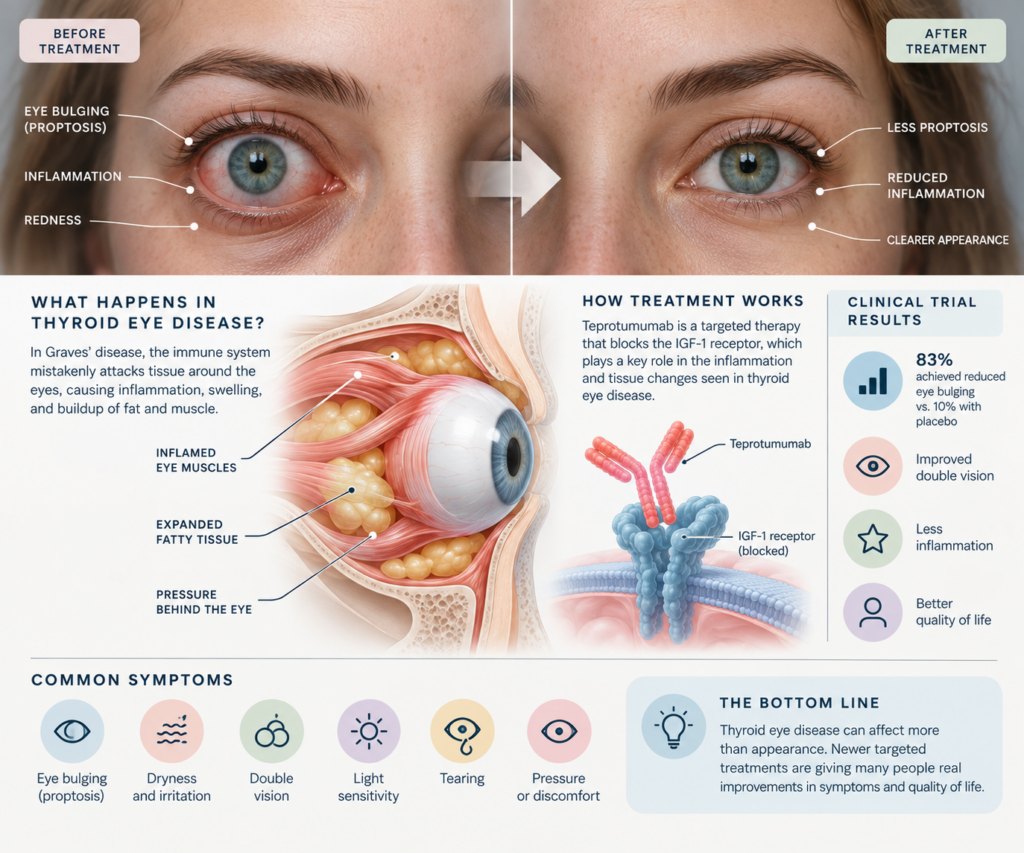
Graves’ disease is best known for causing hyperthyroidism, but the immune process can also affect orbital tissues. Swelling and tissue expansion behind the eye can produce redness, pain, pressure, double vision, and proptosis.
That means a normal TSH after Graves’ treatment does not automatically mean the eye disease is finished. The endocrine problem and the orbital problem are connected but not identical.
The pivotal trial produced an unusually visible effect
In the phase 3 OPTIC trial, 83 adults with active thyroid eye disease received teprotumumab or placebo. At week 24, 83% of patients receiving teprotumumab had at least a 2 mm reduction in proptosis compared with 10% receiving placebo.
Overall response, inflammation scores, double vision, and thyroid eye disease quality of life also favored teprotumumab. The treatment targets the insulin-like growth factor I receptor (IGF-1R), which is implicated in the disease process.
A pair of sunglasses can reduce outdoor light discomfort, but they do not treat orbital inflammation.
Eye symptoms deserve their own follow-up
Thyroid eye disease severity ranges from irritation and appearance changes to corneal exposure or optic nerve compression. Smoking is a major modifiable risk factor for worse disease.
Treatment depends on activity, severity, duration, thyroid status, and individual risk. Options can include lubrication, anti-inflammatory treatment, targeted therapy, radiation in selected cases, and surgery.
A soft sleep mask may be comfortable for some people, but avoid anything that presses on prominent or irritated eyes. A symptom notebook can document double vision, pain, redness, and day-to-day changes.
Targeted treatment has trade-offs
Teprotumumab is not a cosmetic infusion. Reported adverse effects include hyperglycemia, muscle spasms, hearing-related problems, and other treatment risks that require clinical monitoring.
Later real-world experience has made hearing assessment an especially important part of the conversation. The benefit-risk decision belongs with clinicians experienced in thyroid eye disease.
A water bottle supports ordinary hydration during treatment but should not be presented as an eye-disease intervention.
Thyroid control still matters to the eyes
Although orbital disease has its own course, uncontrolled hyperthyroidism and unstable thyroid status can complicate management. The goal is coordinated care rather than choosing between an endocrinologist and an eye specialist.
People with thyroid eye disease often benefit from clinicians who routinely manage the condition because treatment decisions can depend on both endocrine and ophthalmic details.
The Livium recipe
Tool. Photograph visible eye changes periodically if the care team finds that useful.
Behavior. Keep thyroid control, smoking cessation, and ophthalmic follow-up in the same plan.
Threshold. New vision loss, color desaturation, severe pain, or inability to close the eye requires prompt evaluation.
| OPTIC trial outcome at week 24 | Teprotumumab | Placebo |
|---|---|---|
| Proptosis response | 83% | 10% |
| Overall response | 78% | 7% |
| Minimal/no inflammation | 59% | 21% |
| Diplopia response | 68% | 29% |
Source: Douglas et al., New England Journal of Medicine, 2020.
The symptoms can affect everyday function
Double vision can make driving, reading, stairs, and screen work difficult. Proptosis can expose the surface of the eye and change appearance in ways that affect quality of life well beyond the laboratory diagnosis.
Those functional outcomes are why thyroid eye disease research measures more than inflammation. The goal is not merely a quieter immune marker. It is better vision, comfort, appearance, and daily function.
There is also a prevention side
Smoking cessation is one of the most important modifiable steps for people with Graves’ disease because smoking is associated with greater risk and severity of thyroid eye disease. Avoiding smoke exposure belongs beside medication and eye care, not in a separate wellness category.
Selenium has been studied in mild thyroid eye disease in selenium-deficient regions, but supplements should not be generalized to every patient or taken in excessive doses.
Plan of action
- Keep thyroid decisions tied to repeatable laboratory and clinical evidence.
- Track changes over time instead of reacting to one isolated result.
- Tell clinicians about prescriptions, supplements, and major medication changes.
- Use urgent care for severe or rapidly changing symptoms rather than self-adjusting thyroid treatment.
Table of Content

Know your body better.
Trusted By Thousands Daily





FAQs
What is thyroid eye disease?
It is an autoimmune inflammatory disease of the tissues around and behind the eyes, commonly associated with Graves’ disease.
Does normal thyroid bloodwork make thyroid eye disease go away?
Not necessarily. Thyroid control is important, but the orbital autoimmune process can have its own course.
What does teprotumumab do?
It inhibits IGF-1 receptor signaling and was shown in randomized trials to reduce proptosis and other features of active thyroid eye disease.
Legal Disclaimer
The content published on Livium Health is for informational and educational purposes only. Nothing on this site constitutes medical advice, diagnosis, or treatment. Always consult a qualified healthcare provider before making decisions about your health, including changes to medications, supplements, diet, or exercise.
Livium Health is not a medical practice and does not have a patient-provider relationship with its readers. We do not sell supplements, medications, or treatments, and we have no financial relationship with the products or services we reference.
While we work to ensure the information we publish is accurate and up to date, health and medical guidance evolves. We make no guarantees about the completeness or currency of any content on this site. Reliance on any information provided by Livium Health is solely at your own risk.
If you are experiencing a medical emergency, call 911 or your local emergency services immediately.
We may receive compensation, free products, or affiliate commissions for products mentioned in this post. Opinions are our own.