
Share
Fitness
Men's Health
Women's Health
Zone 2 training: The most underrated tool for metabolic health after 40
5 min read

Key takeaways
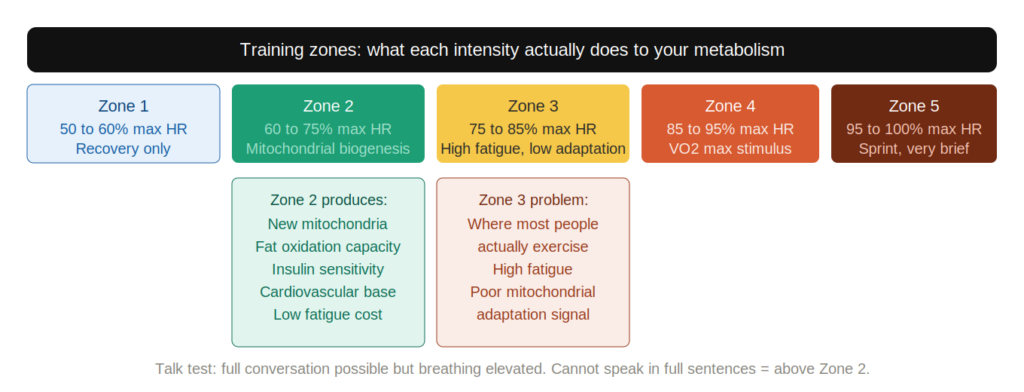
- Zone 2 is the training intensity where you are working hard enough to breathe noticeably but still able to hold a full conversation. It is roughly 60 to 75 percent of maximum heart rate and corresponds to the first lactate threshold.
- Zone 2 is the primary stimulus for mitochondrial biogenesis: the creation of new mitochondria in muscle cells. More mitochondria mean greater fat-oxidation capacity, better insulin sensitivity, and higher metabolic efficiency.
- Most adults who exercise at all exercise too hard. They spend their sessions in Zone 3 and 4, which produces fatigue without the mitochondrial adaptation that Zone 2 uniquely drives.
- Three to four hours of Zone 2 per week is the evidence-based dose for meaningful metabolic adaptation. That is 45 to 60 minutes, three to four times per week, at a pace that feels deceptively easy.
The workout you think is not working
Zone 2 training feels like it is not working. You finish the session, and you are barely sweating. Your heart rate was not impressive. You could have talked on the phone the entire time. Nothing hurt. By the cultural definition of a good workout, nothing happened.
Inside the muscle cell, something happened. Zone 2 is the intensity that maximally activates the signaling pathways (AMPK, PGC-1alpha) that trigger mitochondrial biogenesis. New mitochondria form. Existing mitochondria become more efficient. The cell’s ability to oxidize fat for fuel increases. Fat oxidation capacity is not just about body composition. It is the metabolic foundation for insulin sensitivity, endurance, and the ability to sustain energy throughout the day without crashing. The deceptively easy workout is the metabolically transformative one.
Why it matters specifically after 40
Mitochondrial density and efficiency decline with age. By the mid-40s, most adults have measurably fewer and less efficient mitochondria per muscle cell than they did at 30. This is one of the primary drivers of age-related metabolic slowing, fatigue, and reduced endurance. It is not just time. It is the absence of the mitochondrial stimulus that Zone 2 uniquely provides.
Insulin resistance, which begins increasing in most adults in their 40s, is directly related to mitochondrial function. Muscle cells that cannot efficiently process fuel become resistant to insulin signals. Zone 2 training improves insulin sensitivity through multiple mechanisms: it increases glucose transporter density (GLUT4), improves mitochondrial efficiency, reduces intramyocellular lipid accumulation, and reduces fasting insulin. The metabolic benefit is comparable to metformin in some studies and has no side effects.
How to find your Zone 2
The talk test is the most practical field method. If you can hold a full conversation but your breathing is audibly elevated, and you would not want to sing, you are in Zone 2. If you cannot complete a full sentence, you have drifted into Zone 3.
Heart rate calculation: Zone 2 corresponds to roughly 60-75% of maximum heart rate. Estimate maximum heart rate as 220 minus your age. At 47, that gives a maximum of 173 beats per minute and a Zone 2 ceiling of approximately 130 bpm. A heart rate monitor makes this precise and removes the guesswork.
The surprise for most people: Zone 2 is slower than expected. For many midlife adults who are metabolically average, Zone 2 is a brisk walk. Not a jog. Not a run. A pace that feels almost embarrassingly easy. The discomfort is not physical; it is the psychological resistance to working out at a pace that does not feel like work. That resistance is the only real barrier.
The Livium recipe
Tool. A heart rate monitor is the single most useful Zone 2 investment. Without one, you are guessing. A chest-strap heart rate monitor provides real-time accuracy that wrist-based optical sensors miss during steady-state cardio. For tracking Zone 2 sessions and monitoring improvement in fat oxidation over time: a GPS sports watch with Zone training tracks session time in each zone and builds a training load picture over weeks. For home Zone 2 training without running: a stationary bike or rowing machine delivers Zone 2 stimulus without the joint stress that road running produces for midlife adults returning to cardio.
Behavior. Three to four sessions per week, 45 to 60 minutes each, at genuine Zone 2 intensity. The dose is hours of Zone 2 per week, not pace or distance. The minimum effective dose appears to be around three hours per week. Below that, the mitochondrial adaptation is modest. Above six hours, returns diminish for most non-athletes. The sweet spot for midlife adults is three to four hours per week, distributed across multiple sessions rather than concentrated into one or two long ones.
Threshold. If your resting heart rate is declining over weeks of consistent Zone 2 training, the adaptation is working. A drop in resting heart rate of 5 to 10 beats per minute over 2 to 3 months of consistent Zone 2 is a reliable signal of improved cardiovascular efficiency. If you have a Function Health baseline, fasting insulin and triglycerides are the blood markers most sensitive to Zone 2 adaptation. Both should decline within 90 days of consistent training.
| Activity | Zone 2 accessible? | Joint impact | Notes |
|---|---|---|---|
| Brisk walking | Yes, for most adults | Low | Best entry point for deconditioned adults |
| Cycling | Yes, excellent | Very low | Easiest to hold precise Zone 2 |
| Rowing | Yes | Very low | Full body; high caloric efficiency |
| Running | Yes, but slower than expected | Moderate | Many runners naturally drift above Zone 2 |
| Rucking | Yes | Low to moderate | Adds resistance training stimulus to Zone 2 |
Source: Gonzalez-Agero et al., JCM 2021 — Metabolic Adaptations to Concurrent Training in Adults. CC BY 4.0.
Plan of action
- This week: do a 45-minute brisk walk with a heart rate monitor or chest strap and check where your heart rate sits. If it is above 130 bpm at 47 (or equivalent for your age), slow down. You are not in Zone 2 yet.
- Schedule three Zone 2 sessions per week and protect them like any other appointment. Consistency over 12 weeks is what produces the mitochondrial adaptation. Irregular sessions do not yield the same level of adaptation.
- Add one weekly high-intensity session (Zone 4 to 5 intervals, 20 to 30 minutes). The combination of Zone 2 base training and a small amount of high-intensity work produces better cardiovascular outcomes than either alone. The high-intensity session takes less time and does not replace the Zone 2 sessions.
- Track resting heart rate over 12 weeks. Use a morning heart rate tracker to log your heart rate daily before getting out of bed. A declining resting HR over months is the clearest signal of improving cardiovascular efficiency from Zone 2 training.
Table of Content

Know your body better.
Trusted By Thousands Daily





FAQs
Is Zone 2 the same as LISS (low-intensity steady state)?
Similar but not identical. LISS refers broadly to any sustained low-intensity cardio. Zone 2 is a specific intensity band defined by the first lactate threshold. All Zone 2 is LISS; not all LISS is Zone 2. A slow amble may be Zone 1. The distinction matters because the metabolic adaptation is intensity-specific.
Can I build muscle and do Zone 2 in the same week?
Yes, and the combination is synergistic for midlife adults. Resistance training drives muscle protein synthesis; Zone 2 drives mitochondrial density in the same muscle. Schedule them on different days or with at least six hours between sessions to minimize interference. Most research on concurrent training shows that muscle-building outcomes are maintained when Zone 2 is performed at true Zone 2 intensity rather than at higher intensities.
How long before I see results?
Measurable improvements in fat oxidation begin within four to six weeks of consistent Zone 2 training. Meaningful changes in fasting insulin and resting heart rate typically appear within 8 to 12 weeks. The most significant adaptations occur between weeks 12 and 24. This is not a fast return. It is a durable one.
Legal Disclaimer
The content published on Livium Health is for informational and educational purposes only. Nothing on this site constitutes medical advice, diagnosis, or treatment. Always consult a qualified healthcare provider before making decisions about your health, including changes to medications, supplements, diet, or exercise.
Livium Health is not a medical practice and does not have a patient-provider relationship with its readers. We do not sell supplements, medications, or treatments, and we have no financial relationship with the products or services we reference.
While we work to ensure the information we publish is accurate and up to date, health and medical guidance evolves. We make no guarantees about the completeness or currency of any content on this site. Reliance on any information provided by Livium Health is solely at your own risk.
If you are experiencing a medical emergency, call 911 or your local emergency services immediately.
We may receive compensation, free products, or affiliate commissions for products mentioned in this post. Opinions are our own.