
Share
Energy & Focus
Men's Health
Women's Health
The hydration-cognition link: How mild dehydration degrades focus and decision-making
5 min read
Key takeaways
- A body water deficit of as little as 1 to 2 percent of body weight produces measurable impairments in attention, working memory, processing speed, and decision-making quality in healthy adults.
- Thirst is a lagging indicator: by the time you feel thirsty, you are already mildly dehydrated and cognitive performance has already declined.
- Older adults have a blunted thirst response compared to younger adults, making chronic mild dehydration more common and more consequential after 40.
- The fix is structural, not willpower: a water bottle at the desk, a morning hydration habit before coffee, and electrolytes when sweating significantly all outperform trying to remember to drink more.
The focus problem hiding in plain sight
Most adults who attribute afternoon brain fog to insufficient sleep, stress, or poor nutrition have not first ruled out the simplest explanation. Mild dehydration, a body water deficit of 1 to 2 percent, produces impairments in attention, working memory, and processing speed that are functionally equivalent to a 0.05 percent blood alcohol concentration. Not drunk. But noticeably impaired. The cognitive tax of dehydration is real, measurable, and entirely correctable without supplements, sleep optimization, or behavior change programs. Drink water.
The complicating factor is thirst. Most people assume they will feel thirsty before their cognition is impaired. This is backward. The brain’s thirst signal lags behind actual dehydration. By the time you feel thirsty, you have already lost the 1 to 2 percent that impairs cognitive performance. You have been operating below capacity for some time. This is not a minor biological inefficiency. It is why proactive hydration outperforms reactive hydration for anyone whose work requires sustained cognitive output.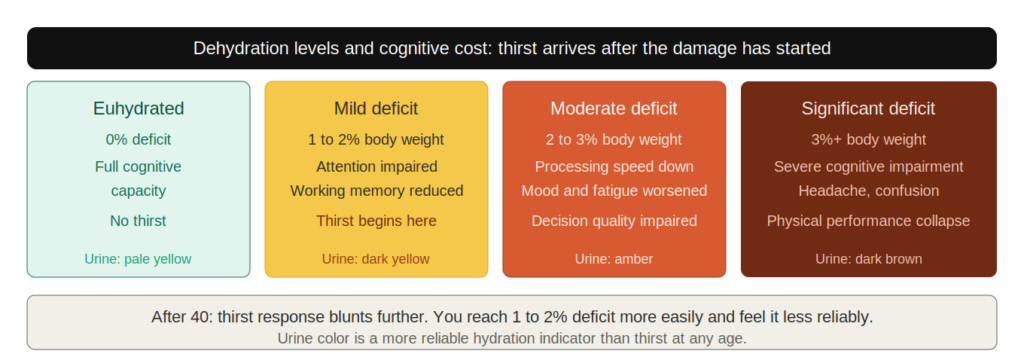
Why older adults are more vulnerable
The thirst response is mediated by osmoreceptors in the hypothalamus that detect changes in blood osmolality. With age, the sensitivity of these receptors declines. Older adults reach a 1- to 2-percent deficit without experiencing the thirst that would prompt younger adults to drink. They are more dehydrated, feel it less, and drink less in response. This is a physiological feedback loop failure, not a behavioral one. Telling a 55-year-old to drink more when thirsty is insufficient advice. Their thirst system cannot be trusted the way it could at 25.
Certain medications common in midlife amplify the risk. Diuretics (blood pressure medications, some heart medications) increase fluid loss. ACE inhibitors and ARBs alter fluid regulation. Beta-blockers reduce the body’s compensatory response to dehydration. Adults on any of these medications are at higher baseline dehydration risk than their peers and need to hydrate more proactively, not just responsively.
The Livium recipe
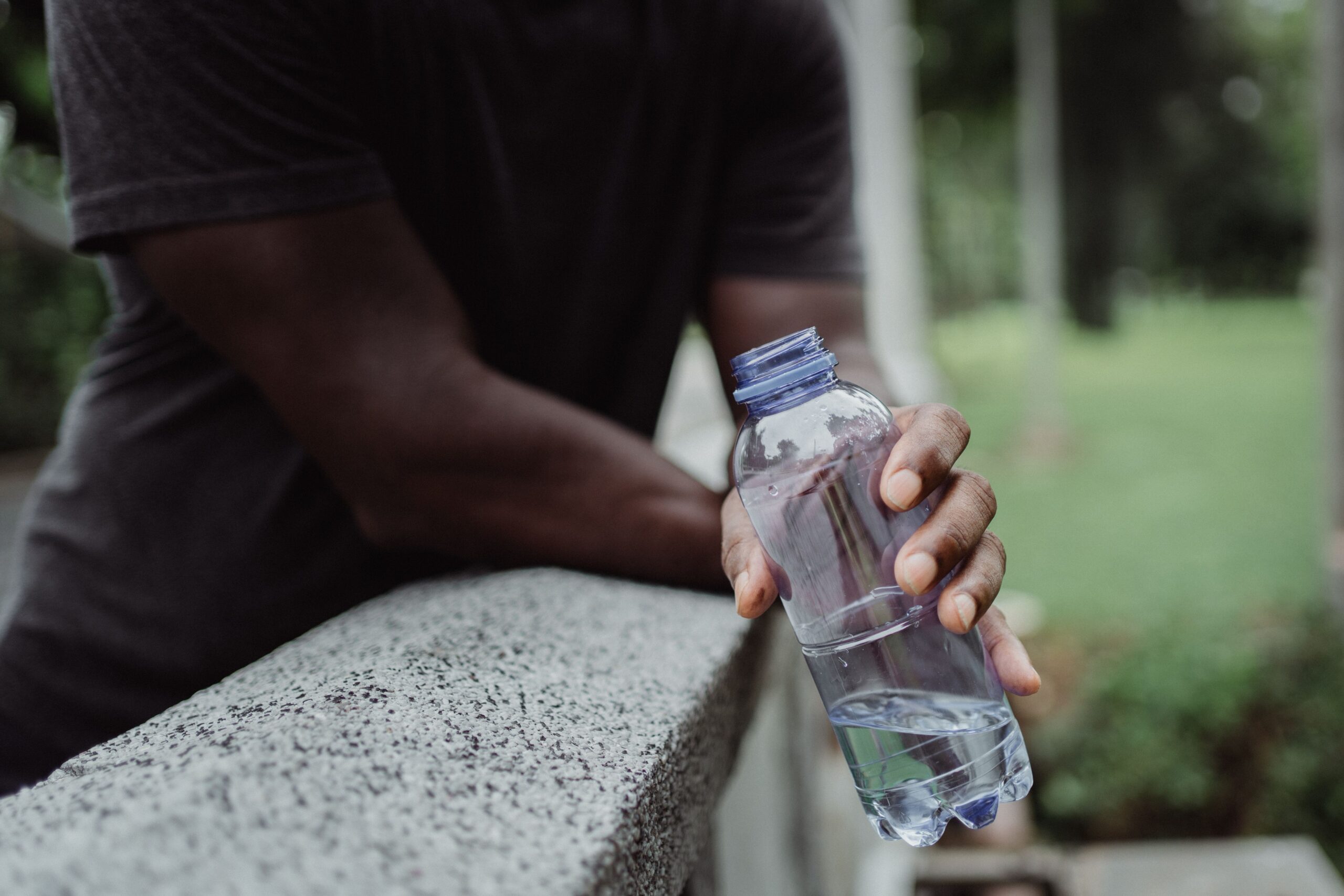
Tool. The most reliable hydration intervention is structural: a large water bottle visible on the desk is more effective than any hydration app or reminder. A 32 oz insulated water bottle at the workstation is the intervention. For people who exercise or live in hot climates: plain water is insufficient when sweat losses are significant. Electrolytes (sodium, potassium, magnesium) are lost in sweat and must be replaced for optimal cellular hydration. An electrolyte powder without added sugar added to one water bottle per day supports hydration more effectively than water alone during high-activity periods. Urine color is the practical monitoring tool: pale yellow is the target; dark yellow means you are behind.
Behavior. Drink 500 ml of water immediately upon waking, before coffee. Overnight fluid loss is significant (approximately 500 ml through breathing and sweat) and morning dehydration is one of the most consistent predictors of poor early-morning cognitive performance. Coffee is a mild diuretic at high doses; drink water alongside it rather than instead of it. Aim for pale yellow urine by mid-morning. If you make it to noon with dark urine, you started the day in a deficit and have been cognitively impaired for hours. Start the clock earlier.
Threshold. Total daily water intake targets are context-dependent. The standard 2.5 to 3.5 liters per day includes water from food, which accounts for 20 to 30 percent of total intake for most adults eating whole foods. As a practical hydration target: aim for 35 ml per kilogram of body weight in fluid form, adjusted upward for heat, exercise, and diuretic medications. If you are on blood pressure medications: ask your prescribing physician whether your medication class increases fluid loss and how to adjust accordingly.
| Hydration habit | When | Why it matters |
|---|---|---|
| 500 ml water on waking | Before coffee | Replaces overnight losses; improves morning alertness |
| Water bottle at desk | All day | Visibility drives drinking; out of sight, out of mind |
| Electrolytes when sweating | Exercise, heat, travel | Water alone does not replace sweat electrolytes |
| Check urine color at noon | Daily | More reliable than thirst after 40 |
Source: Li et al., Nutrients 2023 — Hydration Status in Older Adults. CC BY 4.0.
Plan of action
- Put a 32 oz water bottle on your desk tonight so it is there tomorrow morning. This single structural change produces more consistent hydration improvement than any reminder, app, or goal-setting approach.
- Drink 500 ml of water before your first cup of coffee tomorrow and for the next 14 days. Track your morning alertness and clarity during this period. Most people notice a difference within 3 to 5 days.
- Check your urine color at noon for a week. If it is consistently dark yellow by midday, you are starting from a deficit. Adjust your morning intake upward.
- If you exercise regularly or sweat significantly: add an electrolyte supplement to one of your daily water servings on workout days. Hyponatremia (low sodium from drinking too much plain water without electrolytes) is a real risk for endurance athletes; match water intake with electrolyte replacement.
Table of Content
Know your body better.
Trusted By Thousands Daily




FAQs
Does coffee count toward hydration?
Yes, in moderate amounts. The mild diuretic effect of caffeine at typical consumption levels (1 to 3 cups per day) does not produce net fluid loss. Coffee contributes to total fluid intake. At higher doses (5+ cups per day), the diuretic effect becomes more significant. Drinking coffee is not the same as drinking water, but it is not actively dehydrating at normal intake levels.
Do I need to drink 8 glasses a day?
The 8 glasses rule has no scientific basis as a fixed target. Total fluid needs vary significantly with body weight, activity level, climate, and diet. The 35 ml per kilogram of body weight guideline is more useful as a personal target, adjusted upward for exercise and heat exposure.
Can overhydration also impair cognition?
Yes. Hyponatremia (low blood sodium from excessive plain water intake, typically more than 5 to 6 liters in a short period without electrolyte replacement) produces confusion and cognitive impairment. For most adults drinking normal amounts during the day, overhydration is not a practical concern. It becomes relevant for endurance athletes drinking large volumes over several hours.
Legal Disclaimer
The content published on Livium Health is for informational and educational purposes only. Nothing on this site constitutes medical advice, diagnosis, or treatment. Always consult a qualified healthcare provider before making decisions about your health, including changes to medications, supplements, diet, or exercise.
Livium Health is not a medical practice and does not have a patient-provider relationship with its readers. We do not sell supplements, medications, or treatments, and we have no financial relationship with the products or services we reference.
While we work to ensure the information we publish is accurate and up to date, health and medical guidance evolves. We make no guarantees about the completeness or currency of any content on this site. Reliance on any information provided by Livium Health is solely at your own risk.
If you are experiencing a medical emergency, call 911 or your local emergency services immediately.
We may receive compensation, free products, or affiliate commissions for products mentioned in this post. Opinions are our own.