
Share
Longevity & Aging
Men's Health
Women's Health
The longevity checkup most people skip: Your gums
7 min read

Key takeaways
- Gum health belongs in a longevity plan because oral disease is associated with frailty, biological aging, and mortality, even though those studies do not prove causation.
- Gingivitis can often be reversed, while periodontitis can damage the bone and tissues supporting your teeth and needs professional care.
- Brush twice daily, clean between teeth once daily, and use the tool you will actually stick with.
- Ask for your periodontal pocket measurements. Healthy pockets are usually 1 to 3 millimeters.
Your dentist already has a longevity metric you are probably ignoring
You can know your VO2 max, resting heart rate, ApoB, and sleep score and still have no idea what your gum pockets measure.
That is a strange blind spot in the longevity world. Oral health usually gets filed under cosmetics or twice-a-year maintenance. The newer aging data makes that harder to defend.
A 2026 analysis of U.S. adults 40 and older found that severe periodontitis, extensive tooth loss, poor self-rated oral health, and a high burden of damaged or missing teeth were each associated with higher all-cause mortality and shorter estimated life expectancy. Another 2026 study linked moderate or severe periodontitis with greater biological age advancement. Neither proves that treating your gums adds years to your life. They do make one point hard to ignore. Your mouth is part of the system you are trying to keep healthy.
What is actually happening
Plaque is a sticky bacterial film that builds on teeth and around the gumline. Leave enough of it in place and the gums can become inflamed. That early stage is gingivitis. It can show up as redness, swelling, or bleeding when you brush or clean between your teeth.
Gingivitis is the part you want to catch. Plaque can harden into tartar, which cannot be brushed off at home. In some people, inflammation progresses deeper around the tooth into periodontitis. The gums pull away, pockets deepen, and the bone supporting the teeth can be damaged. Periodontitis is not the same thing as a little blood on the floss once. It is a disease that needs professional treatment. NIDCR lays out the progression here.
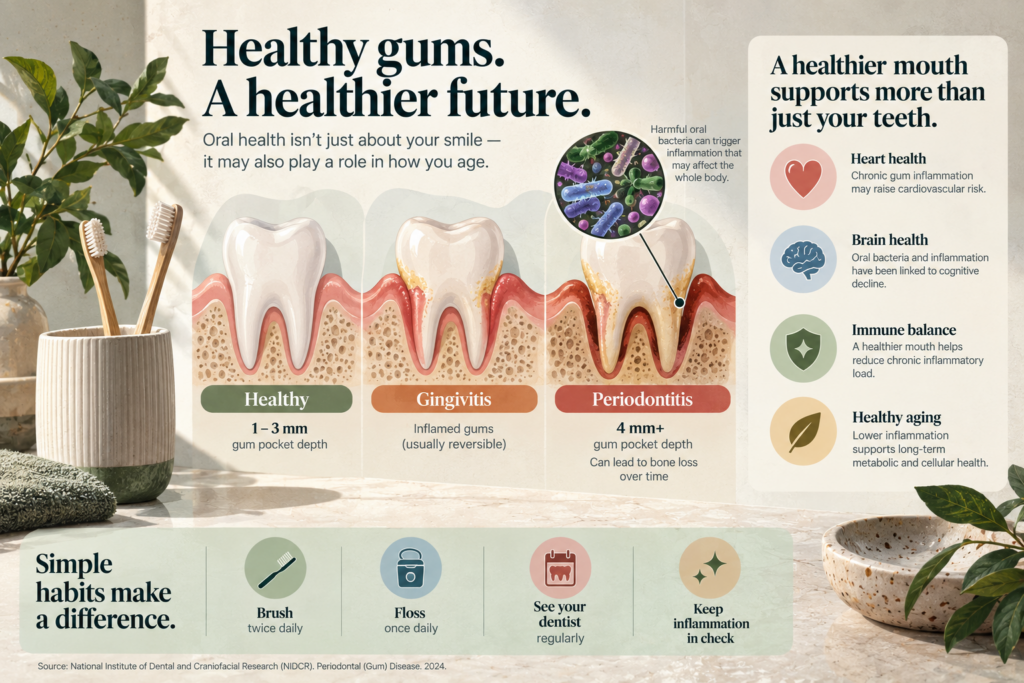
Age raises the stakes. NIDCR lists older age as a risk factor for gum disease, along with smoking, diabetes, genetics, stress, and some illnesses and medications. Current U.S. estimates put periodontitis in roughly two in five adults over 30.
The longevity connection is interesting, but do not turn it into a fairy tale
This is where longevity content tends to get carried away. Inflamed gums do not mean you are aging faster in a way that can be reversed with a new mouthwash.
The evidence is mostly observational. People with worse oral health can also differ in smoking, diabetes, income, diet, access to care, and other things that affect lifespan. Researchers adjust for many of those variables, but adjustment is not magic.
Still, the signal keeps showing up. In the 2026 U.S. analysis, moderate or severe periodontitis was associated with greater advancement on two biological-age measures. A separate long-term cohort found moderate-to-severe periodontitis at baseline was associated with higher all-cause mortality, although the estimate was borderline and the study was small. A 2026 systematic review also found that periodontal disease in older adults consistently predicted tooth loss and continued periodontal breakdown.
The Livium take. Do not brush your teeth because you think it is an anti-aging hack. Take gum health seriously because keeping your teeth, chewing well, controlling chronic oral inflammation, and catching disease early are all useful on their own. The longevity association is extra reason not to ignore the bleeding sink.
What you have probably already tried
A manual toothbrush is fine if your technique is excellent. Most people are not excellent at a repetitive two-minute task they do half-awake at 6:42 AM.
An electric toothbrush removes some of the technique problem. The Philips Sonicare 4100 has a pressure sensor and timer, which are the two features that matter most here. You still have to move it around every tooth. It just makes consistency easier.
Floss works. The American Dental Association recommends cleaning between your teeth daily, and Oral-B Glide Pro-Health floss is an easy option for tight contacts.
If floss is the habit you have failed to build for the last 15 years, stop pretending Monday will be different. Interdental brushes are a legitimate alternative for many mouths. TePe Original Interdental Brushes come in multiple sizes, and a dental hygienist can tell you which size fits without forcing the wire through a space that is too tight.
A Waterpik Aquarius Water Flosser can also make sense, especially around bridges, implants, orthodontic hardware, or for people who simply use a water flosser more consistently than string floss. The evidence for different interdental devices is not equally strong, so the best tool is the one your dental professional says fits your mouth and that you will actually use.
The Livium recipe
Tool. Use a powered toothbrush with a pressure sensor and timer, then choose one between-the-teeth tool that fits your anatomy. For many people that means the Sonicare 4100 plus floss, an interdental brush, or a water flosser. You do not need all four products lined up like a bathroom showroom.
Behavior. Brush twice a day for two minutes with fluoride toothpaste. Once a day, clean between every tooth. Do it at the same time each day until it becomes boring. Boring is good here.
Threshold. Healthy periodontal pockets are usually 1 to 3 millimeters. Ask for your pocket measurements at your next cleaning instead of accepting “looks good” as the entire report. If your gums bleed regularly, look swollen, are receding, or you have persistent bad breath, do not wait for the next six-month reminder. If a dentist finds deeper pockets or bone loss, the home routine becomes maintenance around professional treatment, not a substitute for it.
What your dental visit should actually tell you
A useful periodontal exam is not just a polish and a new toothbrush.
A dentist or hygienist can measure the pocket around each tooth with a small probe. NIDCR describes 1 to 3 millimeters as the usual healthy range. Deeper pockets can signal periodontal disease. X-rays can show whether supporting bone has been lost. Those two pieces of information are far more useful than trying to judge gum health by how white your teeth look.
| Finding | What it can mean | What to do |
|---|---|---|
| Pocket depth 1 to 3 mm | Usually the healthy range | Keep the daily routine consistent |
| Deeper pockets | Can be a sign of periodontal disease | Ask what the full periodontal exam shows |
| Bleeding, swelling, or recession | Possible gum inflammation or disease | Do not ignore persistent changes |
| Bone loss on X-ray | Supporting tissue has been damaged | Ask whether periodontal treatment is needed |
Source: National Institute of Dental and Craniofacial Research, Periodontal (Gum) Disease.
Ask three questions. What are my deepest pocket measurements? Did any areas bleed during probing? Is there any bone loss compared with my prior X-rays?
You are not trying to turn a cleaning into a medical board exam. You are trying to leave with numbers you can compare next time.
What the numbers mean
Pocket depth is not a home diagnostic. It is a professional measurement, and one number does not tell the whole story. Bleeding, attachment loss, bone loss, smoking, diabetes, and how quickly the disease is changing all matter.
But having the measurements changes the conversation. A person with mostly 1-to-3-millimeter pockets and no bleeding has a very different problem from someone with repeated 5-millimeter pockets and radiographic bone loss. The second person does not need a more expensive toothbrush. They need periodontal care.
That distinction is the point. Longevity is full of expensive measurements. This one is already sitting in your dentist’s drawer.
Plan of action
- At your next dental visit, ask for your periodontal pocket numbers and whether there is any bleeding or bone loss.
- If your gums are healthy, keep them boringly healthy. Brush twice daily, clean between teeth once daily, and keep routine dental care on the calendar.
- If you have persistent bleeding, recession, loose teeth, pain with chewing, or deeper pockets, ask whether you need a periodontal evaluation.
- Do not buy more gear to avoid a professional exam. Four products and better intentions are not treatment for established periodontitis.
Table of Content

Know your body better.
Trusted By Thousands Daily







FAQs
Does bleeding when I floss mean I have gum disease?
Not automatically. Occasional bleeding can happen, especially if you have just restarted interdental cleaning. Persistent bleeding, swelling, recession, or bad breath deserves a dental exam because those can be signs of gingivitis or periodontitis.
What is a healthy periodontal pocket depth?
NIDCR says healthy pockets are usually 1 to 3 millimeters. Deeper pockets can be a sign of periodontal disease, but your dentist also looks at bleeding, attachment loss, bone loss, and other risk factors before making a diagnosis.
Is a water flosser better than regular floss?
It depends on your mouth and what you will use consistently. Floss works well for tight contacts, while interdental brushes or water flossers may be easier around wider spaces, bridges, implants, or orthodontic hardware. Ask your dentist or hygienist which tool fits your anatomy.
Legal Disclaimer
The content published on Livium Health is for informational and educational purposes only. Nothing on this site constitutes medical advice, diagnosis, or treatment. Always consult a qualified healthcare provider before making decisions about your health, including changes to medications, supplements, diet, or exercise.
Livium Health is not a medical practice and does not have a patient-provider relationship with its readers. We do not sell supplements, medications, or treatments, and we have no financial relationship with the products or services we reference.
While we work to ensure the information we publish is accurate and up to date, health and medical guidance evolves. We make no guarantees about the completeness or currency of any content on this site. Reliance on any information provided by Livium Health is solely at your own risk.
If you are experiencing a medical emergency, call 911 or your local emergency services immediately.
We may receive compensation, free products, or affiliate commissions for products mentioned in this post. Opinions are our own.