
Share
Energy & Focus
Men's Health
Women's Health
Move more, focus better: Why sitting less helps your brain.
4 min read
Key takeaways
- Brief activity breaks can change neuroelectric markers of attentional processing during long sitting.
- Breaking up sitting also improved post-meal glucose regulation in the randomized study.
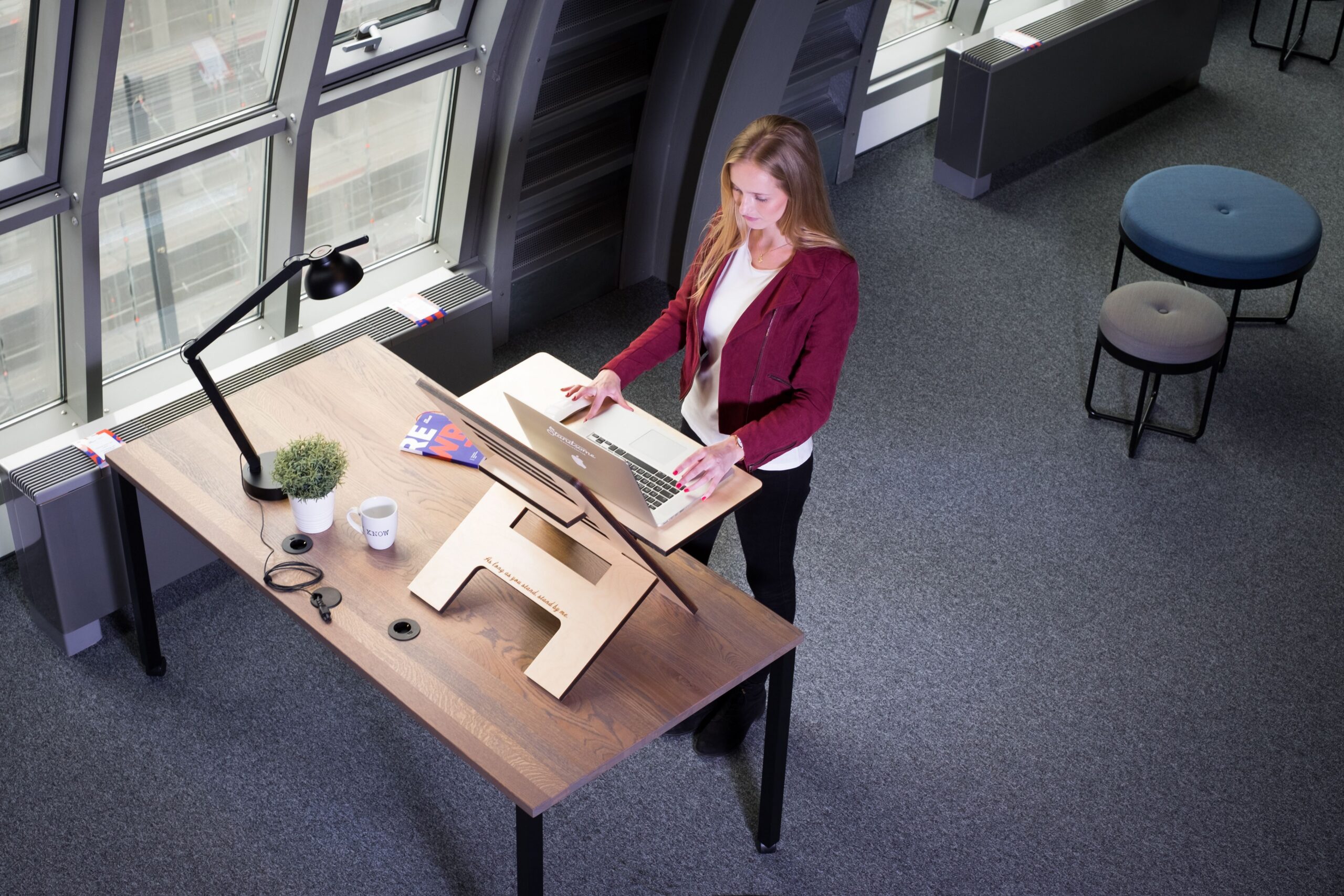
- Standing still is not the only alternative to sitting still. The target is repeated movement.
- Attach movement to meetings, meals, or calls so it does not depend on remembering.
Sitting still is not neutral
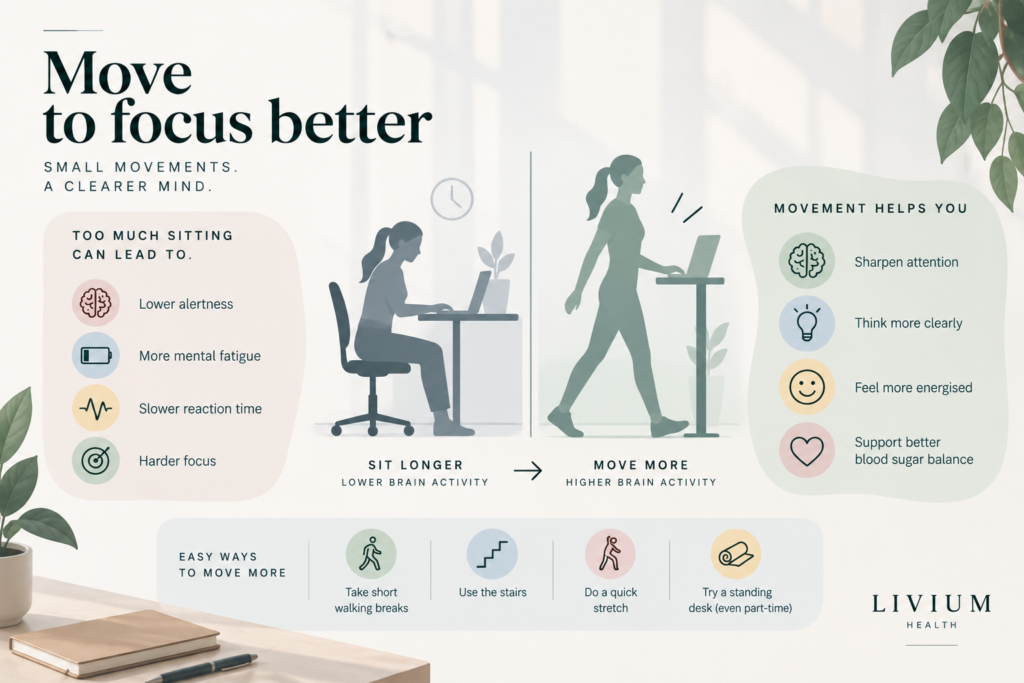
A desk job can ask the brain to stay engaged while the body does almost nothing. In a randomized crossover study, 18 healthy men completed either 3.5 hours of uninterrupted sitting or the same period interrupted by three minutes of brisk walking every 30 minutes.
The activity condition produced a larger P3 amplitude, a neuroelectric measure related to attentional processing, and lower post-meal glucose exposure. Standard inhibitory-control performance did not significantly improve.
That nuance matters. The study does not show that walking every 30 minutes turns you into a sharper thinker. It does show that breaking up sitting changed both a brain measure of attentional engagement and post-meal glucose regulation.
The intervention is interruption
You do not need a workout between meetings. The practical target is breaking long sitting blocks with activity easy enough to repeat. Standing alone can become another position you hold motionless.
If leaving the desk is difficult, an under-desk elliptical can add low-intensity movement during calls or routine work. The machine is not the intervention. It is simply one way to interrupt sitting.
A compact pedal exerciser is another option when storage matters. If neither appeals to you, walking to the kitchen and back is free and accomplishes the core behavior.
Attach movement to events
Event-based cues are easier to repeat than vague intentions. A meeting ends, you walk. Lunch ends, you walk. A phone call begins, you stand or move. The cue already exists in the day.
For a short floor mobility break, a foam kneeling pad can make hard floors less annoying. If remembering is the problem, put one small sticky note near the monitor that says move after calls.
Once the behavior is automatic, remove the reminder. The goal is not to turn the desk into a fitness store.
The Livium recipe
Tool. Pick one movement option that can happen without changing clothes, finding a gym, or leaving the building.
Behavior. Break the longest sitting block first. Two to five minutes is enough for a practical experiment, even though the study protocol used three minutes every 30 minutes.
Threshold. If you regularly discover that three hours passed without standing, change the workflow before adding another stimulant.
| Work pattern | Movement option | Why |
|---|---|---|
| Long writing block | 2-minute walk | Interrupts sitting |
| Video meeting | Stand or pedal | Adds low-intensity movement |
| After lunch | Short walk | Targets post-meal period |
| Afternoon slowdown | Move before caffeine | Tests inactivity first |
Source: Chueh et al., Physiology & Behavior, 2025.
Measure the longest block
Track three workdays and identify the longest period you remain seated. Do not optimize the entire day. Break that one block first. The best movement habit is short, attached to an existing cue, and easy enough that you do not need motivation.
If you usually reach for caffeine when attention drops, try movement first on several days. You are not proving that caffeine is bad. You are testing whether inactivity is contributing to the state you keep labeling as low energy.
Movement cannot compensate for chronic sleep loss, medication sedation, iron deficiency, or another cause of fatigue. It is a workday input, not an explanation for every energy problem.
Why the post-meal window is interesting
The study deliberately included a meal because prolonged sitting and post-meal glucose regulation interact. That does not mean a glucose rise after lunch is inherently bad or that everyone needs to micromanage it. It means the same short walking breaks affected both physiology and a neuroelectric attention marker in this controlled setting.
For a normal workday, the useful translation is simple: lunch does not have to be followed by another uninterrupted two-hour sitting block. A short walk can be a transition into the afternoon rather than a separate workout.
Make it repeatable
The biggest mistake is designing movement breaks that are too disruptive to survive a busy week. If the habit requires changing shoes, finding a private room, or finishing a mini workout, it will disappear on the days you need it most. The useful version is almost boring: stand, walk, pedal lightly, or take the long route to refill water.
Do not judge the experiment by calories burned. Judge it by whether long sitting blocks shrink and whether you return to the next task feeling more alert. If movement does nothing for your afternoon focus, you have still improved the sedentary pattern without pretending it solved a problem it did not.
Plan of action
- Identify your longest sitting block.
- Choose one recurring event that triggers movement.
- Move for 2 to 5 minutes rather than waiting for a full workout.
- Use walking for calls that do not require a screen.
Table of Content

Know your body better.
Trusted By Thousands Daily




FAQs
How often should I move?
There is no single proven focus schedule. The study used three minutes of walking every 30 minutes, but a practical routine should also be repeatable.
Is standing enough?
Standing changes posture, but movement more directly interrupts sedentary time.
Do I need a workout?
No. The research question is about short activity interruptions, not intense exercise between tasks.
Legal Disclaimer
The content published on Livium Health is for informational and educational purposes only. Nothing on this site constitutes medical advice, diagnosis, or treatment. Always consult a qualified healthcare provider before making decisions about your health, including changes to medications, supplements, diet, or exercise.
Livium Health is not a medical practice and does not have a patient-provider relationship with its readers. We do not sell supplements, medications, or treatments, and we have no financial relationship with the products or services we reference.
While we work to ensure the information we publish is accurate and up to date, health and medical guidance evolves. We make no guarantees about the completeness or currency of any content on this site. Reliance on any information provided by Livium Health is solely at your own risk.
If you are experiencing a medical emergency, call 911 or your local emergency services immediately.
We may receive compensation, free products, or affiliate commissions for products mentioned in this post. Opinions are our own.