
Share
Hormones
Women's Health
Hormone therapy will not prevent dementia: What the newest evidence actually says
4 min read

Key takeaways
- Menopausal hormone therapy is effective for appropriate menopause symptoms, but it should not be sold as dementia prevention.
- A 2025 systematic review and meta-analysis included more than one million participants but found the dementia evidence limited by the mix of observational studies and only one randomized trial.
- Timing, formulation, age at menopause, and reason for treatment complicate simple claims of protection or harm.
- Decisions about MHT should be based on established indications and individual risk-benefit assessment, not fear of dementia or promises of brain protection.
The brain-health story has been oversimplified for decades
Estrogen affects the brain, and menopause changes circulating sex steroids. That biological plausibility has fueled two opposite stories: hormone therapy protects women from dementia, or hormone therapy causes dementia.
Neither slogan captures the evidence. Timing, age, formulation, dose, surgical versus natural menopause, and the difference between symptom treatment and disease prevention all matter.
The newest review included more than one million women, but certainty is still the issue
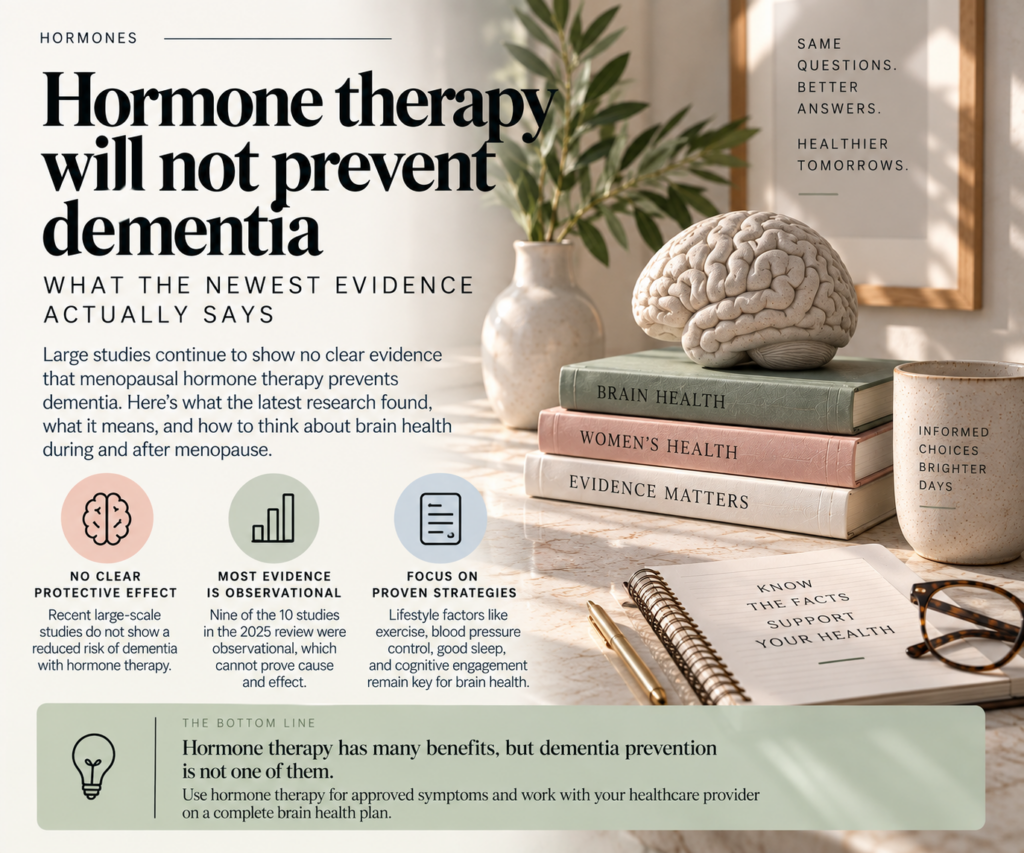
A 2025 systematic review and meta-analysis identified 10 eligible studies with 1,016,055 participants. That sounds enormous, but nine were observational and only one was randomized. Large sample size does not erase study-design limitations.
Observational studies can be affected by who receives hormone therapy, when they start it, access to care, health behaviors, and other differences. Randomized evidence is much harder to obtain for dementia because the outcome can take decades.
A health-history notebook can help organize menopause timing, treatment dates, family history, and questions for a clinician without turning memory risk into daily surveillance.
Do not use a menopause prescription as a nootropic
Hormone therapy can be highly effective for vasomotor symptoms and has established roles in appropriate patients. That is different from taking estrogen to make the brain younger or prevent Alzheimer’s disease.
A 2024 meta-analysis of 34 randomized trials also found no overall cognitive-domain benefit from MHT, although results varied by formulation, timing, and surgical-menopause context.
A reading timer can support focused screen breaks, and a water bottle supports ordinary health habits, but neither is a dementia-prevention device.
Brain health still has modifiable targets
Blood pressure, physical activity, hearing, smoking, diabetes management, social connection, sleep, and other factors contribute to long-term brain health. Those targets remain relevant regardless of whether a woman uses MHT.
If hormone therapy is appropriate for symptoms, brain-health uncertainty does not automatically make it a bad choice. If there is no treatment indication, dementia fear is not a reason to start it.
A sleep mask can improve a dark sleep environment when light is disruptive, but persistent sleep problems deserve their own assessment rather than being folded into a hormone narrative.
What a useful decision looks like
Hormone decisions are rarely improved by chasing one laboratory number or one viral claim. Symptoms, goals, medical history, and the quality of the evidence all belong in the same conversation.
A useful plan also has an evaluation point. Know what outcome you are trying to change, when you will reassess it, and which side effects or new symptoms would make you contact the prescriber sooner.
The Livium recipe
Tool. Separate the question ‘Will this help my menopause symptoms?’ from ‘Will this prevent dementia?’
Behavior. Base MHT decisions on established benefits, risks, and personal medical context.
Threshold. New cognitive changes that interfere with daily function deserve evaluation rather than self-treatment with hormones or supplements.
| 2025 dementia review | Evidence base | Meaning |
|---|---|---|
| Total participants | 1,016,055 | Large sample |
| Randomized trials | 1 | Causal evidence limited |
| Observational studies | 9 | Potential confounding remains |
| Clinical takeaway | Do not prescribe for dementia prevention | Use established MHT indications |
Source: Melville et al., The Lancet Healthy Longevity, 2025.
Why timing keeps entering the debate
One reason hormone-and-brain studies disagree is that exposure at age 52 is not biologically identical to starting treatment decades later. Researchers have long investigated whether timing around the menopause transition changes neurological effects.
The 2025 review examined timing and other treatment characteristics, but the evidence was still not strong enough to convert the timing hypothesis into a dementia-prevention prescription.
Keep prevention and symptom treatment separate
A treatment can be worthwhile because it substantially improves hot flashes, sleep disrupted by vasomotor symptoms, or genitourinary symptoms even if it does nothing to prevent dementia. Those are legitimate outcomes on their own.
Separating those goals makes consent clearer. It allows women to weigh proven benefits against known risks without requiring hormone therapy to become an anti-aging treatment.
Plan of action
- Write down the specific symptom or outcome you want to improve.
- Change one major treatment variable at a time when possible.
- Use follow-up labs or symptom tracking only when they answer a defined question.
- Do not start, stop, or change prescription hormone treatment without appropriate medical guidance.
Table of Content

Know your body better.
Trusted By Thousands Daily





FAQs
Does menopause hormone therapy prevent dementia?
Current evidence does not support prescribing MHT specifically to prevent dementia.
Does hormone therapy cause dementia?
The evidence is also too complex for a blanket claim that MHT causes dementia. Age, timing, formulation, and study design matter.
What should determine whether I use MHT?
Established menopause indications, symptom burden, medical history, age, time since menopause, formulation, and individual risks and preferences should guide the decision.
Legal Disclaimer
The content published on Livium Health is for informational and educational purposes only. Nothing on this site constitutes medical advice, diagnosis, or treatment. Always consult a qualified healthcare provider before making decisions about your health, including changes to medications, supplements, diet, or exercise.
Livium Health is not a medical practice and does not have a patient-provider relationship with its readers. We do not sell supplements, medications, or treatments, and we have no financial relationship with the products or services we reference.
While we work to ensure the information we publish is accurate and up to date, health and medical guidance evolves. We make no guarantees about the completeness or currency of any content on this site. Reliance on any information provided by Livium Health is solely at your own risk.
If you are experiencing a medical emergency, call 911 or your local emergency services immediately.
We may receive compensation, free products, or affiliate commissions for products mentioned in this post. Opinions are our own.