
Share
Energy & Focus
Men's Health
Women's Health
ADHD in midlife: Why so many adults are only now getting diagnosed
5 min read

Key takeaways
- An estimated 15.5 million U.S. adults had an ADHD diagnosis in 2023, with approximately half receiving that diagnosis in adulthood, not childhood.
- Adult ADHD presenting in midlife is frequently the same ADHD that existed in childhood but was masked by structure, intelligence, motivation, or high-stimulation environments that provided the dopamine the brain needed.
- Perimenopause and andropause both reduce the estrogen and testosterone that support dopamine function, causing ADHD symptoms to emerge or intensify in midlife for the first time in many women and men.
- ADHD in adults looks different from ADHD in children: less physical hyperactivity, more internal restlessness, chronic disorganization, emotional dysregulation, difficulty with follow-through, and a persistent sense of underperformance despite high capability.
The diagnosis that finally makes everything make sense
A 47-year-old who has spent 30 years building elaborate coping systems for what they assumed was a character flaw- poor follow-through, difficulty sustaining attention, chronic underdelivery on their own potential, difficulty regulating emotions- gets an ADHD diagnosis, and the response is usually not skepticism. It is recognition. That’s the one. That’s what it is.
Adult ADHD is not a new phenomenon. What is new is the diagnosis rate. Approximately half of U.S. adults diagnosed with ADHD received that diagnosis in adulthood. Many went undiagnosed in childhood because they were smart enough to compensate, because they were girls (historically underdiagnosed), because they were quiet and inattentive rather than disruptive, or because ADHD screening was not offered in their era. The ADHD was always there. The diagnosis arrived late.
Why midlife is when it often surfaces
ADHD is a disorder of dopamine regulation in the prefrontal cortex. Estrogen and testosterone both support dopamine signaling. When those hormones decline in perimenopause and andropause, the dopamine system that was keeping the ADHD marginally compensated becomes undersupported, and symptoms that were manageable at 35 are not manageable at 47. Women in perimenopause commonly report that their focus, organization, and emotional regulation deteriorated suddenly in their mid-40s. ADHD is a significant and underrecognized explanation for this.
Separately, life structure often changes in midlife. High-structure environments like school and early-career roles provide external scaffolding that compensates for ADHD executive function deficits. When autonomy increases, when the job requires self-directed long-term projects rather than reactive task completion, the external structure that was masking the ADHD disappears. The ADHD was always there. The scaffolding just came down.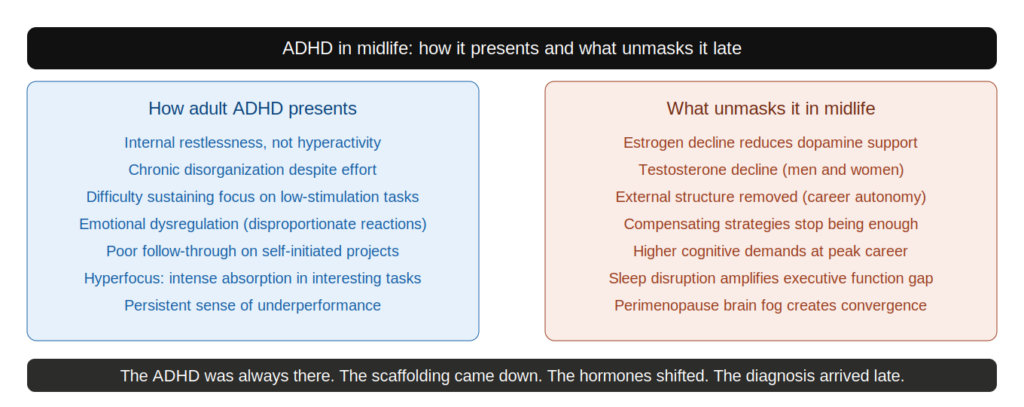
What treatment actually looks like for adults
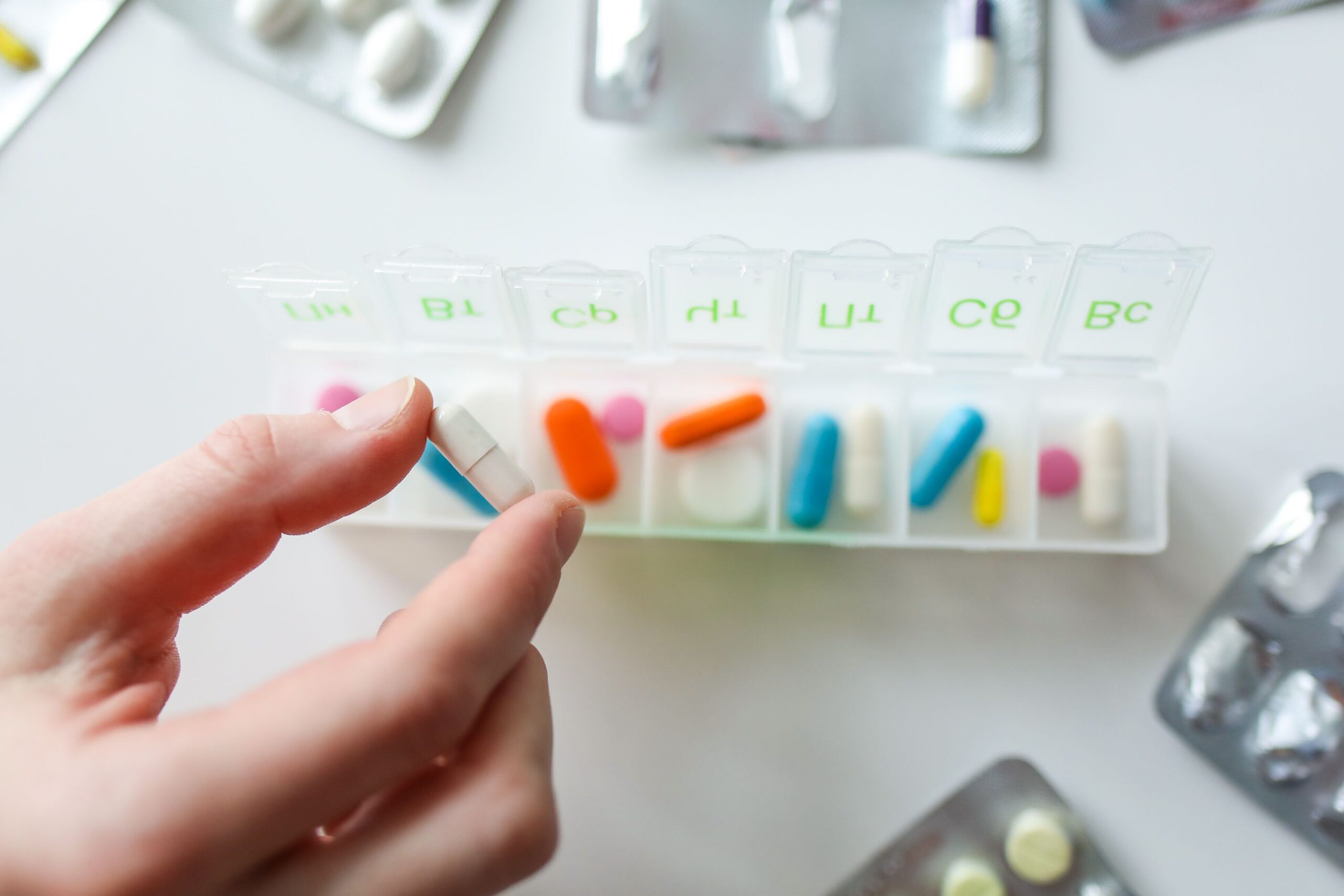
Adult ADHD treatment is effective. Approximately one-third of diagnosed adults use stimulant medication (methylphenidate or amphetamine salts). For those who respond, the effect is often described as the first time their brain operated the way they always thought it should. Non-stimulant options (atomoxetine, bupropion, viloxazine) are alternatives for those who cannot tolerate stimulants or have contraindications.
Medication alone is not sufficient. Behavioral strategies, specifically external systems that replace the internal executive function the ADHD brain cannot generate reliably, are essential. Time-blocking, physical paper to-do lists, body doubling (working in the presence of another person), and environmental design (single-tab browsing, phone in another room) all produce meaningful improvements in output and daily function. These are not workarounds for laziness. They are prosthetics for an executive function deficit.
The Livium recipe
Tool. The first step is assessment. The Adult ADHD Self-Report Scale (ASRS-v1.1) is a validated, publicly available six-question screening tool that provides a starting point for a clinical conversation. It is not a diagnosis. But it tells you whether a formal evaluation is warranted. For supplements with the most consistent evidence for ADHD-related attention support: omega-3 fatty acids (EPA-dominant, 1 to 2 g EPA daily) have RCT evidence for modest ADHD symptom reduction. Zinc and magnesium deficiency are both associated with worse ADHD symptom severity; magnesium glycinate is worth adding if not already supplementing.
Behavior. External systems over internal intention. Write things down on paper, not in your phone. Time-block the calendar for deep work and treat those blocks as non-negotiable. Use body doubling for tasks you perpetually avoid: work in a coffee shop, on a video call with a friend, or with a virtual co-working group. Set a timer rather than relying on attention to naturally return to the task. Exercise, particularly aerobic exercise, acutely increases dopamine and norepinephrine for 2 to 3 hours post-workout and is the highest-efficacy non-pharmacological tool for ADHD symptom management available.
Threshold. If the presentation includes significant impairment in work performance, relationships, finances, or self-regulation: pursue formal assessment with a psychiatrist or psychologist experienced in adult ADHD before spending more time on behavioral strategies alone. The behavioral strategies work better with the medication than without it, and the medication works better with the behavioral strategies than without them. Both together is the evidence-based standard of care. Function Health can rule out thyroid dysfunction and hormonal contributors that mimic ADHD symptoms before a psychiatric evaluation.
| Symptom cluster | Rule out first | If ADHD: address with |
|---|---|---|
| Poor focus, brain fog | Thyroid, iron, B12, sleep apnea | Time-blocking, medication evaluation |
| Emotional dysregulation | Hormonal changes, depression | CBT, non-stimulant ADHD medication |
| Disorganization, follow-through | Overcommitment, burnout | External systems, body doubling |
| New onset in midlife | Perimenopause, testosterone decline | Hormone evaluation + ADHD assessment |
Source: Staley et al., CDC MMWR 2024 — ADHD Diagnosis and Treatment in Adults.
Plan of action
- Complete the ASRS-v1.1 screening (free online, six questions, five minutes). If you score in the consistent-with-ADHD range: print the result and bring it to your next primary care appointment as a conversation starter.
- Before pursuing ADHD evaluation: get thyroid (TSH, free T4, free T3), iron (ferritin), B12, and a sleep apnea screen. These conditions produce ADHD-like symptoms and are frequently the actual explanation. Function Health covers all of them in a single panel.
- Start aerobic exercise 3 times per week regardless of diagnosis status. The increase in dopamine and norepinephrine from 30 minutes of Zone 2 exercise lasts 2 to 3 hours and measurably improves executive function during that window. Schedule your most demanding cognitive work in the post-exercise window.
- Implement one external system this week. A paper planner or time-blocking notebook is more effective for ADHD than digital task managers because the physical act of writing activates encoding and the absence of notifications removes context-switching triggers.
Table of Content

Know your body better.
Trusted By Thousands Daily





FAQs
Is adult ADHD overdiagnosed?
Diagnosis rates have increased significantly, and some of that increase likely reflects overdiagnosis at the margin. But the clinical evidence strongly supports that ADHD was historically underdiagnosed in adults, particularly women. The current increase is better understood as catch-up than as overreach. Rigorous evaluation (not a quick online quiz) with documented functional impairment across multiple life domains is the diagnostic standard.
Is ADHD medication safe for midlife adults?
Stimulant medications require a cardiovascular evaluation before prescribing in adults with hypertension or cardiac history. For adults without cardiovascular contraindications, stimulants are well-tolerated and effective. Non-stimulant options exist for those with cardiovascular concerns. This is a clinical conversation, not a reason to avoid the discussion.
How is ADHD different from just being busy and distracted?
The diagnostic criterion is functional impairment across multiple domains, present since childhood, not explained by other conditions. Being busy produces situational difficulty with focus. ADHD produces a consistent and pervasive pattern of executive function failure that has been present in some form since childhood and causes significant impairment in at least two areas of life (work, relationships, finances, etc.).
Legal Disclaimer
The content published on Livium Health is for informational and educational purposes only. Nothing on this site constitutes medical advice, diagnosis, or treatment. Always consult a qualified healthcare provider before making decisions about your health, including changes to medications, supplements, diet, or exercise.
Livium Health is not a medical practice and does not have a patient-provider relationship with its readers. We do not sell supplements, medications, or treatments, and we have no financial relationship with the products or services we reference.
While we work to ensure the information we publish is accurate and up to date, health and medical guidance evolves. We make no guarantees about the completeness or currency of any content on this site. Reliance on any information provided by Livium Health is solely at your own risk.
If you are experiencing a medical emergency, call 911 or your local emergency services immediately.
We may receive compensation, free products, or affiliate commissions for products mentioned in this post. Opinions are our own.