
Share
Longevity & Aging
Men's Health
Women's Health
Air pollution and brain aging: Why the air in your home deserves a number
4 min read

Key takeaways
- WHO’s 2026 dementia guidance now includes air pollution as a modifiable environmental risk factor.
- PM2.5 is the particle size worth tracking because long-term exposure is linked with dementia and cardiovascular risk.
- A monitor plus correctly sized HEPA filtration is more useful than guessing whether a room feels clean.
- Use the pattern, not one spike. Repeated daily exposure is the target to reduce.
Air quality just moved into the dementia-prevention conversation
Blood pressure has a number. Cholesterol has a number. Sleep has a score whether you asked for one or not. The air you breathe for hours every day is usually just called fine.
That is starting to look outdated.
The World Health Organization updated its dementia risk-reduction guidance in 2026 and added air pollution as a modifiable environmental risk factor. The recommendation is cautious because intervention evidence is still limited, but the direction is clear: reducing exposure to household and ambient air pollution may reduce the risk of cognitive decline and dementia.
A 2025 Lancet Planetary Health meta-analysis also found that long-term air-pollution exposure was associated with incident dementia across a large and rapidly growing body of evidence.
The particle to know is PM2.5
PM2.5 means particulate matter 2.5 micrometers or smaller. These particles are tiny enough to penetrate deep into the lungs, and some can enter the circulation. Major sources include combustion, traffic pollution, wildfire smoke, industrial emissions, and particles generated indoors.
WHO’s air-quality guideline sets a 24-hour PM2.5 mean of 15 micrograms per cubic meter and an annual mean of 5. Those are public-health guideline values, not a promise that risk disappears below the line.
Most homes do not need a laboratory. A consumer monitor can tell you whether cooking, smoke, a bad outdoor-air day, or a closed-up room is driving repeated spikes.
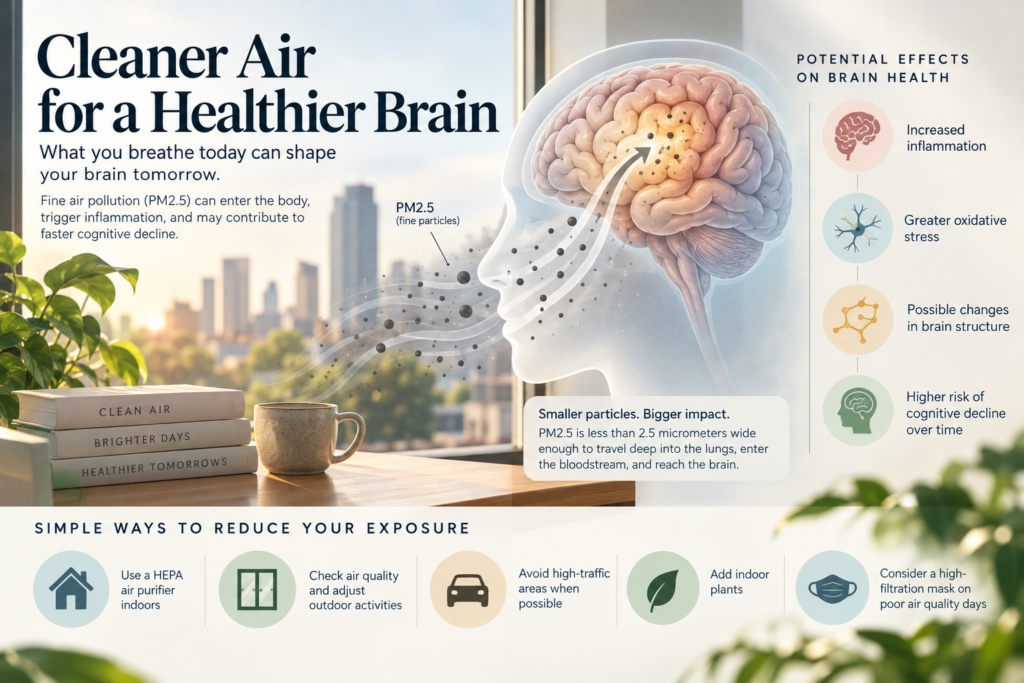
The tool is filtration, not fragrance
Air fresheners do not remove particles. Candles can add particles. Essential-oil diffusers do not turn a smoky room into clean air.
A real setup is less glamorous. A Temtop M10 PM2.5 monitor gives you a number. A Coway Airmega Mighty is a straightforward HEPA purifier for a room you actually occupy. If your HVAC system can handle it, a Filtrete MERV 13 filter captures more fine particles than a lower-rated basic filter. On wildfire or severe smoke days, a well-fitted 3M Aura N95 is a useful exposure tool when you have to go outside.
Do not buy a purifier based on the biggest square-foot number printed on the box. Air changes per hour matter. A smaller purifier working hard in the bedroom can be more useful than an underpowered unit marketed for the whole house.
The Livium recipe
Tool. Put a PM2.5 monitor in the room where you spend the most time. If it regularly climbs during cooking, wildfire smoke, or poor outdoor-air days, use a correctly sized HEPA purifier. Upgrade HVAC filtration only if your system can accommodate the added resistance.
Behavior. Run kitchen exhaust that vents outdoors when cooking. Close windows when outdoor smoke or pollution is high. Move the purifier to the bedroom at night if you only own one. Replace filters on schedule instead of waiting until they look like a science experiment.
Threshold. Use WHO’s 24-hour PM2.5 guideline of 15 micrograms per cubic meter as a practical reference point. One short cooking spike is not the same as living at an elevated level all day. The pattern matters.
| Measure | WHO 2026 guideline | What it means |
|---|---|---|
| PM2.5 annual mean | 5 µg/m³ | Long-term population guideline |
| PM2.5 24-hour mean | 15 µg/m³ | Useful daily reference point |
| PM10 annual mean | 15 µg/m³ | Larger inhalable particles |
| PM10 24-hour mean | 45 µg/m³ | Daily population guideline |
Source: WHO air quality guideline levels, 2026.
What we are ruling out
You do not need to turn your house into a clean room. You also do not need an expensive monitor in every bedroom. The intervention works best when the data changes behavior.
If your PM2.5 stays low, buying three more purifiers is not a longevity plan. If your monitor jumps every evening when you sear dinner with no exhaust fan, you found a variable worth fixing.
Air pollution is one risk factor among many. It does not outrank blood pressure, smoking, diabetes, exercise, hearing, or social connection. The interesting change in 2026 is that it belongs on the list at all.
Plan of action
- Check your local air quality before opening windows on smoky or high-pollution days.
- Measure the room where you spend the most time for one week.
- If PM2.5 is repeatedly elevated, fix the source first and filtration second.
The decision this week. Put a number on the air in your most-used room.
Table of Content
Know your body better.
Trusted By Thousands Daily


FAQs
What PM2.5 level should I aim for at home?
WHO’s 2026 guidance uses 15 micrograms per cubic meter as the 24-hour PM2.5 guideline and 5 as the annual mean guideline.
Will a HEPA purifier remove all air pollution?
No. HEPA filtration is very effective for particles, but it does not solve every gas or pollutant source. Source control and ventilation still matter.
Is indoor air pollution really linked to dementia?
Long-term air-pollution exposure is associated with dementia risk, and WHO now conditionally recommends reducing household and ambient air-pollution exposure as part of risk reduction.
Legal Disclaimer
The content published on Livium Health is for informational and educational purposes only. Nothing on this site constitutes medical advice, diagnosis, or treatment. Always consult a qualified healthcare provider before making decisions about your health, including changes to medications, supplements, diet, or exercise.
Livium Health is not a medical practice and does not have a patient-provider relationship with its readers. We do not sell supplements, medications, or treatments, and we have no financial relationship with the products or services we reference.
While we work to ensure the information we publish is accurate and up to date, health and medical guidance evolves. We make no guarantees about the completeness or currency of any content on this site. Reliance on any information provided by Livium Health is solely at your own risk.
If you are experiencing a medical emergency, call 911 or your local emergency services immediately.
We may receive compensation, free products, or affiliate commissions for products mentioned in this post. Opinions are our own.