
Share
Men's Health
Mental Health
Women's Health
Burnout vs. depression: How to tell the difference and why it matters for treatment
6 min read

Key takeaways
- Burnout and depression share significant symptom overlap: exhaustion, reduced performance, difficulty concentrating, emotional flatness. They are not the same condition and do not respond to the same interventions.
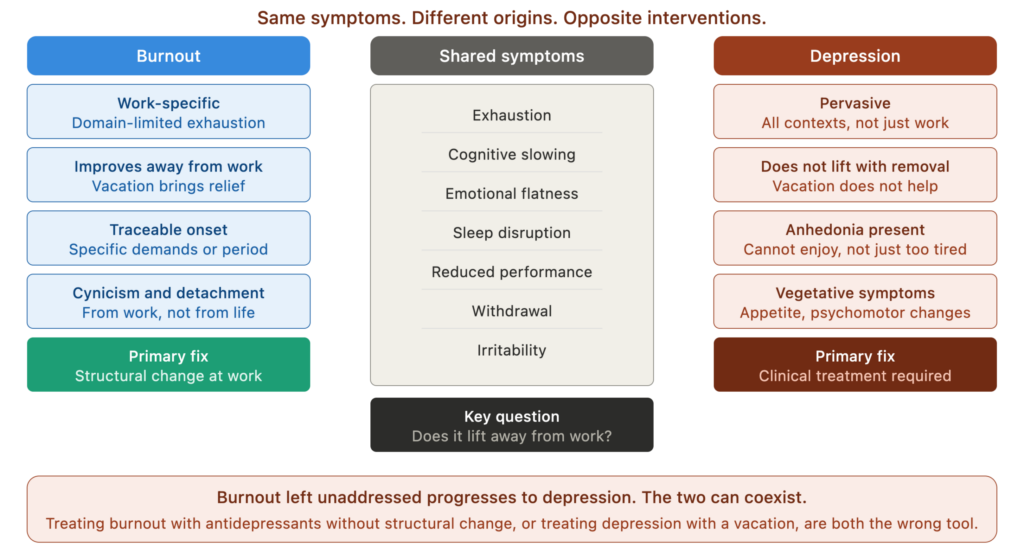
- The key distinguishing feature is context-dependence. Burnout symptoms are domain-specific and improve with removal from the stressor. Depression is pervasive and does not lift when the source of stress is removed. If you feel better on vacation and worse when you return to work, that pattern points toward burnout rather than depression.
- Burnout that is ignored for long enough becomes depression. The HPA axis dysregulation and hippocampal changes that chronic work stress produces eventually cross the threshold into clinical depression. The two conditions exist on a continuum, not in separate boxes.
- The treatment error that produces the most harm: treating burnout with antidepressants without addressing the structural drivers, or treating depression with a vacation when what is needed is medication and therapy. Getting the diagnosis right first matters more than the speed of the intervention.
They feel the same. They are not
The person who is burned out and the person who is depressed both describe the same morning: waking up already tired, dreading the day, getting through tasks on autopilot, coming home and having nothing left. The descriptions are nearly identical. The underlying biology and the appropriate response are not.
Burnout, as defined by Maslach and Leiter and recognized by the World Health Organization as an occupational phenomenon, is characterized by three dimensions: emotional exhaustion from chronic workplace demands, cynicism and detachment from the work itself, and reduced sense of professional efficacy. It is work-generated and work-specific, at least initially.
Depression is a clinical disorder characterized by persistent low mood, anhedonia (loss of pleasure in previously enjoyed activities), and a constellation of cognitive and physical symptoms that are present across contexts. The burned-out person dreads Monday. The depressed person also dreads Saturday. That generalization is imperfect but directionally useful.
The diagnostic questions that matter
Does it improve away from work? A week off that produces genuine recovery, lighter mood, return of energy, and re-engagement with activities outside work is a burnout signal. A week off where the flatness and exhaustion persist regardless of the activity suggests depression. This is the most useful single diagnostic question.
When did it start? Burnout has a traceable origin: a specific period of escalating demand, a role change, a project, a staffing collapse, an impossible target. Depression onset is often less obviously tied to a specific trigger, or the trigger seems disproportionately small relative to the severity of the response.
Is anhedonia present? The absence of pleasure in activities that previously brought it is the hallmark of depression and is not a feature of burnout. The burned-out person may be too exhausted to enjoy things. The depressed person tries to enjoy things and cannot. The distinction is available energy versus available reward-system response.
Are there physical symptoms? Significant appetite change, psychomotor slowing, and sleep changes beyond the work-stress disruption point point toward depression. Burnout produces sleep difficulty and fatigue but rarely the vegetative features of major depression.
The continuum problem
Burnout left unaddressed does not stay burnout. The chronic cortisol elevation, HPA axis dysregulation, and hippocampal changes that sustained occupational stress produces eventually cross the threshold into clinical depression. The person who was clearly burned out at 44 is, at 47, genuinely depressed, and the same vacation that would have worked three years ago no longer touches it.
This progression is one reason the treatment matching matters. Early burnout is primarily addressable through structural changes: workload reduction, role reconfiguration, boundary enforcement, and recovery practices. Late-stage burnout that has progressed to depression requires clinical treatment alongside the structural changes. Structural change alone will not resolve a depressive episode that has fully consolidated.
The Livium recipe
Tool. The Maslach Burnout Inventory is a validated clinical tool for assessing burnout, with versions for different occupational contexts. Free screening versions are available online. The PHQ-9 is the validated depression screener used in clinical settings. Both take under five minutes. Running both gives a clearer picture of where you are on the burnout-to-depression continuum than self-assessment alone. For cortisol tracking that maps the HPA axis state underlying both conditions, an HRV-tracking wearable provides daily readiness scores that correlate with stress load and recovery capacity. For sleep, the common denominator in both conditions, a white noise machine for sleep environment optimization is the lowest-friction sleep adjunct with consistent user evidence.
Behavior. For burnout: the structural intervention is primary. Identify the specific job demands that are producing the exhaustion and address them directly, whether through role negotiation, workload reduction, boundary enforcement, or a job change. Burnout does not respond to self-care in the absence of structural change. A meditation app will not fix a job that is genuinely too much. Recovery practices (sleep, exercise, social connection, time off) prevent burnout from progressing to depression while the structural change is being pursued. For depression: see a physician or psychiatrist. The behavioral changes that help burnout (rest, vacation, reduction in demands) help depression at the margins but are insufficient as primary treatment. Medication and therapy are indicated, not optional nice-to-haves.
Threshold. If you are unsure which you have: see a physician and say exactly that. “I don’t know if I am burned out or depressed and I want to figure it out.” That is a complete clinical referral prompt. A good clinician will run both screens and take a history that distinguishes the pattern. Do not self-diagnose and self-treat either condition for more than two to four weeks without professional input.
| Feature | Burnout | Depression |
|---|---|---|
| Context-dependence | Work-specific; improves away from job | Pervasive; does not lift with removal from stressor |
| Anhedonia | Absent or mild; too tired to enjoy, not unable | Present; loss of pleasure even in activities previously enjoyed |
| Onset | Traceable to specific demands or period | Often less clear; may follow burnout |
| Primary intervention | Structural change plus recovery practices | Clinical treatment (medication and therapy) |
Source: WHO: Burn-Out an Occupational Phenomenon (ICD-11).
Plan of action
- Run both screens this week. The PHQ-9 depression screener is freely available at phqscreeners.com. Search for a validated burnout scale appropriate to your occupation. Score both honestly. The combination tells you more than either alone.
- If it looks like burnout: identify the specific demands producing the exhaustion. Write them down. What would need to change structurally for this to be sustainable? That is the conversation to have with your employer, partner, or yourself. A structured time and energy audit journal makes the demand inventory concrete rather than a general feeling of overload.
- If it looks like depression, or if you genuinely cannot tell: see a physician this month. Do not wait for it to resolve. Depression does not typically resolve without intervention, and the longer the episode continues, the more difficult treatment becomes. Bring your PHQ-9 score to the appointment.
- In either case: protect sleep aggressively. Sleep deprivation drives both conditions and is the one intervention that works across both diagnoses as a damage-limiter while the primary treatment is being organized. A sleep mask and earplugs are the unsexy tools that deliver meaningful improvements in sleep quality with no friction and no prescription.
Table of Content

Know your body better.
Trusted By Thousands Daily







FAQs
Can you have both burnout and depression at the same time?
Yes, and this is common in midlife. Burnout that progressed to depression means both the structural occupational problem and the clinical mood disorder are present and need concurrent treatment. Addressing only one produces incomplete recovery.
Will taking time off fix burnout?
Time off helps burnout but does not fix it if the structural conditions causing the burnout are unchanged. People who return to the same job with the same demands after recovery time typically return to the same burnout within weeks to months. Recovery practices buy time. Structural change is the fix.
Does burnout affect physical health?
Significantly. Chronic burnout is associated with elevated cardiovascular risk, impaired immune function, metabolic dysregulation, and accelerated biological aging markers. The HPA axis dysregulation that produces burnout symptoms is the same mechanism that drives these physical outcomes. Burnout is not just a workplace problem.
Legal Disclaimer
The content published on Livium Health is for informational and educational purposes only. Nothing on this site constitutes medical advice, diagnosis, or treatment. Always consult a qualified healthcare provider before making decisions about your health, including changes to medications, supplements, diet, or exercise.
Livium Health is not a medical practice and does not have a patient-provider relationship with its readers. We do not sell supplements, medications, or treatments, and we have no financial relationship with the products or services we reference.
While we work to ensure the information we publish is accurate and up to date, health and medical guidance evolves. We make no guarantees about the completeness or currency of any content on this site. Reliance on any information provided by Livium Health is solely at your own risk.
If you are experiencing a medical emergency, call 911 or your local emergency services immediately.
We may receive compensation, free products, or affiliate commissions for products mentioned in this post. Opinions are our own.