
Share
Energy & Focus
Men's Health
Women's Health
Caffeine after 40: Why your energy strategy stopped working
6 min read

Key takeaways
- Caffeine’s half-life is roughly 5 to 6 hours in healthy adults, but that number extends with age, stress load, hormonal changes, and certain medications. A cup of coffee at 2 PM is still partly in your system at 10 PM, which is why your sleep quality degrades before your sleep quantity does.
- Caffeine works by blocking adenosine receptors, not by eliminating adenosine itself. The sleep pressure you feel is real and accumulating behind the block. When caffeine wears off, the pressure hits all at once, producing the afternoon crash that sends most people to the coffee machine for another round.
- After 40, morning cortisol is higher and peaks earlier for most adults. Stacking caffeine on top of already-elevated morning cortisol amplifies the mid-morning energy spike and deepens the subsequent trough. The 2 PM cutoff is the standard Livium default. For adults with cortisol dysregulation or poor sleep, noon is the more appropriate cutoff during a reset period.
- Most adults in their 40s and 50s are using caffeine to compensate for sleep debt, hormonal changes, or micronutrient deficiencies rather than to enhance already-adequate energy. The caffeine is not fixing the problem; it is papering over it while making the underlying cause harder to identify.
The strategy that used to work
In your 20s and early 30s, caffeine was reliable. Coffee in the morning, maybe one in the afternoon, sharp and functional all day. Sleep was fine. The system worked.
Somewhere in the mid-40s, it stopped working as cleanly. The morning coffee hits harder but fades faster. The afternoon slump is deeper and arrives earlier. A second coffee helps but leaves you wired at 11 PM staring at the ceiling. Sleep is lighter. Morning energy is worse. So you start earlier with caffeine and use more of it. The wheel spins faster and the problem compounds.
This is not a caffeine tolerance problem. It is a biology problem that caffeine is no longer equipped to solve.
What caffeine actually does
Adenosine is a byproduct of cellular energy metabolism that accumulates in the brain throughout the day. As it builds up, it binds to adenosine receptors and signals increased sleepiness. Caffeine is a structural mimic of adenosine: it occupies the same receptors without activating them, blocking the sleepiness signal without eliminating the adenosine that would have triggered it.
This is important. Caffeine does not create energy. It borrows time. The adenosine keeps accumulating behind the block. When caffeine clears the receptors (roughly 5 to 6 hours after ingestion in a healthy adult), the accumulated adenosine floods in and the sleepiness arrives compressed and intensified. That is the crash.
Sleep is the only mechanism that actually clears adenosine. Which is why the caffeine-poor sleep-caffeine cycle is self-reinforcing: the caffeine disrupts the sleep that would otherwise clear the adenosine it was blocking. Every morning starts with a higher adenosine baseline than the morning before.
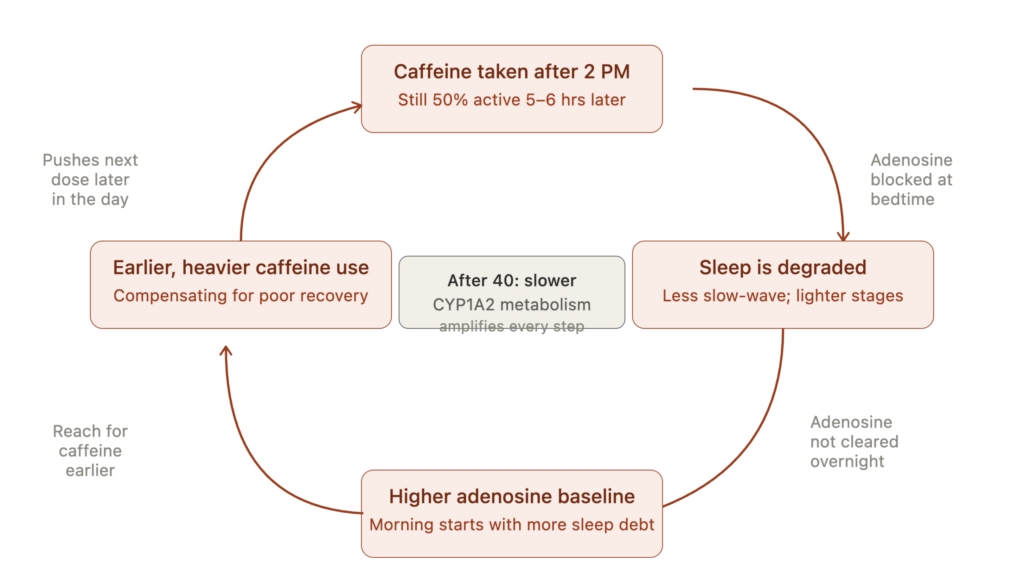
Caffeine does not create energy — it borrows it from tomorrow. Late caffeine blocks adenosine at bedtime, degrades slow-wave sleep, leaves adenosine uncleared overnight, and produces a worse baseline the next morning. After 40, slower CYP1A2 metabolism means each dose stays active longer, tightening every link in the loop. Source: Schlichtiger et al., Nutrients 2025 — Effects of Caffeine Intake on Self-Administered Sleeping Quality and Wearable Monitoring of Sleep in a Cohort of Young Healthy Adults. CC BY 4.0.
What changes after 40
Caffeine metabolism slows. The enzyme CYP1A2 handles most caffeine metabolism in the liver. Its activity declines with age and is further suppressed by elevated cortisol, certain medications (particularly hormonal contraceptives and some antibiotics), and significant stress load. A cup of coffee that cleared your system in 5 hours at 32 may take 7 or 8 hours at 47. Same dose, longer duration, more sleep disruption.
Morning cortisol peaks earlier and higher. Cortisol follows a diurnal rhythm, peaking roughly 30 to 45 minutes after waking (the cortisol awakening response) and declining through the morning. After 40, that peak tends to arrive earlier, be more pronounced, and decline more steeply. Consuming caffeine during or immediately after this peak amplifies the spike and sharpens the subsequent trough. Waiting 60 to 90 minutes after waking before the first coffee allows cortisol to peak and begin its natural decline before caffeine enters the picture.
Sleep quality degrades independently. Slow-wave sleep (the most restorative phase) declines measurably after 40, meaning even a full night in bed produces less recovery than the same hours did ten years earlier. This baseline recovery deficit means you are starting each day with more adenosine than before, reaching for caffeine earlier, and perpetuating the cycle.
Hormonal changes alter sensitivity. Declining estrogen and testosterone both affect sleep quality, energy regulation, and the subjective experience of fatigue. Caffeine does not address hormonal fatigue; it masks it temporarily while the underlying cause continues unchecked.
The Livium recipe
Tool. A two-week caffeine reset is the diagnostic tool, not a permanent prescription. The goal is to separate caffeine-dependent energy from baseline energy so you can see what the actual problem is. A high-quality green tea at 25 to 50 mg caffeine is the reduction step if cold turkey produces withdrawal headaches (which are real and peak at 24 to 48 hours). L-theanine 200 mg, taken with morning coffee, smooths the cortisol-caffeine spike and reduces the anxious edge that midlife caffeine often produces, without reducing alertness. For adults who want to understand how their caffeine metabolism actually works: CYP1A2 genotype testing is available through most functional medicine panels and determines whether you are a fast or slow metabolizer.
Behavior. Three changes with the most evidence behind them. Wait 60 to 90 minutes after waking before the first coffee. Cut caffeine at 2 PM as the standard default. During the two-week reset window, cut to noon to get a cleaner read on baseline energy. If you use a sleep tracker, watch your deep sleep percentage during the reset period. Most adults see measurable improvement in slow-wave sleep within a week of moving the cutoff earlier.
Threshold. If your energy during the two-week reset is significantly better than before, caffeine timing was the problem. Fix it and move on. If your energy during the reset is still poor despite adequate sleep, the problem is upstream: hormones, iron, thyroid, sleep quality, or something else that bloodwork through Function Health will identify. Caffeine was covering the symptom. The reset reveals the source.
| Caffeine behavior | What it does | Livium adjustment |
|---|---|---|
| Coffee immediately on waking | Stacks on peak cortisol; deepens mid-morning trough | Wait 60–90 minutes after waking |
| Afternoon coffee (after 2 PM) | Still active at 10 PM; reduces slow-wave sleep | Hard cutoff at 2 PM; noon during reset |
| High daily volume (4+ cups) | Elevates cortisol, increases anxiety, masks fatigue cause | Reduce to 1–2 cups; add L-theanine |
| Caffeine as primary energy tool | Borrows energy from tomorrow; compounds deficit | Two-week reset to identify underlying cause |
Source: Sleep Foundation: Caffeine and Sleep.
Plan of action
- Move your first coffee to 60 to 90 minutes after waking this week. Not a permanent restriction. A test. Notice whether the mid-morning trough is shallower. Most people find it is.
- Set a 2 PM caffeine cutoff and hold it for two weeks. If you use a sleep tracker, check your deep sleep score before and after. The data usually closes the argument.
- Add L-theanine to your morning coffee. The 2:1 theanine-to-caffeine ratio (200 mg L-theanine with 100 mg caffeine) is the most-researched combination for alertness without a cortisol spike. Most people notice a cleaner, calmer energy within a week.
- If energy is still poor after two weeks of corrected timing, run a bloodwork panel. Low ferritin, suboptimal thyroid, low testosterone or estrogen, and vitamin D deficiency all present as persistent fatigue that caffeine masks but cannot fix. Function Health covers all of these in a single annual panel.
Table of Content

Know your body better.
Trusted By Thousands Daily




FAQs
Is decaf actually caffeine-free?
No. Decaf contains approximately 2 to 15 mg of caffeine per cup depending on the decaffeination method and the coffee variety. For most people, this is inconsequential. For slow caffeine metabolizers or adults with significant sleep sensitivity, even decaf in the evening can produce measurable sleep disruption. If you are in a reset period, herbal tea is cleaner than decaf.
Does caffeine affect men and women differently after 40?
Yes, meaningfully. Estrogen inhibits CYP1A2 activity, which means women on hormonal contraceptives or in perimenopause with fluctuating estrogen levels metabolize caffeine more slowly than men of the same age. Women in perimenopause often report that caffeine sensitivity increases sharply as estrogen declines. The same dose that felt manageable at 38 can produce anxiety and sleep disruption at 46 without any change in consumption habits. The biology changed; the amount of caffeine did not.
Is there a benefit to cycling off caffeine periodically?
Yes. Adenosine receptor upregulation from chronic caffeine use (tolerance) means you need progressively more caffeine to achieve the same effect. A 10 to 14-day break allows receptor density to normalize. The reset is uncomfortable for days one through three (headache, fatigue, irritability) and significantly better from day four onward. Most people who complete a reset report that their caffeine sensitivity improves substantially and their baseline energy without caffeine is better than they expected.
Legal Disclaimer
The content published on Livium Health is for informational and educational purposes only. Nothing on this site constitutes medical advice, diagnosis, or treatment. Always consult a qualified healthcare provider before making decisions about your health, including changes to medications, supplements, diet, or exercise.
Livium Health is not a medical practice and does not have a patient-provider relationship with its readers. We do not sell supplements, medications, or treatments, and we have no financial relationship with the products or services we reference.
While we work to ensure the information we publish is accurate and up to date, health and medical guidance evolves. We make no guarantees about the completeness or currency of any content on this site. Reliance on any information provided by Livium Health is solely at your own risk.
If you are experiencing a medical emergency, call 911 or your local emergency services immediately.
We may receive compensation, free products, or affiliate commissions for products mentioned in this post. Opinions are our own.