
Share
Energy & Focus
Men's Health
Women's Health
Chronotype shifts after 40: Why you’re exhausted by 9 PM and what to do about it
5 min read
Key takeaways
- Chronotype, the internal biological timing preference for sleep and waking, shifts progressively toward morningness with age, meaning most adults become earlier risers and earlier faders whether they want to or not.
- Fighting your chronotype, by staying up late on an evening-person schedule when your biology has shifted morning, produces a form of chronic circadian misalignment that degrades cognitive performance, mood, and metabolic health.
- Morning light exposure is the most powerful tool for anchoring and stabilizing chronotype, producing downstream improvements in energy, mood, and sleep quality within days of consistent use.
- Evening chronotype in midlife and older adults is associated with worse sleep quality, higher distress, and poorer morning alertness regardless of total sleep time.
Your body moved its bedtime. Nobody told you
Chronotype is not a personality trait. It is a biological timing preference driven by the suprachiasmatic nucleus (SCN), the brain’s master clock, and expressed through the timing of cortisol, melatonin, core body temperature, and alertness across the 24-hour day. Evening types run late on all of these. Morning types run early. And the distribution shifts with age in a consistent direction: toward earlier timing.
Most people in their 20s run slightly toward evening. By their 40s and 50s, the same people have shifted toward morning, becoming sleepier earlier and waking earlier even without an alarm. This is not a discipline improvement. It is a biological phase advance driven by age-related changes in circadian amplitude and sensitivity. The person who could stay sharp at a 10 PM dinner at 32 is genuinely, biologically tired at 9 PM at 48. It is not a character flaw. It is chronobiology.
Why misalignment costs you
The problem is not the chronotype shift itself. It is fighting it. Adults who try to maintain an evening-oriented social schedule (late dinners, late work, late entertainment) on a biology that has shifted to the morning end up with what researchers call social jetlag: a chronic mismatch between biological timing and social timing that produces the same impairments as regular transatlantic travel, repeated weekly. Impaired alertness, mood instability, higher cortisol, metabolic disruption. The circadian system is not flexible about this. It wants what it wants, and what it wants at 48 is earlier than what it wanted at 28.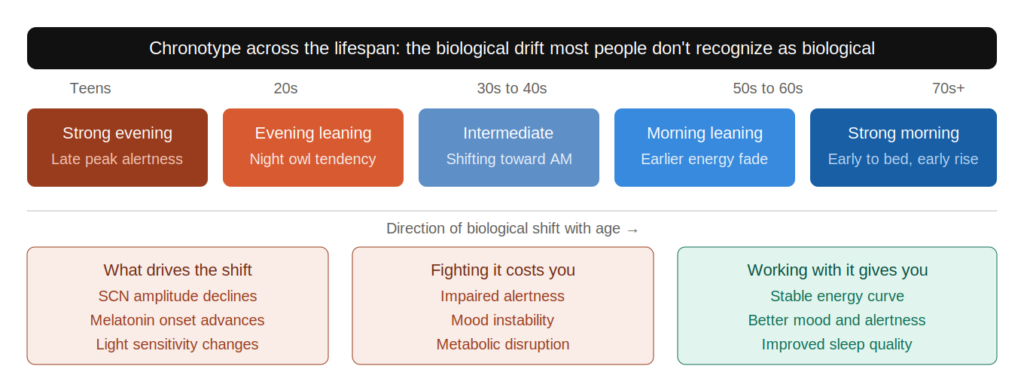
How to work with your shifted chronotype
Chronotype is partially modifiable. You cannot fully override the biological phase advance, but you can anchor and stabilize it in ways that improve energy and performance. Morning light is the most powerful tool available. Bright light in the first 30 to 60 minutes after waking locks in the circadian anchor point, stabilizes cortisol timing, and improves alertness and mood throughout the day. This is not optional niceness. It is the strongest single intervention for circadian timing outside of medication.
Schedule your most cognitively demanding work in the morning, when your shifted chronotype gives you peak alertness. Protect that window ruthlessly. Meetings, administrative tasks, and reactive work belong in the afternoon. The morning window is not infinite; it is typically two to four hours of genuine peak cognitive performance. Use it on the right things.
The Livium recipe
Tool. A 10,000-lux light therapy lamp used for 20 to 30 minutes within the first hour of waking is the evidence-based standard for circadian anchoring when natural sunlight is unavailable. On days when you can get outside, direct sunlight within 30 minutes of waking is more effective than any lamp. A sunrise alarm clock that gradually brightens 30 minutes before wake time reduces the cortisol spike of abrupt awakening and makes the transition into morning alertness smoother. Blue-light-blocking glasses for 2 to 3 hours before your target bedtime allow melatonin to rise at the appropriate time rather than being suppressed by evening screens.
Behavior. Set a consistent wake time and hold it, including weekends. Chronotype stability depends on a consistent anchor point. Sleeping two hours later on weekends shifts your circadian phase backward and reproduces the social jetlag you spent the week trying to avoid. The one behavior with the highest leverage on chronotype stability is an unwavering wake time. Schedule your highest-priority cognitive work in the first two to three hours of the day. Protect that window from meetings, email, and reactive demands. The afternoon is for tasks that do not require peak executive function.
Threshold. If your chronotype has advanced so far that you are regularly falling asleep before 9 PM and waking before 5 AM against your preference, this is advanced sleep-wake phase disorder, which is clinically distinct from normal chronotype shift. Bright evening light therapy (not morning light) is the treatment for phase advancement, and it is the opposite of the protocol most sleep articles recommend. A sleep specialist can confirm the diagnosis and prescribe the correct light timing.
| Time of day | Chronotype-aligned behavior | Why |
|---|---|---|
| Within 30 min of waking | Bright light (outside or lamp) | Anchors circadian clock, stabilizes cortisol |
| Morning (hours 1 to 3) | Deep work, creative work, decisions | Peak alertness window for shifted chronotype |
| Afternoon | Meetings, admin, reactive tasks | Alertness declining; lower cognitive demand appropriate |
| 2 to 3 hrs before bed | Dim lights, blue-light blocking | Allows melatonin to rise at appropriate time |
Source: Niu et al., Journal of Sleep Research 2025 — Eveningness in Middle-Aged and Older Adults. CC BY 4.0.
Plan of action
- Set a consistent wake time this week and hold it through the weekend. This single change is the most impactful chronotype stabilizer available without a prescription or device.
- Get outside within 30 minutes of waking for 10 to 15 minutes of direct light exposure. On dark or overcast days, a 10,000-lux lamp for 20 minutes achieves the same circadian anchoring effect.
- Audit your schedule for the next two weeks. Move your most cognitively demanding tasks to the first two hours of the day and move meetings to the afternoon. Treat this as a productivity experiment with a specific evaluation date.
- Stop fighting the 9 PM fade. Leaning into your shifted chronotype rather than battling it leads to better sleep quality, greater morning alertness, and improved overall cognitive performance. Blue-light blocking glasses from 7 PM onward support the earlier melatonin onset your biology now wants.
Table of Content

Know your body better.
Trusted By Thousands Daily






FAQs
Can I reverse my chronotype shift and become a night person again?
Partially. Evening light exposure and consistent late bedtimes can delay the phase somewhat. But the biological drift toward morningness with age is driven by changes in the SCN that are not fully reversible. Working with the shift produces better outcomes than fighting it for most adults.
Is the morning chronotype actually healthier?
In population studies, morning types show better metabolic health, lower rates of depression, and longer life expectancy. But this is largely because social schedules are built for morning people. The health costs of eveningness are primarily driven by circadian misalignment with social demands, not eveningness itself. An evening person whose schedule allows for late sleep and late waking shows health outcomes similar to those of a morning person.
Does melatonin help shift my chronotype?
Low-dose melatonin (0.5 mg) taken 5 to 6 hours before your target sleep time has modest phase-advancing effects and can help anchor an earlier bedtime. It is not a substitute for consistent light management but is a reasonable adjunct for the first few weeks of chronotype realignment.
Legal Disclaimer
The content published on Livium Health is for informational and educational purposes only. Nothing on this site constitutes medical advice, diagnosis, or treatment. Always consult a qualified healthcare provider before making decisions about your health, including changes to medications, supplements, diet, or exercise.
Livium Health is not a medical practice and does not have a patient-provider relationship with its readers. We do not sell supplements, medications, or treatments, and we have no financial relationship with the products or services we reference.
While we work to ensure the information we publish is accurate and up to date, health and medical guidance evolves. We make no guarantees about the completeness or currency of any content on this site. Reliance on any information provided by Livium Health is solely at your own risk.
If you are experiencing a medical emergency, call 911 or your local emergency services immediately.
We may receive compensation, free products, or affiliate commissions for products mentioned in this post. Opinions are our own.