
Share
Energy & Focus
Men's Health
Women's Health
Creatine after 40: The focus supplement hiding in the gym aisle
8 min read
Key takeaways
- Creatine is not just a muscle supplement. The brain uses it too, and brain creatine levels drop with age.
- The cognitive evidence is strongest in adults over 60 and in anyone running on poor sleep. Younger, well-rested adults see less benefit.
- 3 to 5 grams of creatine monohydrate daily is the clinically supported dose. Loading phases are unnecessary and hard on your kidneys.
- Most people already eat creatine in meat and fish. Supplementing fills the gap, especially for anyone eating less animal protein than they used to.
It has been sitting in the gym bag since 1998
You know creatine as the stuff guys take to push harder in the gym. The white powder. The bloating scare of the late nineties. The supplement that serious lifters swear by and everyone else ignores.
That reputation is costing you something.
Creatine is not only one of the most studied supplements on the market. It is one of the few that shows up in brain research with a straight face. Your muscles run on it. Your brain does too. And after 40, both of those tanks are running lower than they did at 25.
The gym bag was always the wrong shelf for it.
What creatine actually does in the brain
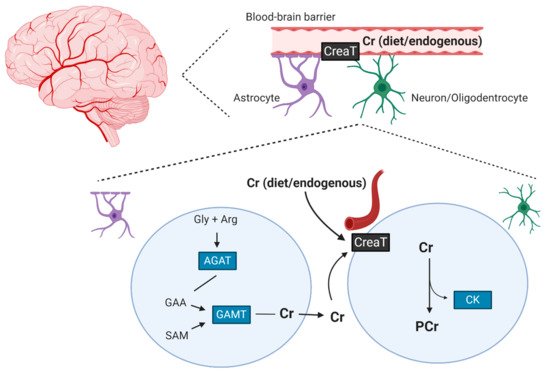
Your cells make energy in the form of adenosine triphosphate (ATP). When demand spikes during a sprint, a hard mental task, or a night of bad sleep, the cell needs to regenerate ATP fast. Phosphocreatine is the emergency reserve. It donates a phosphate group to adenosine diphosphate (ADP), converting it back to ATP in under a second.
Muscles use this system constantly. So does the brain. Neurons are metabolically expensive. High-demand mental tasks burn through ATP quickly, and the brain’s phosphocreatine reserve is what keeps performance from collapsing before the slower aerobic system catches up.
The problem after 40: brain creatine levels decline with age. Not catastrophically, but measurably. And most people over 40 are eating less red meat than they used to, which is the primary dietary source. The gap widens quietly.
What the research actually says (and what it doesn’t)
The cognitive research on creatine is real. It is also easy to overread.
A 2024 systematic review in Frontiers in Nutrition found positive effects on cognitive performance in adults, particularly in memory and executive function. A separate analysis focused on older adults reached a similar conclusion: creatine supplementation is associated with cognitive benefits in generally healthy people over 60. The European Food Safety Authority reviewed the same data pool and noted methodological limitations in some of the meta-analyses, specifically regarding non-independent outcome measures that inflated apparent effect sizes.
What the data actually shows, read conservatively:
The benefit is clearest when the brain is under metabolic stress. Sleep deprivation is the best-studied example. A 2024 randomized controlled trial published in Scientific Reports found that a single high dose of creatine preserved cognitive performance and changed brain energy markers during sleep deprivation in ways a placebo did not. When the brain is operating near its reserve capacity, the phosphocreatine buffer matters more. When you are well-rested and 30 years old, the effect shrinks toward noise.
After 40, most people are chronically underslept, have a slightly lower dietary creatine intake than they did a decade ago, and notice that mental stamina later in the day is not what it used to be. That is the profile the research fits best.
The Livium take. Creatine is not a nootropic stack or a smart drug. It is a cellular energy buffer; the backup generator for your ATP system. Most people over 40 are running with a smaller buffer than they realize. Creatine does not sharpen you as caffeine does. It sustains you when the tank runs low. That is a different thing. A more useful thing, honestly.
The Livium recipe
Tool. Creatine monohydrate, unflavored powder. The form matters: monohydrate is the most studied version and is consistently as effective as every more expensive alternative. Thorne Creatine is NSF Certified for Sport, micronized for mixability, and free from heavy metals and banned contaminants. About $35 for 90 servings at 5g per day.
Behavior. 3 to 5 grams daily, mixed into water or a morning drink. No loading phase needed. Loading protocols (20g/day for a week) saturate muscle stores faster but offer no additional benefit over steady daily use and impose unnecessary strain on the kidneys. Take it at the same time each day. Consistency matters more than timing. Morning with coffee is fine. Pre-workout is fine. The data does not strongly favor one window.
Threshold. Four weeks of daily use at 3 to 5g before you evaluate. Brain creatine saturation takes time. Do not judge it after a week. What to watch for at the four-week mark: sustained mental energy later in the afternoon, less sharp drop-off on cognitively demanding days, and quicker recovery from nights of poor sleep. If you want a baseline before starting, Function Health panels include creatinine markers that give you a pre-supplementation metabolic snapshot.
The muscle case is still worth making
The brain angle is the underappreciated story. The muscle angle is not worth skipping.
After 40, muscle mass starts declining at roughly 1 percent per year without deliberate intervention. By 60, sarcopenia, the clinical term for age-related muscle loss, affects a meaningful percentage of otherwise healthy adults. Creatine supplementation combined with resistance training consistently outperforms resistance training alone in studies of older adults, both in muscle strength and in lean mass retention.
You are not taking creatine to look like a bodybuilder. You are taking it to keep the muscle you have, support the training that builds more, and give your brain the same phosphocreatine buffer your cells have always depended on. Those are three separate arguments pointing at the same daily habit.
If your testosterone is low, muscle retention gets harder regardless of creatine. Creatine does not increase testosterone. Worth knowing before you expect it to solve what it was not designed to solve. If low T is a live question, Hone Health runs the full hormone panel and handles prescriptions where appropriate.
Safety, kidneys, and the bloating question
Two things come up every time creatine gets mentioned outside the gym: kidneys and water weight.
Kidneys first. Creatine at 3 to 5 grams daily is safe for adults with healthy kidney function. Harvard Health is direct on this: an adult dose of 3 to 5 grams daily is safe. The caveat is for people with existing kidney disease, who should talk to their doctor before supplementing. If you have never had a kidney function panel and you are over 40, that is a reasonable test to add to your next physical. Function Health includes it.
Water weight. Some people retain a couple of pounds of fluid in the first week of creatine use. It is temporary and does not persist with continued use. It is also not fat. If the number on the scale goes up by two pounds in week one, that is water moving into muscle cells, not anything to be alarmed about.
Creatine is not a steroid. Does not increase testosterone. Does not cause hair loss in people with normal androgen sensitivity, despite what a widely cited 2009 study on rugby players suggested. That study measured dihydrotestosterone (DHT), not hair loss outcomes, and has not been replicated.
Creatine vs. common focus supplements: what the evidence says
The supplement aisle has a lot of opinions about brain performance. Here is where creatine sits relative to the alternatives most people in this audience are already considering.
| Supplement | Mechanism | Brain evidence | Side effects to know | Livium verdict |
|---|---|---|---|---|
| Creatine monohydrate | Replenishes phosphocreatine; supports ATP regeneration in neurons | Strongest in older adults and sleep-deprived individuals; moderate overall | Temporary water retention in week 1; kidney caution if disease present | Worth it. The safety profile and dual muscle/brain benefit make it the most defensible daily supplement for adults over 40. |
| Caffeine | Blocks adenosine receptors; delays perceived fatigue | Strong and well-replicated for acute focus and reaction time | Sleep disruption if taken after 2 PM; tolerance builds; withdrawal headaches | Use it. But it masks depletion rather than filling it. Not a substitute. |
| Lion’s mane mushroom | Proposed to stimulate nerve growth factor (NGF); mechanism in humans unclear | Small, underpowered trials; promising but not established | Generally well-tolerated; limited long-term data | Interesting. Not yet. Check back in five years when the trial quality improves. |
| Alpha-GPC / choline | Precursor to acetylcholine; supports neurotransmitter synthesis | Moderate evidence in older adults with mild cognitive decline; less clear in healthy adults | Some data linking high-dose long-term use to increased cardiovascular risk; under review | Proceed with caution until the cardiovascular signal is better understood. |
| Nootropic stacks (multi-ingredient) | Varies; typically 8–15 ingredients at subclinical doses each | Almost no stack-level evidence; individual ingredient doses too low to replicate trial findings | Hard to isolate which ingredient causes any effect or side effect | Pass. You are paying premium prices for underdosed ingredients and marketing copy. |
Sources: Harvard Health Publishing; Frontiers in Nutrition (2024); Nutrition Reviews (2025); Examine.com.
Plan of action
- Pick up creatine monohydrate, unflavored. Thorne Creatine is the default recommendation. NSF-certified, no fillers, mixes cleanly.
- Start at 3 to 5 grams daily. No loading phase. Mix it into water, coffee, or a morning smoothie. Set a four-week window before you decide anything about whether it is working.
- If you have never had a kidney function panel or a full metabolic panel, add one. Function Health covers both, plus 100+ other biomarkers that tell you what else might be affecting your energy.
- If you are doing resistance training, keep doing it. Creatine without training is a smaller return. Creatine, combined with consistent resistance work, is one of the better longevity moves available at any drugstore price point.
- If muscle retention or fatigue is also tied to low testosterone, creatine will not fix that. Hone Health runs the hormone panel and handles next steps if T is the actual problem.
Table of Content

Know your body better.
Trusted By Thousands Daily




FAQ
Is creatine safe for women over 40?
Yes. The research on creatine and muscle retention in older adults includes women, and some studies specifically flag perimenopausal and postmenopausal women as a group that benefits from it given the accelerated muscle loss that accompanies declining estrogen. Three to five grams daily is the same dose regardless of sex.
Do I need to cycle creatine on and off?
No. There is no evidence that cycling is necessary or beneficial. Long-term daily use at 3 to 5 grams is the most studied protocol and is considered safe for healthy adults. Cycling is a gym myth that has not been supported by the clinical literature.
Does creatine cause hair loss?
The concern comes from a single 2009 study in rugby players that found elevated DHT levels after creatine loading. DHT is associated with male pattern baldness in people who are genetically susceptible. The study did not measure hair loss directly and has not been replicated. Current evidence does not support a meaningful risk of hair loss from creatine at standard doses.
Can I take creatine if I have kidney issues?
Not without talking to your doctor first. Creatine supplementation increases serum creatinine, which is a marker doctors use to evaluate kidney function. In healthy kidneys, this is not a problem. In kidneys that are already compromised, additional metabolic load is a live concern. Get a creatinine and glomerular filtration rate (GFR) panel first.
What is the difference between creatine monohydrate and creatine HCl?
Marketing, mostly. Creatine HCl is promoted as better absorbed at smaller doses. The research does not support meaningful advantages over monohydrate at equivalent saturating doses. Monohydrate has 30 years of clinical data. HCl does not. Monohydrate also costs significantly less per serving.
Legal Disclaimer
The content published on Livium Health is for informational and educational purposes only. Nothing on this site constitutes medical advice, diagnosis, or treatment. Always consult a qualified healthcare provider before making decisions about your health, including changes to medications, supplements, diet, or exercise.
Livium Health is not a medical practice and does not have a patient-provider relationship with its readers. We do not sell supplements, medications, or treatments, and we have no financial relationship with the products or services we reference.
While we work to ensure the information we publish is accurate and up to date, health and medical guidance evolves. We make no guarantees about the completeness or currency of any content on this site. Reliance on any information provided by Livium Health is solely at your own risk.
If you are experiencing a medical emergency, call 911 or your local emergency services immediately.
We may receive compensation, free products, or affiliate commissions for products mentioned in this post. Opinions are our own.