
Share
Longevity & Aging
Men's Health
Women's Health
Custom ear protection: When off-the-shelf isn’t enough
5 min read

Key takeaways
- Custom molded ear protection is made from an impression of your ear canal and fits with a seal that generic foam or silicone earplugs cannot replicate. The fit difference yields more consistent attenuation, particularly at lower frequencies, where foam earplugs notoriously underperform.
- The populations who benefit most: musicians and frequent concert-goers (who need flat-spectrum attenuation, not muffled sound), industrial workers who wear protection for full shifts (comfort drives consistency), hunters and shooters (who need impulse sound suppression with pass-through for ambient hearing), and swimmers with recurrent ear infections.
- The cost range is wide: $50 to $100 for DIY impression kits with mail-order custom plugs, $150 to $400 from an audiologist with acoustic filter options. That is a one-time cost for a device that lasts three to five years and is worn daily by people in high-noise environments.
- Off-the-shelf high-fidelity earplugs (Loop, Eargasm, Etymotic) are a legitimate and significantly cheaper alternative for casual or intermittent use. Custom is justified when the use case is daily, the fit of generic options is poor, or the acoustic requirements are specific.
Why fit matters more than NRR
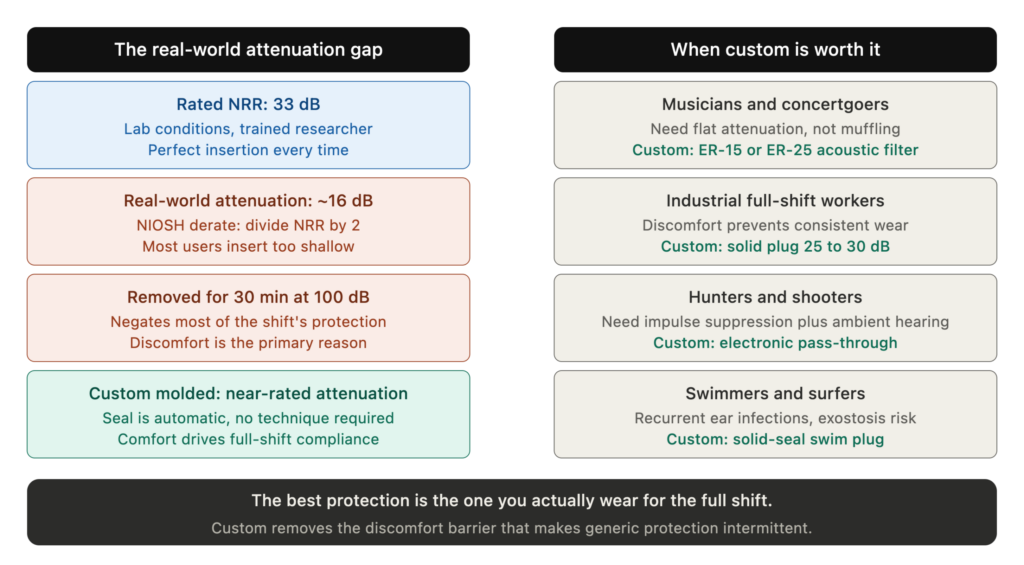
The noise reduction rating printed on any earplug assumes proper insertion, producing a complete acoustic seal. Foam earplugs, rolled correctly and inserted deeply, achieve close to their rated attenuation. Most people do not insert foam earplugs correctly or deeply enough. Real-world attenuation studies consistently show that users achieve roughly half the rated NRR in practice.
Custom molded earplugs seal against the specific geometry of your ear canal. There is no technique to get right. The plug goes in, it seats, the seal is made. Audiologists performing real-ear measurements on correctly fitted customs typically find attenuation values much closer to their rated performance than with generic alternatives. Comfort is also meaningfully better during long-duration wear, which is the primary reason industrial workers remove their protective gear before the end of the shift.
Which type of custom for which situation
Musicians and concertgoers. The priority is flat attenuation: reduce volume without changing the frequency balance of the sound. Generic foam plugs muffle high frequencies while allowing low frequencies through, making music sound muffled and unnatural. Custom musician plugs use acoustic filters (ER-9, ER-15, or ER-25, referring to dB of attenuation) that produce spectrally flat reduction. The music sounds like music, just quieter.
Hunters and shooters. The priority is impulse noise suppression with preserved ambient hearing. Electronic pass-through customs use microphones and speakers to amplify ambient sound at safe levels while electronically suppressing impulsive sounds (gunshots) above a threshold. This allows full situational awareness and communication while eliminating the impulse peak that damages hearing. Passive custom plugs for shooting are cheaper but sacrifice ambient hearing.
Industrial workers. The priority is maximum consistent attenuation across a full shift. Custom solid plugs in the 25-30 dB attenuation range, worn for eight-hour shifts five days a week, provide far better cumulative protection than foam alternatives that are removed repeatedly due to discomfort or poor fit. Some industrial customs include detachable cords for retention and hygiene.
Swimmers. Custom swim plugs seal the ear canal against water entry, preventing chronic outer ear infections (swimmer’s ear) and the rare but serious condition of exostosis (bone growth in the ear canal from repeated exposure to cold water, common in surfers and open-water swimmers). These are solid-seal plugs, not attenuation devices.
The Livium recipe
Tool. For casual and intermittent use, Loop Engage 2 Plus earplugs are the best-designed off-the-shelf high-fidelity option for social situations and moderate noise environments. For DIY custom impressions at home, an ear impression kit allows you to take your own ear impressions and mail them to a lab for custom plug fabrication at significantly lower cost than an audiologist visit. For hunting and shooting, electronic hearing protection earmuffs with pass-through amplification provide the best combination of impulse suppression and ambient awareness for occasional use without the custom cost. For swimmers: moldable silicone swim plugs provide a reasonable seal for casual swimmers; frequent open-water swimmers and surfers are the population for whom custom swim plugs are worth the cost.
Behavior. The best protection is the one you actually wear. Custom plugs increase wear compliance by being more comfortable, easier to insert correctly, and less likely to fall out. If you are currently not consistently wearing protection in a high-noise environment because generic earplugs are uncomfortable or fall out, custom earplugs are a justified upgrade. The audiologist visit for impressions takes 20 minutes.
Threshold. Custom is worth the cost when you are in a high-noise environment regularly (weekly or more), when the comfort of generic protection is preventing consistent use, or when your noise environment has specific acoustic requirements (music, communication, impulse suppression) that generic attenuation cannot meet well.
| Use case | Best off-the-shelf option | When custom is worth it |
|---|---|---|
| Concerts and live music | Loop Experience, Eargasm | Weekly attendance, professional musicians |
| Industrial noise, full shift | 3M E-A-Rsoft foam, NRR 33 | Daily wear, discomfort preventing use |
| Hunting and shooting | Electronic over-ear with pass-through | Frequent shooting, earmuffs impractical |
| Swimming and surfing | Mack’s moldable silicone | Daily swimming, recurrent ear infections |
Source: NIOSH: Noise and Occupational Hearing Loss.
Plan of action
- If you attend concerts or live music more than once a month: get a pair of high-fidelity earplugs this week. Loop Experience 2 or Eargasm are the two with the best frequency response data. Use them every time without exception. The cumulative dose from repeated concert exposure adds up faster than most people expect.
- If you work in a noisy environment and are not wearing protection consistently because foam is uncomfortable: book an audiologist appointment for ear impressions. The fitting takes 20 minutes. Custom plugs ship within two weeks. The discomfort barrier to consistent use disappears.
- If you shoot regularly without hearing protection: start with electronic earmuffs immediately. Gunshot impulse levels (140 to 165 dB) exceed the threshold for immediate cochlear damage. This is not a gradual risk. A single unprotected shot causes measurable damage.
- For anyone using in-ear headphones for extended periods: keep listening levels below 60 percent of maximum volume and limit continuous sessions to 60 minutes. The 60/60 rule is not a cure for exposure risk, but it is a practical threshold that keeps daily recreational exposure well below levels that cause damage.
Table of Content

Know your body better.
Trusted By Thousands Daily






FAQs
How long do custom earplugs last?
Three to five years with regular cleaning and proper storage. Ear canal shape changes slightly with age, and a refitting may be needed after that period if the seal becomes less reliable. The acoustic filters in musician plugs can be replaced independently of the mold, extending the device’s lifespan.
Can I take my own ear impressions?
DIY impression kits are available and work reasonably well for straightforward ear canal geometries. Audiologist-taken impressions are more reliable, particularly for ears with unusual canal shapes or a history of ear surgery. For standard musician or swim plugs that don’t have high acoustic requirements, DIY is a reasonable and significantly cheaper option.
Are custom earplugs covered by insurance?
Rarely by personal health insurance. Custom swim plugs prescribed for recurrent swimmer’s ear are sometimes covered with a physician referral. In occupational settings, employer-provided hearing conservation programs are required to provide hearing protection at no cost to workers under OSHA regulations. FSA and HSA funds can typically be used for custom hearing protection.
Legal Disclaimer
The content published on Livium Health is for informational and educational purposes only. Nothing on this site constitutes medical advice, diagnosis, or treatment. Always consult a qualified healthcare provider before making decisions about your health, including changes to medications, supplements, diet, or exercise.
Livium Health is not a medical practice and does not have a patient-provider relationship with its readers. We do not sell supplements, medications, or treatments, and we have no financial relationship with the products or services we reference.
While we work to ensure the information we publish is accurate and up to date, health and medical guidance evolves. We make no guarantees about the completeness or currency of any content on this site. Reliance on any information provided by Livium Health is solely at your own risk.
If you are experiencing a medical emergency, call 911 or your local emergency services immediately.
We may receive compensation, free products, or affiliate commissions for products mentioned in this post. Opinions are our own.