
Share
Hormones
Women's Health
Estrogen dominance: What it is, what it isn’t, and why the term is overused
7 min read
Key takeaways
- “Estrogen dominance” is a real physiological state with a specific clinical definition: estrogen that is elevated or normal while progesterone is disproportionately low, shifting the estrogen-to-progesterone ratio in ways that produce identifiable symptoms. It is not a diagnosis. It is a hormonal pattern that can be caused by several different underlying conditions.
- The term has been aggressively expanded by the wellness industry to explain a broad range of symptoms in women over 40. Most of what gets labeled estrogen dominance online is perimenopause, in which both hormones decline but progesterone declines earlier and more steeply. This is a different physiological pattern with different implications for treatment.
- Actual elevated estrogen (hyperestrogenism) has specific causes: obesity and visceral fat (adipose tissue is an estrogen production site), anovulatory cycles (no ovulation means no progesterone secretion from the corpus luteum), certain medications, and rare estrogen-secreting tumors. These require clinical investigation rather than DIM supplements.
- Testing matters. The symptoms attributed to estrogen dominance (bloating, breast tenderness, mood changes, heavy periods, fatigue) overlap with thyroid dysfunction, perimenopause, insulin resistance, and several other conditions. Without measuring both estrogen and progesterone at the correct point in the menstrual cycle, the diagnosis is a guess.
A term that means too many things
Search “estrogen dominance,” and you find a coherent and authoritative-sounding framework: a list of symptoms (bloating, fatigue, anxiety, weight gain, heavy periods, brain fog, poor sleep), a cause (too much estrogen relative to progesterone), and a solution (DIM, calcium d-glucarate, seed cycling, specific supplements). The framework is internally consistent. It is also dramatically oversimplified, and in its oversimplification it misdirects a significant number of women away from the actual diagnosis and treatment they need.
The concept was introduced by the late Dr. John Lee, an OB-GYN, in the 1990s, and has been amplified and modified by functional medicine practitioners and wellness brands ever since. The core observation is real: estrogen and progesterone exist in a ratio, and that ratio matters. The problem is the expansion of the concept to encompass every hormonal complaint in every woman at every life stage without adequate clinical specificity.
When it is real: The actual clinical picture
True estrogen dominance, in the clinical sense, has three recognizable causes.
Anovulation. Ovulation triggers progesterone secretion from the corpus luteum. If a cycle occurs without ovulation (which becomes more common in perimenopause and in women with PCOS), estrogen is secreted normally in the follicular phase, but progesterone does not follow in the luteal phase. The result is a cycle dominated by estrogen without the progesterone counterbalance. Symptoms: heavy or irregular periods, breast tenderness, bloating, mood instability in the luteal phase.
Excess adipose tissue. Fat tissue contains aromatase, the enzyme that converts androgens to estrogens. Significant visceral fat increases circulating estrogen through this conversion pathway. This is the mechanism behind the association between obesity and estrogen-sensitive cancers (breast, uterine). Reducing visceral fat reduces this source of estrogen production.
Impaired estrogen metabolism. The liver metabolizes and clears estrogen into forms excreted in bile. Conditions that impair liver function, dysbiosis of gut bacteria that deconjugate reabsorbed estrogens, and genetic variations in the CYP1B1 enzyme pathway all affect estrogen clearance. Elevated estrogen metabolites in urine testing can reflect impaired clearance rather than excess production.
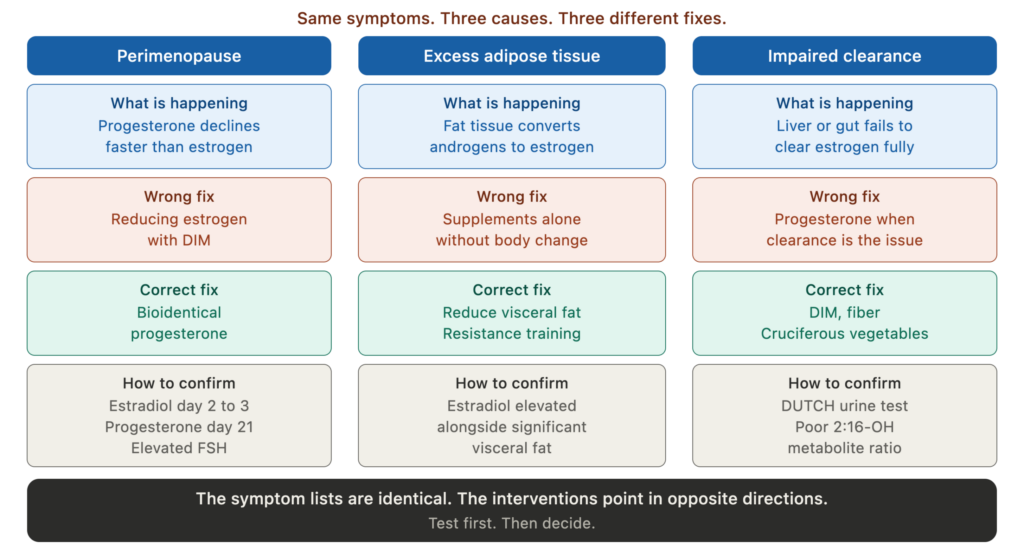
The symptom lists for perimenopause, adipose-driven estrogen excess, and impaired clearance are nearly identical. The interventions point in opposite directions. Reducing estrogen in a woman who actually has low progesterone makes the problem worse. Testing first is not optional. Source: The Endocrine Society — Female Reproductive Hormones.
When it is not: Perimenopause is not estrogen dominance
The most common misapplication of estrogen dominance is to perimenopausal women whose progesterone has declined more steeply than estrogen. This is real, and the shift in ratios produces real symptoms. But calling it estrogen dominance implies the problem is too much estrogen, which leads to the prescription of estrogen-lowering interventions (DIM, cruciferous vegetables, reduced phytoestrogen intake) when the actual problem is not enough progesterone.
The clinical intervention for perimenopausal progesterone decline is progesterone, specifically bioidentical progesterone (oral or topical), not estrogen reduction. These are opposite directions. Getting the direction right requires knowing whether the ratio shift is driven by elevated estrogen or depleted progesterone, which in turn requires measuring both. The symptom lists overlap completely. Testing does not.
The supplement industry problem
DIM (diindolylmethane) and calcium d-glucarate are the primary supplements sold for estrogen dominance. Both have legitimate mechanisms. DIM shifts estrogen metabolism toward less proliferative metabolite ratios in vitro and in some animal studies. Calcium d-glucarate inhibits gut bacterial beta-glucuronidase, which deconjugates estrogens, thereby allowing their reabsorption. These are real mechanisms with plausible clinical relevance in the specific populations where impaired estrogen metabolism is the documented problem.
The human clinical evidence that these supplements produce meaningful hormonal changes in women with normal liver function and normal gut microbiomes is much weaker than marketing suggests. They are sold to every woman with symptoms on the estrogen dominance symptom list, regardless of whether impaired estrogen metabolism is actually the mechanism driving their symptoms. Most of them, if they have any hormonal disruption at all, have perimenopausal progesterone decline. DIM does not address that.
The Livium recipe
Tool. The correct starting tool is a hormonal panel drawn at the right time in the cycle. Estradiol and progesterone measured on cycle day 21 (the mid-luteal phase, when progesterone should be at peak) give the most clinically informative picture of the estrogen-to-progesterone ratio. FSH measured on cycle days 2 to 3 indicates how hard the pituitary is working to stimulate declining ovarian function, which is an early perimenopause marker. Function Health covers the full sex hormone panel. DUTCH urine testing (dried urine testing for comprehensive hormone levels) provides estrogen metabolite data for women in whom impaired clearance is the suspected mechanism. This is the test that DIM and calcium d-glucarate are actually designed to address. A home estrogen metabolite test provides a first-pass picture before a clinical DUTCH test.
Behavior. If the issue is truly elevated estrogen from adipose tissue: reducing visceral fat is the intervention with the best evidence for reducing aromatase-driven estrogen production. Resistance training and dietary improvement are the tools. If the issue is impaired gut estrogen clearance, a diet high in cruciferous vegetables (broccoli, Brussels sprouts, cauliflower) naturally supports DIM production, and fiber supports gut microbiome diversity, which helps maintain healthy beta-glucuronidase activity. Magnesium glycinate supports liver phase II detoxification, which is relevant for estrogen clearance. If the issue is progesterone deficiency in perimenopause: see a menopause-informed provider about bioidentical progesterone. This is the intervention, not estrogen reduction.
Threshold. If your symptoms include very heavy periods (soaking a pad or tampon hourly for two or more hours), significant between-period bleeding, or pelvic pain, see a gynecologist to rule out fibroids, endometriosis, or endometrial pathology before pursuing hormonal optimization. These conditions can occur alongside hormonal imbalance but require their own clinical investigation and are not addressed by supplements.
| What you have | Mechanism | The correct intervention |
|---|---|---|
| Perimenopausal symptoms with low progesterone | Progesterone declines faster than estrogen | Bioidentical progesterone, not estrogen reduction |
| Anovulatory cycles, heavy periods | No progesterone from missed ovulation | Progesterone support, investigation of PCOS |
| Elevated estrogen with high visceral fat | Aromatase in adipose tissue producing excess estrogen | Body composition improvement; resistance training |
| Poor estrogen metabolite ratios on DUTCH testing | Impaired hepatic or gut estrogen clearance | DIM, calcium d-glucarate, cruciferous vegetables, fiber |
Source: The Endocrine Society: Female Reproductive Hormones.
Plan of action
- Get a hormonal panel before buying any supplement. Estradiol on day 21, progesterone on day 21, FSH on day 2 to 3, testosterone, and SHBG. Function Health covers all of these. Without this data, any supplement decision is based on a symptom list that could apply to a dozen different conditions.
- If your panel shows normal estrogen and low progesterone: the intervention is progesterone, not estrogen reduction. See a menopause-informed provider about bioidentical progesterone. The Menopause Society provider locator at menopause.org finds certified specialists.
- Eat cruciferous vegetables daily: broccoli, Brussels sprouts, cauliflower, kale. These provide indole-3-carbinol, the precursor to DIM, in forms better regulated by your own digestive chemistry than supplemental DIM at high doses. They also provide fiber that supports the gut microbiome, which is responsible for healthy estrogen clearance.
- If you have significant visceral fat and suspect adipose-driven estrogen elevation: Track your waist-to-height ratio as a proxy for visceral fat over time. Resistance training three times weekly, plus dietary improvements targeting visceral fat, is the most direct intervention for this specific mechanism. A CGM through Function Health helps identify the insulin patterns that drive visceral fat accumulation.
Table of Content

Know your body better.
Trusted By Thousands Daily





FAQs
Does seed cycling work for estrogen dominance?
Seed cycling involves eating specific seeds at different times in the menstrual cycle (flax and pumpkin in the follicular phase; sesame and sunflower in the luteal phase) to support hormone production and metabolism. There is no published clinical trial evidence supporting seed cycling for estrogen balance or symptom improvement. The proposed mechanisms are plausible: lignans in flaxseed can bind estrogen receptors and modulate estrogenic activity, but the doses consumed in seed cycling are unlikely to produce measurable hormonal effects. It is not harmful. It is not a clinical intervention.
Can men have estrogen dominance?
Yes. In men, the relevant estrogen is estradiol, produced primarily through aromatase conversion of testosterone in adipose tissue. Men with high visceral fat, low testosterone, or impaired liver estrogen clearance can develop elevated estradiol that produces symptoms including gynecomastia (breast tissue development), reduced libido, fatigue, and mood changes. In men on testosterone replacement therapy, estradiol rises with the increased testosterone substrate available to aromatase. Managing the testosterone-to-estrogen ratio is a standard part of TRT monitoring.
Is DIM safe to take without testing?
DIM at standard supplement doses (100 to 300 mg) has a reasonable short-term safety profile. The risk of taking it without testing is not toxicity but misdirection: if your symptoms are driven by progesterone deficiency rather than estrogen metabolism problems, DIM will do nothing for those symptoms, and you will attribute its ineffectiveness to the wrong cause, delaying the intervention that would actually help. Test first, then decide whether DIM is targeting the actual mechanism.
Legal Disclaimer
The content published on Livium Health is for informational and educational purposes only. Nothing on this site constitutes medical advice, diagnosis, or treatment. Always consult a qualified healthcare provider before making decisions about your health, including changes to medications, supplements, diet, or exercise.
Livium Health is not a medical practice and does not have a patient-provider relationship with its readers. We do not sell supplements, medications, or treatments, and we have no financial relationship with the products or services we reference.
While we work to ensure the information we publish is accurate and up to date, health and medical guidance evolves. We make no guarantees about the completeness or currency of any content on this site. Reliance on any information provided by Livium Health is solely at your own risk.
If you are experiencing a medical emergency, call 911 or your local emergency services immediately.
We may receive compensation, free products, or affiliate commissions for products mentioned in this post. Opinions are our own.