
Share
Men's Health
Thyroid Health
Women's Health
Hashimoto’s thyroiditis: The autoimmune condition most thyroid patients don’t know they have
5 min read

Key takeaways
- Hashimoto’s thyroiditis is the most common autoimmune disease in iodine-sufficient countries and the leading cause of hypothyroidism. It affects five to ten times more women than men and becomes increasingly prevalent after 30.
- The condition is detectable years before TSH rises outside the normal range. TPO antibodies (thyroid peroxidase antibodies) are present and climbing while the thyroid is still compensating and TSH appears normal. Most standard thyroid panels do not include TPO antibodies.
- People with Hashimoto’s frequently report feeling unwell even when their thyroid levels are technically normal. This is partly because the autoimmune inflammation itself produces symptoms, and partly because the standard treatment (levothyroxine) addresses thyroid hormone levels but not the autoimmune activity driving the damage.
- Selenium supplementation (200 mcg daily) is the most evidence-based non-pharmacological intervention for Hashimoto’s, with multiple RCTs showing meaningful reductions in TPO antibody levels and inflammation.
The diagnosis hiding behind a normal TSH
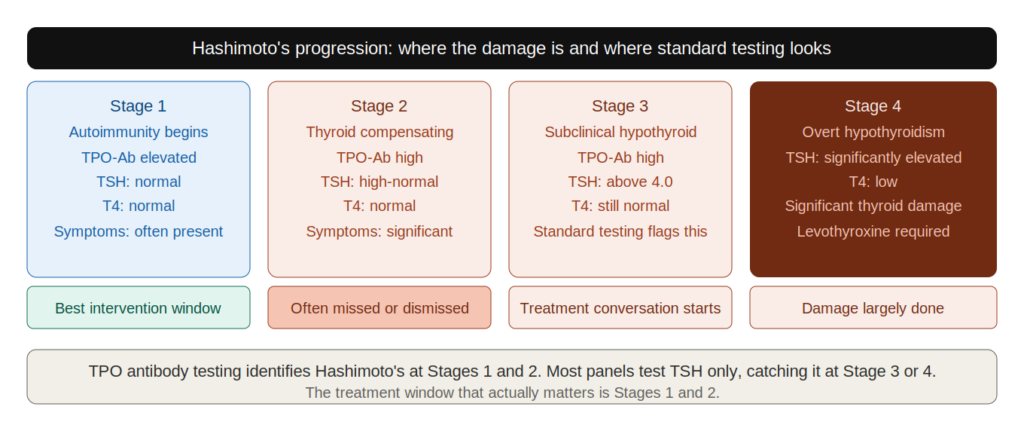
Hashimoto’s thyroiditis is an autoimmune condition in which the immune system attacks thyroid tissue through both cellular and antibody-mediated mechanisms. The destruction is slow and variable. In the early stages, the thyroid compensates by working harder, keeping TSH in the normal range and free T4 apparently adequate. The person feels the inflammation, but the labs look fine.
This is the window during which most cases of Hashimoto’s go undiagnosed. The person has elevated TPO antibodies, active autoimmune destruction of thyroid tissue, and often a full set of hypothyroid symptoms: fatigue, brain fog, cold sensitivity, weight gain, hair thinning, constipation, depression. The TSH is 2.8. Everything is fine. Except it is not.
The standard of care is to wait until TSH rises above 4.0 before treating with levothyroxine. This approach addresses the hormone deficiency resulting from Hashimoto’s. It does not address the autoimmune process causing the deficiency. The analogy: diagnosing the flooded basement but not fixing the broken pipe.
What drives it and what makes it worse
Hashimoto’s develops at the intersection of genetic predisposition and environmental triggers. The genetic component is significant: having a first-degree relative with any autoimmune thyroid disease is a meaningful risk factor. But the triggers that activate the genetic susceptibility are modifiable: vitamin D deficiency, selenium deficiency, iodine excess, gut dysbiosis, chronic stress, pregnancy, and certain infections (particularly Epstein-Barr virus) are all associated with Hashimoto’s onset or exacerbation.
Excess iodine is a counterintuitive trigger. Iodine is required for thyroid hormone synthesis, and deficiency causes thyroid problems. But excess iodine, particularly in genetically susceptible individuals, appears to accelerate autoimmune thyroid activity. High-dose iodine supplements marketed for thyroid health can worsen Hashimoto’s in this subset. Kelp supplements, which are extremely high in iodine, are a particular risk.
Why symptoms persist despite “normal” treatment
Many people on levothyroxine with “optimal” TSH still feel poorly. Quality of life studies in Hashimoto’s consistently show that patients on thyroid replacement therapy report worse quality of life than the general population, even when biochemically euthyroid. This finding has two probable explanations.
First, levothyroxine provides T4 only. Some people with Hashimoto’s have impaired T4-to-T3 conversion due to inflammation, selenium deficiency, or genetic variants in the DIO2 enzyme. They need T3 alongside T4 for complete symptom resolution, which standard levothyroxine monotherapy does not provide.
Second, the autoimmune inflammation itself has systemic effects beyond thyroid function. TPO antibodies and the inflammatory cytokines associated with active Hashimoto’s produce fatigue, brain fog, joint pain, and mood changes that are not resolved by normalizing TSH alone. Reducing the autoimmune activity, not just replacing the hormone, is the more complete treatment approach.
The Livium recipe
Tool. The complete thyroid panel: TSH, free T4, free T3, TPO antibodies, and thyroglobulin antibodies. This is non-negotiable for diagnosing Hashimoto’s and understanding the full thyroid picture. Function Health covers all of these. Selenium 200 mcg daily is the intervention with the most robust RCT evidence for Hashimoto’s: multiple trials show significant reductions in TPO antibody levels and in thyroid ultrasound abnormalities. Take it with food. Vitamin D3 2,000 to 4,000 IU daily, with vitamin K2, consistently addresses the deficiency associated with worse Hashimoto’s outcomes. Test first, supplement to adequate levels, retest at 90 days.
Behavior. Avoid high-dose iodine supplements. Read labels on any thyroid supplement before taking it. Iodine doses above 500 mcg per day can exacerbate autoimmune activity in susceptible individuals. Kelp supplements are the most common high-iodine offender. Gluten elimination for 90 days is worth trialing in Hashimoto’s, particularly for those who also have digestive symptoms or who test positive for celiac antibodies. The thyroid and intestinal mucosa share molecular structures (molecular mimicry) that may drive autoimmune cross-reactivity in gluten-sensitive individuals. Stress management and sleep are not soft recommendations here. Chronic cortisol elevation directly worsens autoimmune thyroid activity through immune dysregulation.
Threshold. If you are on levothyroxine with TSH in range and still feel poorly: ask your provider about free T3 levels and whether a T3-containing preparation (liothyronine, desiccated thyroid) might address the conversion problem. This conversation is evidence-supported and is increasingly recognized in thyroid medicine, though not universally practiced. A thyroid specialist or endocrinologist familiar with combination T4/T3 therapy is the appropriate referral if your current provider does not engage with this question.
| Intervention | Target | Evidence |
|---|---|---|
| Selenium 200 mcg daily | Reduces TPO antibodies, thyroid inflammation | Strong (multiple RCTs) |
| Vitamin D to adequacy | Immune modulation, antibody reduction | Moderate (observational plus RCTs) |
| Gluten elimination trial (90 days) | Reduces molecular mimicry trigger | Moderate (strongest for celiac-positive subset) |
| Avoid high-dose iodine | Prevents autoimmune exacerbation | Consistent observational evidence |
| T4 plus T3 therapy | Addresses conversion impairment | Moderate (RCTs in symptomatic euthyroid patients) |
Source: Mikulska et al., IJMS 2022 — Metabolic Characteristics of Hashimoto’s Thyroiditis. CC BY 4.0.
Plan of action
- Get TPO antibodies tested if you have hypothyroid symptoms and have only had TSH checked. Request the full panel explicitly: TSH, free T4, free T3, TPO-Ab, thyroglobulin Ab. If your provider will not order it, use Function Health.
- Start selenium 200 mcg daily with food. This is the most directly evidence-based adjunct for Hashimoto’s and the one with the most consistent RCT data. Give it 90 days and retest TPO antibodies.
- Check your vitamin D and optimize it. Target serum 25-OH vitamin D of 40 to 60 ng/mL. Vitamin D3 with K2 at 2,000 to 4,000 IU daily is appropriate for most adults who test deficient. Retest at 90 days.
- Read every thyroid supplement label before taking it. If it contains more than 150 mcg of iodine per dose, or is a kelp-based product, set it aside. High iodine can accelerate Hashimoto’s activity in susceptible individuals. The marketing targets the same people who should be most careful.
Table of Content

Know your body better.
Trusted By Thousands Daily




FAQs
Is Hashimoto’s the same as hypothyroidism?
No. Hashimoto’s is an autoimmune disease. Hypothyroidism is the functional deficiency that Hashimoto’s eventually causes. Many people with Hashimoto’s have normal thyroid function for years. Treating hypothyroidism addresses the downstream deficiency. Treating Hashimoto’s means also addressing the upstream autoimmune activity.
Can Hashimoto’s go into remission?
Yes, in some cases. TPO antibodies can decline significantly with selenium supplementation, vitamin D optimization, dietary intervention, and stress reduction. Remission is more likely in early-stage Hashimoto’s before significant thyroid tissue destruction has occurred. Once substantial hypothyroidism has developed, the thyroid function typically does not recover even if antibodies decrease.
Does Hashimoto’s increase cancer risk?
Hashimoto’s is associated with a modestly increased risk of thyroid lymphoma, a rare malignancy, compared to the general population. The absolute risk remains very low. It is not associated with a meaningful increase in thyroid cancer risk overall. Routine thyroid ultrasound monitoring is a reasonable surveillance strategy for long-standing Hashimoto’s with structural thyroid changes.
Legal Disclaimer
The content published on Livium Health is for informational and educational purposes only. Nothing on this site constitutes medical advice, diagnosis, or treatment. Always consult a qualified healthcare provider before making decisions about your health, including changes to medications, supplements, diet, or exercise.
Livium Health is not a medical practice and does not have a patient-provider relationship with its readers. We do not sell supplements, medications, or treatments, and we have no financial relationship with the products or services we reference.
While we work to ensure the information we publish is accurate and up to date, health and medical guidance evolves. We make no guarantees about the completeness or currency of any content on this site. Reliance on any information provided by Livium Health is solely at your own risk.
If you are experiencing a medical emergency, call 911 or your local emergency services immediately.
We may receive compensation, free products, or affiliate commissions for products mentioned in this post. Opinions are our own.