
Share
Longevity & Aging
Men's Health
Women's Health
How sleep apnea damages your hearing: The connection most ENTs don’t mention
5 min read

Key takeaways
- Adults with obstructive sleep apnea have significantly higher rates of sensorineural hearing loss than age-matched controls without apnea. Multiple studies show the association across both high and low frequencies, with high-frequency loss appearing most consistently.
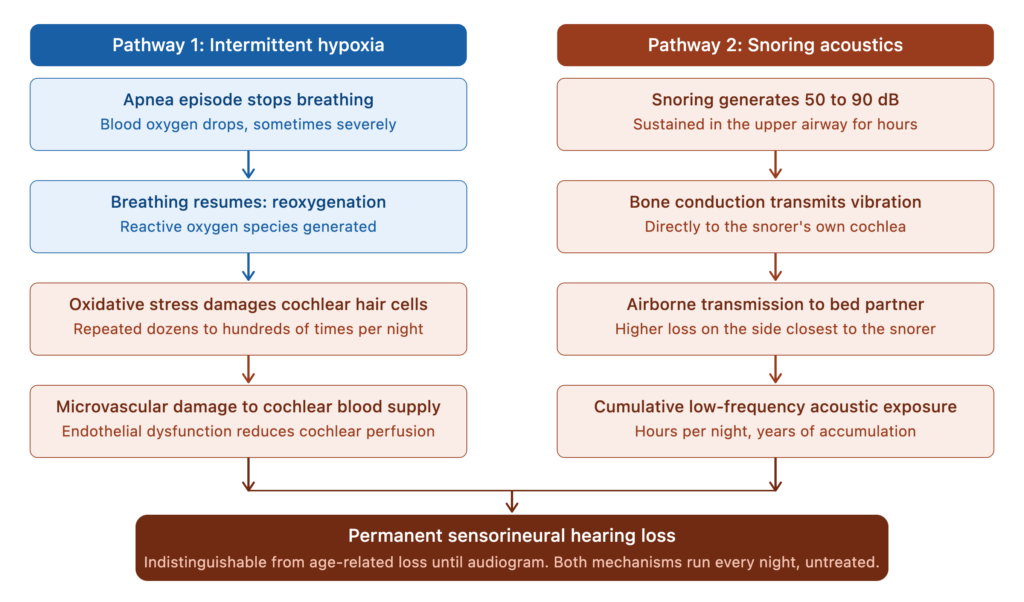
- The proposed mechanisms are intermittent hypoxia and oxidative stress. The cochlea is metabolically active and highly vulnerable to oxygen deprivation. Repeated apneic episodes throughout the night produce cycles of low oxygen followed by reoxygenation, generating reactive oxygen species that damage cochlear hair cells.
- The snoring itself may be a secondary contributor. Habitual loud snoring generates sustained low-frequency sound pressure in the upper airway that transmits to the cochlea through bone conduction. Bed partners of heavy snorers show higher rates of low-frequency hearing loss on the side closer to the snoring partner.
- CPAP treatment appears to slow the progression of hearing loss in OSA patients in preliminary research. Treating the apnea is the mechanism, and treating it early matters more than treating it late when cochlear damage is already established.
A problem hiding in the same patient
Sleep apnea and hearing loss share a patient population. Both become more prevalent with age, both are more common in men, both are associated with obesity and cardiovascular risk, and both are significantly underdiagnosed. The association between them is therefore easy to dismiss as confounding: maybe people with sleep apnea have hearing loss because they are older, heavier, and more likely to have a history of noise exposure, not because of the apnea itself.
The research has addressed this directly. Studies controlling for age, BMI, noise exposure, and cardiovascular risk still find elevated rates of hearing loss in OSA patients. Apnea severity (measured by the apnea-hypopnea index, or AHI) correlates with the degree of hearing loss: more severe apnea, more hearing impairment. That dose-response relationship is the strongest evidence against pure confounding.
The hypoxia mechanism
The cochlea is one of the most metabolically active tissues in the body. The outer hair cells, which amplify sound and sharpen frequency discrimination, are exquisitely sensitive to oxygen deprivation. The stria vascularis, the cochlear structure responsible for maintaining the ionic environment required for sound transduction, is also highly vulnerable to vascular compromise.
In obstructive sleep apnea, each apnea episode drops blood oxygen saturation, sometimes dramatically in severe cases. When breathing resumes, reoxygenation occurs rapidly, generating reactive oxygen species through ischemia-reperfusion pathways. This oxidative stress cycle, repeated dozens to hundreds of times per night over years, is the proposed mechanism for cumulative cochlear damage in OSA patients. The same mechanism explains the cochlear vulnerability in other hypoxic conditions.
The vascular component is also relevant. OSA promotes endothelial dysfunction, reduced nitric oxide availability, and microvascular disease. The cochlear blood supply is supplied by small vessels that are vulnerable to the same vascular pathology that affects the heart, brain, and kidneys in OSA. Cochlear microvascular insufficiency is likely a parallel contributor to the observed hearing loss.
The snoring noise problem
Heavy snoring generates sound pressure levels between 50 and 90 dB, sustained across hours of sleep. This is not ambient noise. It is a continuous low-to-mid-frequency sound source generated in the upper airway and transmitted via bone conduction to both the snorer’s own cochlea and, via airborne transmission, to a bed partner sleeping nearby.
A 2012 study found that bed partners of heavy snorers had higher rates of low-frequency hearing loss in the ear closest to the partner compared to the opposite ear. The snorer also showed hearing asymmetries consistent with exposure to self-generated bone-conducted sound. Hours per night, across years, add up. The sound pressure generated by snoring alone may produce cumulative acoustic trauma independent of the hypoxia mechanism.
The Livium recipe
Tool. The intervention for OSA-related hearing loss is treating the OSA. A home sleep test from Lofta diagnoses OSA without a sleep lab visit. If OSA is confirmed: a RespiraX AirSense 11 CPAP is the standard first-line treatment and has the most real-world data. For the bed partner while OSA is being diagnosed and treated: a white noise machine reduces acoustic exposure from snoring and improves partner sleep quality simultaneously. For antioxidant support during OSA treatment: N-acetylcysteine (NAC) is the antioxidant with the most cochlear-protective data in hypoxic conditions and has a reasonable safety profile at standard doses.
Behavior. If you have been diagnosed with OSA and are not using CPAP consistently, the cochlear protection argument is one more reason to use it. The cardiovascular and cognitive rationale is already strong. Add cochlear preservation to the list. If you snore heavily but have not been tested for OSA: get a home sleep test. The association between heavy snoring and OSA is strong, and the hearing data lends the conversation about snoring more urgency than it usually gets. Get a baseline audiogram alongside the sleep study. Document where your hearing is before years of further apneic exposure.
Threshold. If your apnea-hypopnea index is above 15 (moderate OSA) and you are not on treatment, the risk of cochlear damage accumulates nightly. Treatment is the intervention. No supplement, no dietary change, and no hearing protection device addresses the root mechanism. The hypoxia has to stop.
| OSA severity | AHI range | Cochlear risk | Action |
|---|---|---|---|
| Mild | 5 to 14 | Elevated vs. no OSA | Treat, baseline audiogram, annual monitoring |
| Moderate | 15 to 29 | Significantly elevated | CPAP priority, audiogram, NAC support |
| Severe | 30+ | Highest risk group | Aggressive CPAP compliance, ENT and audiology co-management |
Source: AASM Practice Guidelines: Obstructive Sleep Apnea.
Plan of action
- If you snore heavily or have suspected OSA: order a home sleep test from Lofta and book a hearing assessment at the same time. Get both baselines documented before you start treatment so you can track whether treatment is slowing the hearing loss progression.
- If you have confirmed OSA and are already on CPAP: ask your audiologist to run a pure-tone audiogram now and repeat annually. Track the high-frequency thresholds specifically. Stability or improvement in those frequencies with CPAP use is the outcome signal that treatment is protecting cochlear function.
- For the bed partner: a sleep tracking device documents snoring volume and frequency, which helps motivate the OSA evaluation conversation and provides data for the sleep study. If snoring is loud enough to wake the partner, it is loud enough to cause acoustic exposure damage over time.
- Add magnesium glycinate to your evening supplement stack if you have OSA. Magnesium reduces sympathetic activation and may improve sleep quality to a limited extent during the CPAP adjustment period. The cochlear antioxidant pathway is also supported by adequate magnesium. The primary intervention remains CPAP.
Table of Content

Know your body better.
Trusted By Thousands Daily





FAQs
Does CPAP reverse existing hearing loss from OSA?
Probably not in full. Sensorineural hearing loss from cochlear hair cell damage is permanent. The evidence suggests CPAP slows progression rather than reverses existing loss. Starting treatment earlier in the course of OSA, before significant cochlear damage has accumulated, is when the protective effect is greatest.
Is the hearing damage from snoring or from the apnea itself?
Both mechanisms appear to contribute independently. The hypoxia and vascular damage from apneic episodes affect both ears equally. The acoustic exposure from snoring produces asymmetric effects that depend on sleep position. The two mechanisms are separable, but in most patients with OSA, both are operating simultaneously.
Should I get a hearing test before starting CPAP treatment?
Yes, as a baseline. Starting CPAP and then testing 12 months later gives you a baseline to compare against. If hearing thresholds are stable or improved at follow-up, that is meaningful information about whether treatment is protecting cochlear function. If they continue to decline despite adequate CPAP use, other factors (noise exposure, age-related loss, vascular disease) may be driving the progression.
Legal Disclaimer
The content published on Livium Health is for informational and educational purposes only. Nothing on this site constitutes medical advice, diagnosis, or treatment. Always consult a qualified healthcare provider before making decisions about your health, including changes to medications, supplements, diet, or exercise.
Livium Health is not a medical practice and does not have a patient-provider relationship with its readers. We do not sell supplements, medications, or treatments, and we have no financial relationship with the products or services we reference.
While we work to ensure the information we publish is accurate and up to date, health and medical guidance evolves. We make no guarantees about the completeness or currency of any content on this site. Reliance on any information provided by Livium Health is solely at your own risk.
If you are experiencing a medical emergency, call 911 or your local emergency services immediately.
We may receive compensation, free products, or affiliate commissions for products mentioned in this post. Opinions are our own.