
Share
Gut Health
Men's Health
Women's Health
IBS diets are getting personal: Why low FODMAP may not be the final answer
4 min read

Key takeaways
- Both microbiome-guided personalization and low FODMAP improved IBS symptoms initially in the randomized trial.
- At 12 months, symptom response was more durable in the personalized-diet group in this follow-up analysis.
- The study does not validate every commercial microbiome test or personalized-diet service.
- Long-term IBS nutrition should aim to expand tolerated foods, not preserve unnecessary restriction.
The low-FODMAP diet may not be the finish line
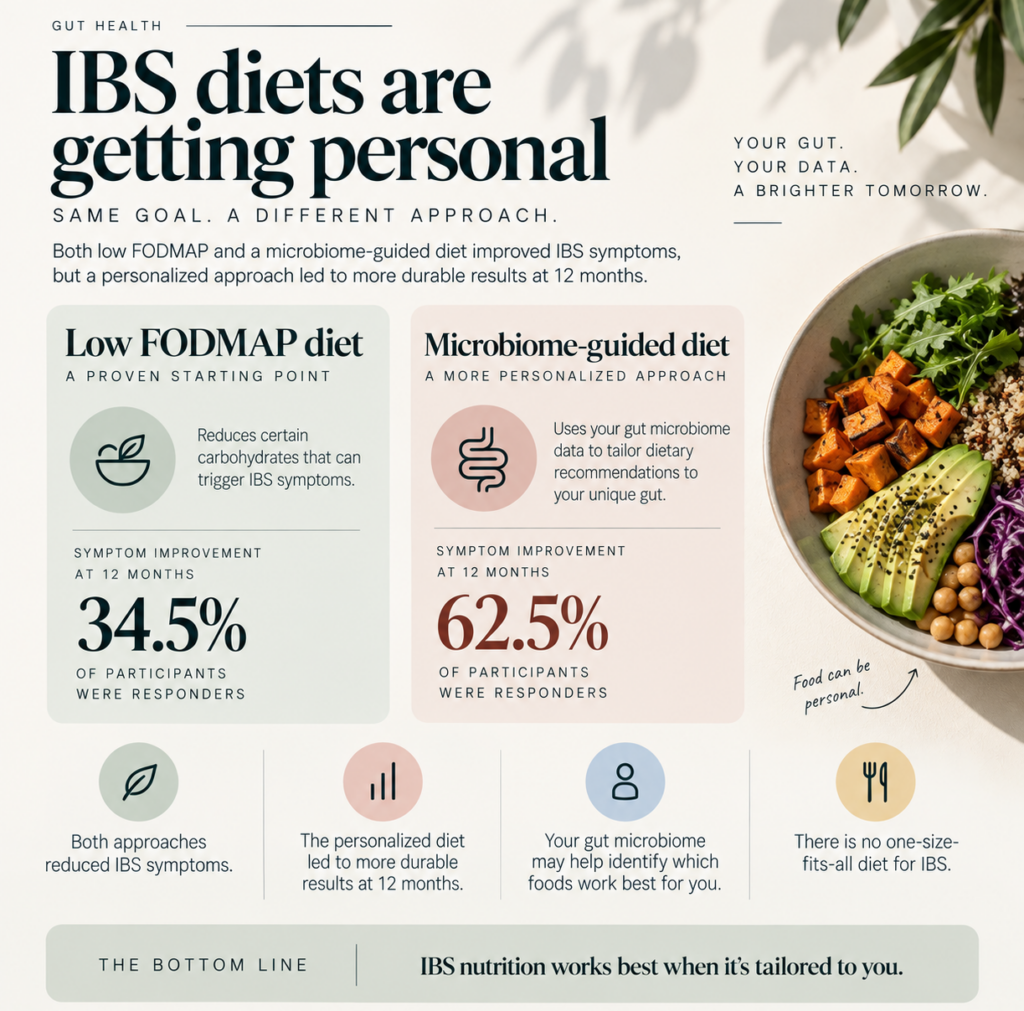
The low-FODMAP diet is one of the best-known dietary strategies for irritable bowel syndrome, but it was never meant to become a permanent list of forbidden foods. A newly published 12-month follow-up of a randomized trial raises an even more interesting question: could a microbiome-guided personalized diet hold up better over time?
Participants had previously completed six weeks of either a microbiome-guided personalized diet or a standard low-FODMAP diet. Both groups improved initially. Researchers then followed them without additional dietary intervention at six and 12 months.
The long-term curves separated
At 12 months, the personalized-diet group maintained a large reduction in IBS symptom severity, while the low-FODMAP group’s benefit had partially regressed. Responder rates were 62.5% with the personalized diet and 34.5% with low FODMAP at 12 months.
The personalized group also had more favorable quality-of-life, anxiety, and depression trajectories and showed sustained gains in one measure of microbiome diversity. The authors appropriately call the follow-up hypothesis-generating. It was not a new large trial powered specifically for every long-term outcome.
Before changing your diet, use a food and symptom notebook to identify what actually happens after meals. Memory is bad at separating a true pattern from the one terrible Tuesday you still remember.
Personalization does not mean buying a random microbiome test
The study used a specific microbiome-based algorithm inside a research protocol. It does not validate every commercial stool test, food-sensitivity panel, or app that promises a personalized gut diet.
The broader lesson is more useful: IBS diets may work better when they are built to expand rather than permanently restrict. A plain psyllium product can be useful for some people with IBS, but fiber tolerance is individual and should be increased gradually.
Meal preparation can also make controlled reintroduction easier. A portable food container lets you change one lunch component without changing the entire meal.
The Livium recipe
Tool. Keep a short food, stool, and symptom record during any elimination and reintroduction process.
Behavior. If low FODMAP helps, move toward structured reintroduction rather than assuming every restricted food is permanently unsafe.
Threshold. Weight loss, bleeding, anemia, fever, nocturnal diarrhea, or a major new bowel-pattern change are not reasons to keep experimenting with elimination diets. They deserve medical evaluation.
The goal is a wider diet that still feels good
Restriction can make symptoms easier to interpret in the short term, but a narrow diet carries its own nutritional and social costs. Long-term success should include symptom control and a diet you can actually live with.
Keep normal hydration available with a water bottle while changing fiber intake, but do not force excessive water as an IBS cure. The useful target is consistency while you learn which foods and portions are genuinely tolerable.
| 12-month outcome | Personalized diet | Low-FODMAP diet |
|---|---|---|
| IBS symptom response | 62.5% responders | 34.5% responders |
| Symptom trajectory | Benefit largely maintained | Benefit partially regressed |
| Microbiome diversity | Sustained gains reported | Less favorable trajectory |
| Interpretation | Promising long-term signal | Still effective for many people |
Source: Long-term microbiome-guided personalized diet trial, 2026.
Why long-term IBS data matters
Many IBS diets look impressive at six weeks because a controlled elimination period can reduce triggers and simplify eating. The harder test is what happens when real life returns. Restaurants, travel, family meals, cost, and nutritional variety all challenge a diet that depends on permanent restriction.
That is why the 12-month follow-up is interesting even though it is not definitive. Durability is a different outcome from short-term symptom reduction. A plan that works slightly less dramatically at first but can be maintained and expanded may ultimately be more useful than a stricter plan that slowly collapses.
Personalization should also include preferences, culture, budget, cooking ability, and nutritional adequacy. The microbiome may become one input, but it should not erase the person attached to it.
Reintroduction is where the useful information appears
The elimination phase tells you that a group of fermentable carbohydrates may be contributing to symptoms. Reintroduction tells you which foods, portions, and combinations you can actually tolerate. Without that step, the diet remains unnecessarily broad.
A person may react to a large serving of onion but tolerate a smaller amount, or struggle with one FODMAP category while doing well with another. That level of detail is what turns a temporary therapeutic diet into a sustainable eating pattern.
Plan of action
- If low FODMAP helps, plan the reintroduction phase from the beginning.
- Track portions as well as foods because tolerance can be dose-dependent.
- Do not assume a commercial microbiome test reproduces the research protocol.
- Use a dietitian or gastroenterology clinician when restriction becomes complicated.
Table of Content

Know your body better.
Trusted By Thousands Daily



FAQs
Is a personalized IBS diet better than low FODMAP?
This follow-up found more durable improvement with the study’s microbiome-guided diet, but larger long-term trials are still needed.
Should low FODMAP be permanent?
Usually no. It is generally used as a structured elimination followed by reintroduction and personalization.
Can I use a commercial microbiome test to copy this approach?
Not necessarily. The trial evaluated a specific research protocol and does not validate all consumer microbiome tests.
Legal Disclaimer
The content published on Livium Health is for informational and educational purposes only. Nothing on this site constitutes medical advice, diagnosis, or treatment. Always consult a qualified healthcare provider before making decisions about your health, including changes to medications, supplements, diet, or exercise.
Livium Health is not a medical practice and does not have a patient-provider relationship with its readers. We do not sell supplements, medications, or treatments, and we have no financial relationship with the products or services we reference.
While we work to ensure the information we publish is accurate and up to date, health and medical guidance evolves. We make no guarantees about the completeness or currency of any content on this site. Reliance on any information provided by Livium Health is solely at your own risk.
If you are experiencing a medical emergency, call 911 or your local emergency services immediately.
We may receive compensation, free products, or affiliate commissions for products mentioned in this post. Opinions are our own.