
Share
Energy & Focus
Men's Health
Women's Health
Light exposure and energy: How to use morning light and avoid the wrong kind at night
5 min read
Key takeaways
- Morning bright light exposure within 30 to 60 minutes of waking anchors the circadian clock, drives the cortisol awakening response, and sets the timing of melatonin onset that night, making it the highest-leverage single daily behavior for sustained energy.
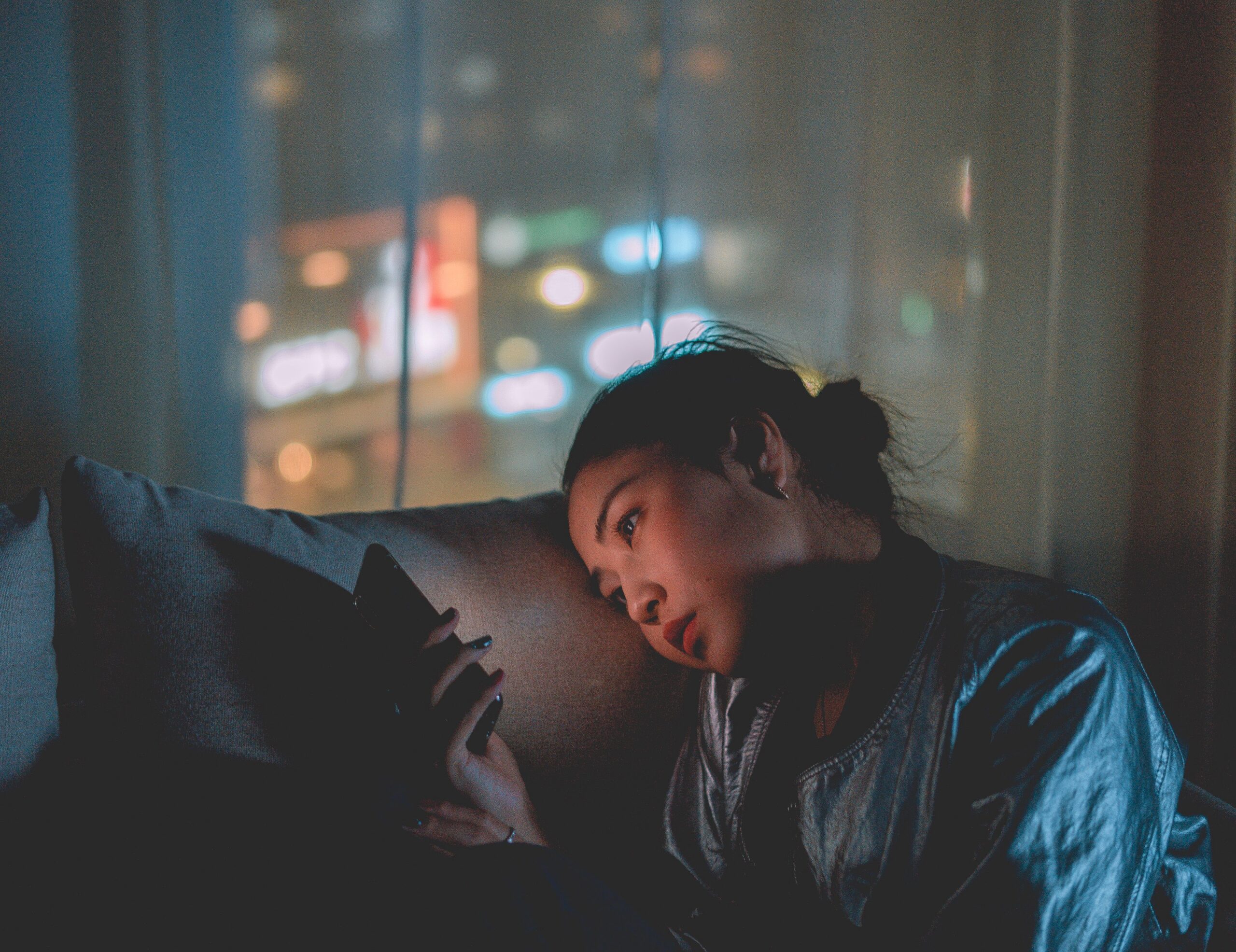
- Evening exposure to short-wavelength (blue) light from screens suppresses melatonin, delays sleep onset, and reduces sleep quality regardless of total time in bed.
- The threshold for melatonin suppression is much lower than most people assume: indoor room lighting at typical evening levels (100 to 200 lux) is sufficient to suppress melatonin by 50 percent or more.
- Outdoor light in the morning is 10 to 100 times brighter than indoor artificial light, making outside time the most effective and cheapest light intervention available.
Your brain runs on a light schedule
The suprachiasmatic nucleus (SCN), the brain’s master circadian clock, receives direct input from intrinsically photosensitive retinal ganglion cells (ipRGCs) that are maximally sensitive to short-wavelength blue light. These cells do not care whether you are looking at a phone, a TV, or the sky. They respond to light intensity and wavelength, using that information to synchronize every clock in every tissue in the body to a 24-hour schedule. Get the light inputs right, and the downstream energy, sleep, hormonal timing, and metabolic function align. Get them wrong, and none of it runs correctly.
The light problem for most modern adults is two-sided. Insufficient bright light in the morning (we wake before sunrise or go straight from the bedroom to the car to the office without outdoor exposure) means the circadian anchor signal is weak. Excessive blue-spectrum light in the evening (screens at full brightness until 11 PM) suppresses the melatonin signal that should rise around 9 PM. The result is a circadian system that is both under-stimulated at the right time and over-stimulated at the wrong time. Energy, focus, and sleep all degrade.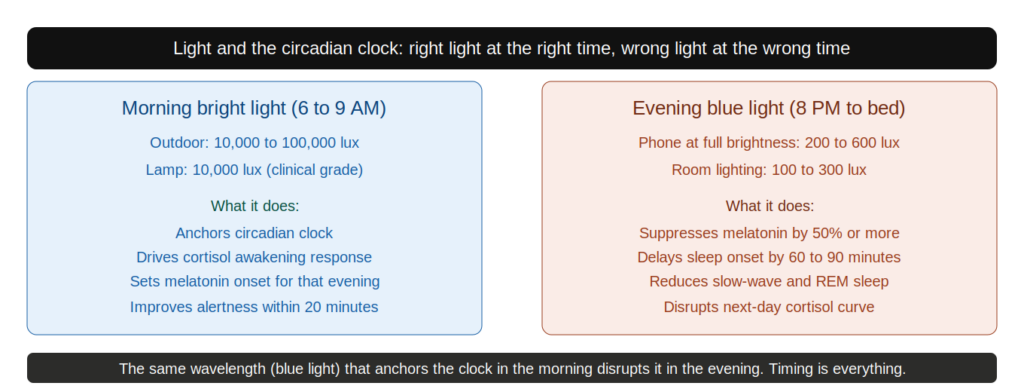
How much morning light is enough
The dose question is actually about intensity. Outdoor light on a clear morning is 50,000 to 100,000 lux. Outdoor light on an overcast morning is still 1,000 to 10,000 lux. A well-lit indoor office is 200-500 lux. The circadian system requires at least 1,000 lux for meaningful entrainment, which is why indoor lighting alone is often insufficient for circadian anchoring. Ten to fifteen minutes outside in the morning, even on a cloudy day, provides this signal. Sunglasses block it.
The evening problem is the inverse. Indoor room lighting, which ranges from 100 to 300 lux depending on fixture type and room brightness, is sufficient to significantly suppress melatonin. You do not need to be staring at a phone for the melatonin suppression to occur. Regular indoor lighting in the two hours before bed delays sleep onset. Dimming lights and shifting to warm-toned bulbs (an amber spectrum, which is low in blue-wavelength content) in the evening allow melatonin to rise at the appropriate biological time.
The Livium recipe
Tool. For morning: go outside. This is the recommendation, and it costs nothing. If outdoor morning light is genuinely inaccessible (pre-dawn work schedule, northern-latitude winter, office with no windows), a 10,000-lux light therapy lamp for 20 to 30 minutes while eating breakfast or at the desk provides the circadian signal. For evening: blue-light-blocking glasses worn for 2 to 3 hours before sleep block the short-wavelength light from screens without requiring screen elimination. Smart bulbs that shift to warm amber in the evening on a timer automate the lighting change without requiring willpower at 9 PM.
Behavior. Morning: outside within 30 minutes of waking for 10 to 15 minutes minimum. No sunglasses during this window (indirect sky viewing is sufficient; do not stare at the sun). Do this before checking your phone. Evening: dim all lights by 8 PM. Switch to warm-spectrum bulbs or lamps. Put on blue-light-blocking glasses if you continue using screens. This is not about eliminating evening activity. It is about managing the light spectrum so the circadian system gets the signals it needs at the times it needs them.
Threshold. Light therapy is the primary clinical treatment for seasonal affective disorder (SAD) and is used in phase-advance protocols for circadian disorders. If your low energy is seasonal (worse October through March), a bright light lamp used daily from September through April is a meaningful intervention. If your low energy is year-round and accompanied by mood symptoms, the light intervention is worth combining with a clinical evaluation for depression and hormonal contributors.
| Time | Light behavior | Effect |
|---|---|---|
| Within 30 min of waking | Outside 10 to 15 min (no sunglasses) | Anchors clock, drives CAR, improves alertness |
| Morning (if no outdoor access) | 10,000 lux lamp, 20 to 30 min | Clinical equivalent of outdoor exposure |
| Evening (2 to 3 hrs before bed) | Dim lights, warm spectrum bulbs | Allows melatonin to rise on schedule |
| Screen use after 8 PM | Blue-light blocking glasses | Reduces melatonin suppression without screen elimination |
Source: Hernández-Macías et al., IJERPH 2022 — Light Pollution and Circadian Misalignment. CC BY 4.0.
Plan of action
- Go outside tomorrow morning within 30 minutes of waking. Leave your sunglasses inside for the first 10 to 15 minutes. Do this for 14 consecutive days before evaluating the effect on morning alertness, afternoon energy, and evening sleepiness.
- Set all bedroom and living room lights to dim at 8 PM tonight using a timer or smart plug. This removes the willpower requirement from the behavior entirely.
- A pair of blue-light blocking glasses kept next to the sofa removes the friction from the evening screen habit. Put them on automatically at 8 PM rather than when you decide you should.
- If your energy is consistently worse October through March: start using a 10,000 lux light therapy lamp every morning from September onward. SAD responds to light therapy within two weeks and requires consistency across the darker months to maintain the effect.
Table of Content

Know your body better.
Trusted By Thousands Daily

FAQs
Does looking at the sky through a window count?
Partially. Glass filters out a significant portion of the UV and short-wavelength light content that drives the ipRGC response. Window light is better than no light, but outdoor light with the face exposed to open sky is meaningfully more effective. Even 5 minutes outside is better than 30 minutes through glass.
Do blue-light blocking glasses actually work?
Yes, for melatonin suppression reduction. Orange-tinted lenses that block 99 percent of wavelengths below 550 nm are the most effective. Clear lenses marketed as blue-light blocking provide minimal benefit. The orange-tinted glasses look absurd. They work.
What about night mode on phones?
Night mode shifts the screen color toward warmer tones but does not eliminate blue content or reduce screen brightness. It is a partial mitigation, not a full solution. Blue-light blocking glasses are more effective than night mode alone.
Legal Disclaimer
The content published on Livium Health is for informational and educational purposes only. Nothing on this site constitutes medical advice, diagnosis, or treatment. Always consult a qualified healthcare provider before making decisions about your health, including changes to medications, supplements, diet, or exercise.
Livium Health is not a medical practice and does not have a patient-provider relationship with its readers. We do not sell supplements, medications, or treatments, and we have no financial relationship with the products or services we reference.
While we work to ensure the information we publish is accurate and up to date, health and medical guidance evolves. We make no guarantees about the completeness or currency of any content on this site. Reliance on any information provided by Livium Health is solely at your own risk.
If you are experiencing a medical emergency, call 911 or your local emergency services immediately.
We may receive compensation, free products, or affiliate commissions for products mentioned in this post. Opinions are our own.