
Share
Longevity & Aging
Men's Health
Women's Health
Listening fatigue: The daily cognitive tax of unaddressed hearing loss
7 min read

Key takeaways
- Listening fatigue is the measurable cognitive exhaustion that results from the sustained effort of following speech when hearing is impaired. It is recognized in the clinical literature as a distinct and real outcome of mild-to-moderate hearing loss, separate from the tiredness that comes from a long day or poor sleep.
- Adults with unaddressed hearing loss use significantly more cognitive resources to follow conversations than peers with normal hearing in the same environment. Those resources come from the same pool used for memory, analysis, and decision-making. The tax is invisible to colleagues and often invisible to the person paying it.
- The relational cost compounds the cognitive one. When conversations are effortful, people misunderstand, respond to the wrong thing, or disengage. Partners, colleagues, and family members frequently interpret this as inattention or indifference when the mechanism is auditory, not behavioral.
- Hearing aids and assistive listening technology reduce listening effort measurably, with improvements in end-of-day fatigue reported within weeks of consistent use in multiple clinical studies.
You blame the meeting. It might be your ears
Four hours of back-to-back calls. By 3 PM, you feel as though you have run a half marathon while sitting at your desk. You know the content. You engaged the whole time. You are simply wrecked in a way that does not match the physical demand of what you just did.
Most people attribute this to meeting culture, screen fatigue, or the general depletion of a demanding job. Those are real contributors. But for adults in their 40s and 50s with mild or undiagnosed hearing loss, a significant portion of that end-of-day wreckage comes from a specific and measurable source: the cognitive cost of effortful listening sustained across an entire workday.
It does not feel like a hearing problem because the content gets through. You follow most of it. You miss some words in noisy calls, fill in gaps, move on. The perception is of normal function at slightly higher effort. The measurement tells a different story.
The cognitive load research
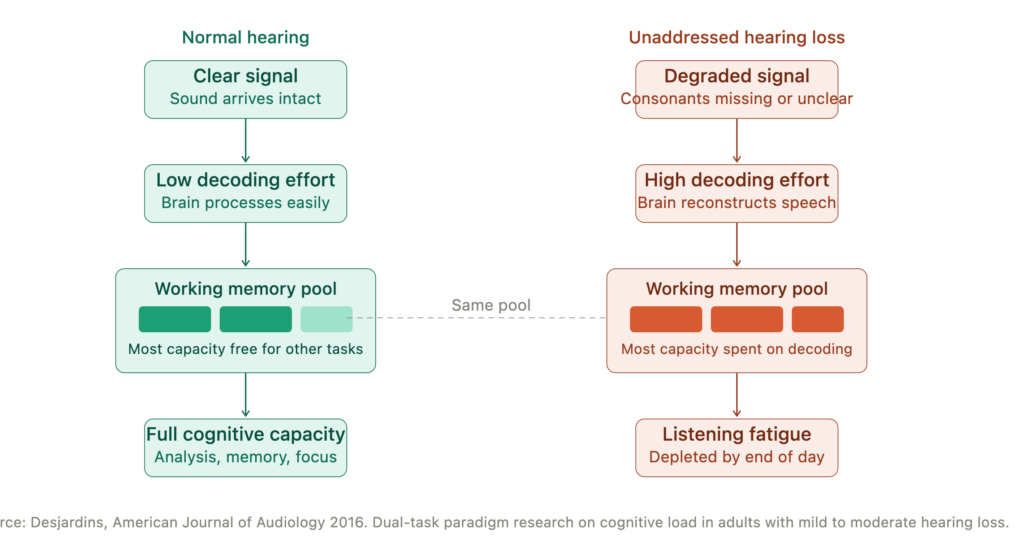
The clearest evidence comes from dual-task studies. In a dual-task paradigm, participants listen to speech while simultaneously performing a secondary cognitive task (memory recall, reaction time, visual tracking). The degradation in secondary task performance while listening reveals how much cognitive capacity listening itself consumes.
Research by Dr. Jamie Desjardins at the University of Texas at El Paso found that adults with mild to moderate hearing loss showed significantly greater degradation in secondary task performance during listening than normal-hearing adults in the same environment. The listening was consuming resources the normal-hearing adults had available for other tasks. In real terms, the person with mild hearing loss in a meeting is using cognitive resources that their normal-hearing colleague uses for analysis and memory formation.
A follow-up study by Desjardins found that when the same adults were fitted with hearing aids, their secondary task performance improved significantly, approaching the levels of normal-hearing controls. Less effort spent decoding the signal. More capacity available for everything else.
The relational cost
The cognitive cost shows up at home in a specific way. After a workday of effortful listening, the person with unaddressed hearing loss arrives home depleted in a way their partner cannot see and usually does not understand. Conversation feels like more effort. Short responses, missed questions, the TV volume going up. The partner reads it as disengagement or emotional distance. The person with hearing loss is not emotionally distant. They are cognitively spent.
AARP research on the relational impact of hearing loss consistently finds that partners of adults with unaddressed hearing loss report higher rates of loneliness, frustration, and feeling unheard in the relationship. The hearing loss affects two people, and neither of them always knows the mechanism.
Naming it changes things. When a couple understands that the end-of-day disengagement is a measurable product of cognitive depletion from effortful listening rather than indifference, the conversation about hearing aids moves from a vanity question to a practical one. It is not about whether you want to wear a device. It is about whether you want to have the energy to be present at home.
The Livium recipe
Tool. The primary tool is whatever reduces listening effort in your highest-demand environments. For adults with confirmed mild-to-moderate hearing loss: hearing aids. The OTC category (Jabra Enhance, Eargo, Lexie B, Sony CRE series) brings this under $1,500 per pair without a prescription. For calls and video conferences specifically: a USB conference speakerphone with directional microphone improves signal clarity at the source and reduces the decoding burden before it reaches your ears. For in-person meetings in poor acoustics: positioning (front and center, facing the speakers, away from noise sources) and Roger or other personal FM/telecoil systems for severe hearing loss.
Behavior. Audit your listening load. Which environments produce the most fatigue? Large group meetings with poor acoustics, open-plan offices, restaurants, phone calls without video. Once you know the specific contexts, you can address them specifically rather than managing general depletion. Schedule the most cognitively demanding solo work (writing, analysis, decision-making) in windows that do not follow high listening-load periods. Carrying high-fidelity earplugs for loud post-work environments (restaurants, transit, events) preserves the recovery window when your auditory system is already depleted. Protecting the hour after a demanding meeting from additional complex cognitive work is not laziness. It is matching your cognitive availability to the task demand. Communicate the mechanism to your partner or family. “I am worn out from a day of listening” lands differently than silence or short answers.
Threshold. If you consistently arrive home from a full workday with less energy for conversation and engagement than for physical tasks, and if this pattern is worse on days with more meetings or more complex social listening, that asymmetry is the signal. Get a hearing evaluation that includes speech-in-noise testing. If mild hearing loss is confirmed, the question is not whether to treat it but how quickly.
| Environment | Listening effort level (with mild hearing loss) | Practical mitigation |
|---|---|---|
| One-on-one in quiet | Low to moderate | Face-to-face positioning; good lighting for lip reading |
| Video call (good connection) | Moderate | Captions on; directional microphone at source |
| Group meeting (in-person, hard room) | High | Front-center seating; hearing aid with directional mic; written agenda |
| Restaurant or social event | Very high | Corner table; back to noise; hearing aid with restaurant program |
| Phone call (audio only) | High (no visual cues) | Switch to video when possible; Live Captions; hearing aid telecoil |
Source: Livium editorial synthesis based on NIDCD Hearing Loss in Older Adults and Desjardins, American Journal of Audiology (2016) dual-task research.
Plan of action
- Track your fatigue against your listening load for two weeks. On days with more than three hours of meetings or group conversations, note your energy level at 5 PM. On days with predominantly solo work, note the same. If the gap is consistent and large, the listening load is a real contributor and warrants evaluation.
- Get a hearing evaluation that includes speech-in-noise testing. Pure-tone audiometry alone can miss mild high-frequency hearing loss sufficient to produce significant listening effort in real-world noise. Ask specifically for a QuickSIN or speech-in-noise test in addition to the standard audiogram.
- If you work in a high-listening-demand environment and have not checked your hearing since your late 30s, you have no baseline. The evaluation itself takes 45 minutes and costs nothing if your insurance covers diagnostic audiology. The information changes the conversation.
- A white noise machine in the bedroom creates a consistent low-level sound floor that reduces the contrast of any tinnitus component in listening fatigue and supports sleep quality on high-demand days. Talk to your partner about the mechanism before it becomes a relational issue. The research on partners’ experiences of hearing loss is detailed: frustration accumulates silently for years before it surfaces as conflict. Naming the mechanism early reframes it as a shared problem with a practical solution rather than a character failing.
Table of Content

Know your body better.
Trusted By Thousands Daily






FAQs
Can listening fatigue happen without measurable hearing loss?
Yes. Listening fatigue is documented in adults with normal audiograms who have hidden hearing loss (cochlear synaptopathy), central auditory processing difficulties, or high cognitive load from other sources. It is also documented in adults with normal hearing who work in sustained high-noise environments. The presence of listening fatigue is a signal to evaluate further, not a definitive indication of a specific diagnosis.
Do hearing aids help with listening fatigue, even with mild hearing loss?
Yes, and this is one of the underappreciated benefits of early intervention. The Desjardins study specifically found improvements in cognitive load among adults with mild hearing loss who were using hearing aids, not just among those with moderate or severe loss. The OTC category makes this accessible at a price point that makes earlier intervention economically rational rather than waiting until loss is more severe.
Is a video better than a phone for people with hearing difficulties?
Consistently yes. For days when listening load is unavoidably high, L-Theanine 200 mg taken before high-demand call blocks reduces the anxious vigilance that amplifies listening effort without sedation or performance impairment. Video calls provide lip-reading cues, facial expressions, and gestures that supplement the degraded audio signal. Research on speech intelligibility in noise consistently shows that audiovisual speech understanding is significantly better than audio-only for adults with hearing loss. If you have a choice between a phone call and a video call, the video call is lower effort for the same content.
Legal Disclaimer
The content published on Livium Health is for informational and educational purposes only. Nothing on this site constitutes medical advice, diagnosis, or treatment. Always consult a qualified healthcare provider before making decisions about your health, including changes to medications, supplements, diet, or exercise.
Livium Health is not a medical practice and does not have a patient-provider relationship with its readers. We do not sell supplements, medications, or treatments, and we have no financial relationship with the products or services we reference.
While we work to ensure the information we publish is accurate and up to date, health and medical guidance evolves. We make no guarantees about the completeness or currency of any content on this site. Reliance on any information provided by Livium Health is solely at your own risk.
If you are experiencing a medical emergency, call 911 or your local emergency services immediately.
We may receive compensation, free products, or affiliate commissions for products mentioned in this post. Opinions are our own.