
Share
Men's Health
Mental Health
Men and therapy: Why midlife men avoid it and what changes their mind
7 min read

Key takeaways
- Men are significantly less likely than women to seek mental health treatment at every age, and the gap is widest in midlife. Men account for 80 percent of suicides in the US, the majority in the 45 to 65 age bracket.
- The barriers are well-documented and distinct from indifference: stigma about emotional vulnerability, a strong preference for self-reliance, difficulty identifying and describing emotional states, and a mental health system that was not designed with male communication patterns in mind.
- Framing matters enormously for male engagement. Men who enter therapy for a specific, solvable problem (sleep, performance, anger management, a relationship issue) engage better and drop out less than men who enter for diffuse emotional support. Meeting men where they are in their problem-solving orientation, rather than asking them to adopt a different mode, moves the needle.
- The evidence for therapy in men is identical to the evidence in women. CBT, acceptance and commitment therapy (ACT), and problem-solving therapy all produce clinically meaningful outcomes in male patients. The treatment works. The access and engagement barriers are what need to be solved.
The number that does not move
Men die by suicide at four times the rate of women. That ratio has been consistent for decades. It does not improve in proportion to general mental health awareness campaigns because the campaigns are not reaching the men who most need them, or reaching them in ways that prompt action. The men most at risk are not the ones saying they are struggling. They are the ones who say nothing at all.
Midlife is the peak risk period. The combination of declining testosterone (which has direct mood effects), career and identity pressure, relationship strain, physical health changes, and the first real confrontation with mortality creates a psychological load that many men carry with no outlet and no vocabulary for what they are carrying. The coping strategies that worked at 30 (work harder, push through, stay busy) no longer work at 47. The thing they were running from catches up.
Why men do not go
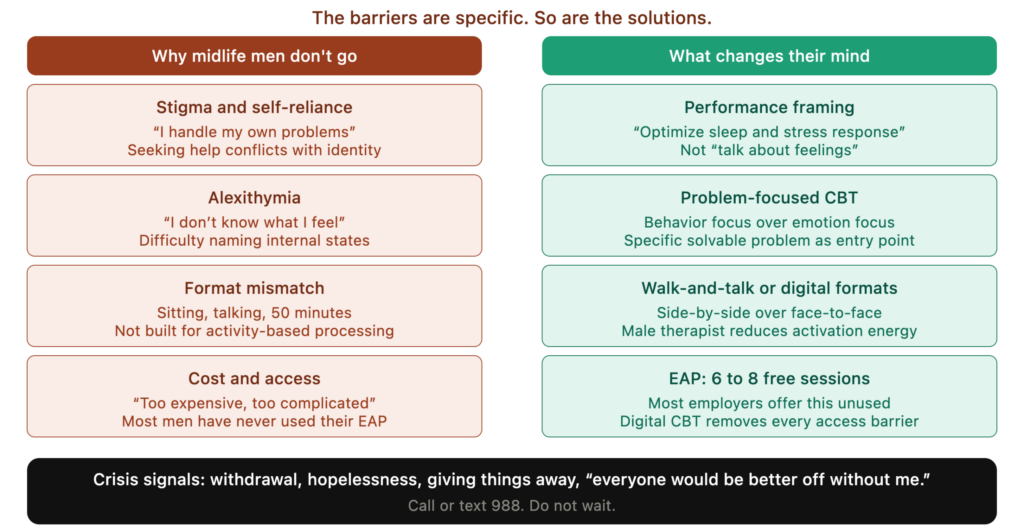
Stigma and identity. Many midlife men were raised with a model of masculinity that treats emotional difficulty as weakness. Seeking help for psychological distress conflicts with a self-image built on self-sufficiency and competence. This is not irrationality. It is a coherent value system that has been adaptive in some contexts and catastrophic in this one.
Alexithymia. Research consistently shows that men have higher rates of alexithymia, the difficulty identifying and describing emotional states. When a therapist asks “how does that make you feel?”, the honest answer for many male patients is “I don’t know.” Not because they do not feel things, but because the internal language for translating felt experience into words is less developed. Traditional talk therapy assumes a capacity that many men have not cultivated.
The format problem. Sitting across from a stranger in a quiet room talking about feelings for 50 minutes is a format optimized for a certain kind of person. It is not optimized for men whose emotional processing happens through activity, problem-solving, and side-by-side interaction rather than face-to-face disclosure. Walk-and-talk therapy, activity-based sessions, and structured problem-solving formats all show better male engagement than traditional formats.
What changes their mind
A specific problem, not a general struggle. Men who enter therapy for “I want to be a better father” or “I cannot sleep, and it is affecting my work” or “I keep losing my temper in a way I don’t want to” engage more consistently than men who enter for “I am not feeling like myself.” The problem-solving frame makes therapy legible as a tool rather than an admission of defeat.
A trusted referral. Men are significantly more likely to engage with therapy when someone they trust has done it and said it helped. The friend who says “I saw a therapist when things got bad, and it was useful” does more than any awareness campaign. This is also why male therapists often see faster initial engagement with male patients, not because women are less effective therapists, but because the shared reference point reduces the identity threat.
The health frame. Framing mental health care as performance optimization rather than symptom management removes the stigma for men who are motivated by function rather than feeling. A man who would not describe himself as depressed will often engage with “I want to improve my focus, energy, and stress management.” The therapist addresses the same underlying picture. The entry point is different.
The Livium recipe
Tool. SAMHSA’s National Helpline (1-800-662-4357) is free, confidential, and available 24 hours, and connects callers to local treatment options. For finding a therapist: Psychology Today’s therapist finder filters by male therapist, specialty (men’s issues, CBT, anger management), and insurance. For men who want a structured, asynchronous entry point before committing to therapy, a men’s mental health workbook built on CBT principles provides a problem-solving format that engages male learners. For physical activity as a therapy adjunct: a kettlebell set supports the structured physical training that research consistently shows improves depression and anxiety outcomes in men, often more reliably than men expect. The gym is not a substitute for therapy, but for many men, it is the door that opens the conversation about therapy.
Behavior. If you are a midlife man who has been avoiding this conversation: name the specific problem, not the general feeling. “I want to sleep better and stop losing my temper” is a valid entry point. You do not need to identify as depressed or anxious to benefit from talking to someone. A single session with a therapist to describe what you are dealing with and see if it is useful costs less than most people think and risks nothing. If it is not useful, stop. Most men who try it do not stop. For the man reading this about someone else: the most effective thing you can do is share your own experience with therapy if you have had one, without pressure and without framing it as something they need.
Threshold. If a man in your life is withdrawing socially, expressing hopelessness, giving away possessions, or saying things like “everyone would be better off without me”: these are emergency signals, not mood fluctuations. Call or text 988 (Suicide and Crisis Lifeline) or take him to an emergency room. Do not wait and hope it passes.
| Barrier | What it sounds like | Engagement strategy |
|---|---|---|
| Stigma | “I can handle my own problems” | Frame as performance tool, not emotional support |
| Alexithymia | “I don’t know what I feel” | CBT or problem-solving therapy; behavior focus over emotion focus |
| Format mismatch | “Sitting and talking feels wrong” | Walk-and-talk therapy, activity-based sessions, male therapist |
| Cost and access | “It’s too expensive and complicated to find someone” | SAMHSA helpline, employer EAP, digital CBT platforms |
Source: NIMH: Men and Mental Health.
Plan of action
- Name the specific problem you want to solve. Write it down. “I want to stop snapping at my kids.” “I cannot turn my brain off at night.” “I feel flat, and I do not know why.” That sentence is your entry point for searching for a therapist.
- Check your employer’s Employee Assistance Program (EAP). Most provide six to eight free therapy sessions annually. Most men have never used this benefit. It is the lowest-friction entry point and fully covers the first-cost barrier.
- If in-person feels like too much: try a structured digital program first. A CBT-based audio or app program provides the psychoeducation and skill-building of therapy at your own pace. For many men, it is the bridge that makes in-person therapy feel less foreign.
- If you have a man in your life who you are worried about: ask him directly, once, without softening it. “I have noticed you seem off lately. Are you doing okay?” Then listen without offering solutions. That question, asked sincerely, is more effective than any pamphlet. And if crisis signals are present: act immediately. Call 988 together or take him to care. The moment passes faster than the regret of not acting.
Table of Content

Know your body better.
Trusted By Thousands Daily








FAQs
Does therapy actually work for men?
Yes. The outcome data for CBT, ACT, and problem-solving therapy in male patients is equivalent to that of female patients when men engage consistently. The engagement barrier, not the treatment efficacy, is what produces worse outcomes in men at a population level.
Should I see a male therapist?
Research suggests male patients engage faster with male therapists initially, with the gap narrowing significantly once a therapeutic alliance is established. If a male therapist reduces the activation energy to start, it is worth filtering for one. Therapist fit matters more than gender once you are in the room.
How long does therapy take?
For specific problem-focused therapy (CBT for anxiety, anger management, sleep), 8 to 16 sessions is a typical evidence-based course. Ongoing therapy for more complex or chronic presentations is longer. You do not need to commit to indefinite treatment to start. Eight sessions is a reasonable trial that most men can frame as a defined project.
Legal Disclaimer
The content published on Livium Health is for informational and educational purposes only. Nothing on this site constitutes medical advice, diagnosis, or treatment. Always consult a qualified healthcare provider before making decisions about your health, including changes to medications, supplements, diet, or exercise.
Livium Health is not a medical practice and does not have a patient-provider relationship with its readers. We do not sell supplements, medications, or treatments, and we have no financial relationship with the products or services we reference.
While we work to ensure the information we publish is accurate and up to date, health and medical guidance evolves. We make no guarantees about the completeness or currency of any content on this site. Reliance on any information provided by Livium Health is solely at your own risk.
If you are experiencing a medical emergency, call 911 or your local emergency services immediately.
We may receive compensation, free products, or affiliate commissions for products mentioned in this post. Opinions are our own.