
Share
Hormones
Women's Health
Menopause without hormones: The new drugs that target the hot-flash circuit
4 min read

Key takeaways
- New nonhormonal menopause drugs target neurokinin signaling in the brain rather than replacing estrogen.
- Phase 3 randomized data show elinzanetant reduces the frequency and severity of vasomotor symptoms compared with placebo.
- The effect can begin early and also improve sleep disturbance and menopause-related quality of life in trials.
- Nonhormonal does not mean side-effect free, and medication choice still requires individualized review.
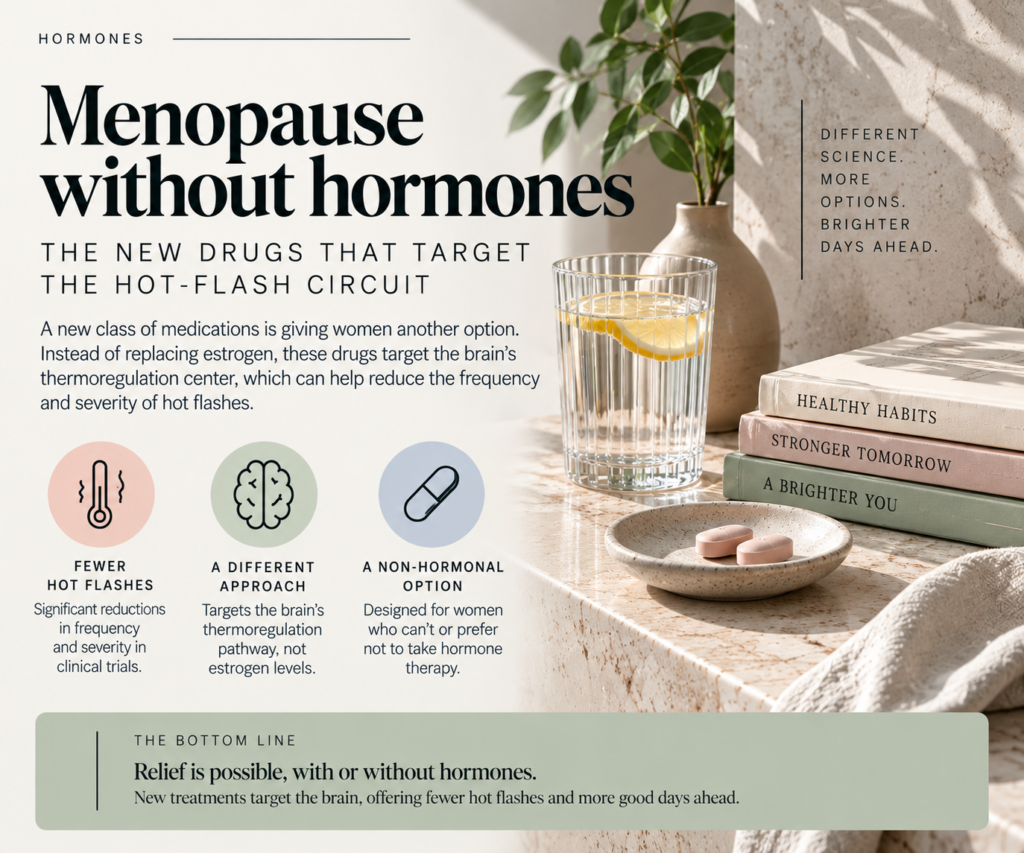
Hot flashes start in the brain’s thermostat network
Menopause lowers estrogen, but the hot flash is not simply heat produced by low estrogen. Hormonal change alters signaling in hypothalamic neurons involved in thermoregulation, narrowing the body’s comfortable temperature zone.
That biology created a new treatment target: neurokinin signaling. Instead of replacing estrogen, neurokinin antagonists act on the neural pathway that helps generate vasomotor symptoms.
A new phase 3 trial moved the field forward
In the 2025 OASIS 3 phase 3 randomized trial, elinzanetant was tested against placebo for moderate to severe vasomotor symptoms associated with menopause. The drug reduced hot-flash frequency and severity and added to a growing phase 3 evidence base for this class.
A 2025 meta-analysis covering 10 studies and 4,663 participants also found both fezolinetant and elinzanetant effective for vasomotor symptoms, with elinzanetant showing a strong efficacy signal in the pooled comparisons.
A bedside fan can still be useful for immediate comfort, but it treats the heat experience, not the neurokinin pathway.
Why this matters for women who do not use hormone therapy
Some women cannot use menopausal hormone therapy because of medical history. Others can use it but prefer not to. Historically, many nonhormonal options were medications developed for other conditions and then repurposed for hot flashes.
Neurokinin antagonists are different because they were developed around vasomotor biology. That does not automatically make them the best choice for every woman, but it expands the menu of evidence-based options.
A insulated water bottle and cooling sleep mask can make a rough night more manageable while the underlying treatment is being adjusted.
Nonhormonal is not the same as risk-free
These are prescription medications with contraindications, interactions, and monitoring considerations. Fezolinetant, for example, has specific liver-related safety requirements. Elinzanetant has its own adverse-effect profile.
The useful question is not hormones versus natural. It is which evidence-based treatment fits the symptom burden and the person’s health history.
A hot-flash diary can document frequency and severity before and after a treatment change, which makes response easier to judge.
What a useful decision looks like
Hormone decisions are rarely improved by chasing one laboratory number or one viral claim. Symptoms, goals, medical history, and the quality of the evidence all belong in the same conversation.
A useful plan also has an evaluation point. Know what outcome you are trying to change, when you will reassess it, and which side effects or new symptoms would make you contact the prescriber sooner.
The Livium recipe
Tool. Track hot-flash frequency and night-sweat disruption for two weeks.
Behavior. Ask about both hormonal and nonhormonal prescription options instead of assuming the choice is HRT or nothing.
Threshold. Medication selection and monitoring should be individualized by a qualified prescriber.
| Treatment concept | Target | What randomized evidence shows |
|---|---|---|
| Hormone therapy | Replaces estrogen signaling | Highly effective for vasomotor symptoms |
| Fezolinetant | NK3 receptor | Reduces frequency and severity |
| Elinzanetant | NK1 and NK3 receptors | Reduces symptoms and can improve sleep/QOL |
| Cooling tools | Environment | Comfort only; does not treat pathway |
Source: Panay et al., JAMA Internal Medicine, 2025.
The treatment landscape changed quickly
For years, women who did not use estrogen often heard about cooling strategies, antidepressants, gabapentin, or simply waiting for symptoms to improve. Neurokinin-targeted drugs represent a genuinely different mechanism rather than another lifestyle workaround.
That is especially relevant when night sweats are fragmenting sleep. Treating the vasomotor event itself can be more useful than endlessly optimizing bedding around repeated awakenings.
Measure the symptom, not the marketing
Before starting a treatment, estimate how many moderate or severe hot flashes occur in a typical day and how many nights per week are disrupted. Repeat the same simple measure after several weeks.
A treatment that meaningfully reduces those events is doing something concrete. That is more useful than deciding whether a drug sounds more modern, more natural, or more hormonal.
Plan of action
- Write down the specific symptom or outcome you want to improve.
- Change one major treatment variable at a time when possible.
- Use follow-up labs or symptom tracking only when they answer a defined question.
- Do not start, stop, or change prescription hormone treatment without appropriate medical guidance.
Table of Content

Know your body better.
Trusted By Thousands Daily







FAQs
What is elinzanetant?
It is a nonhormonal medication that blocks neurokinin-1 and neurokinin-3 receptors involved in menopausal vasomotor symptoms.
Does it contain estrogen?
No. It treats hot flashes through neurokinin signaling rather than hormone replacement.
How quickly can it work?
Clinical trial data have shown improvement beginning as early as the first week, with benefits sustained during treatment.
Legal Disclaimer
The content published on Livium Health is for informational and educational purposes only. Nothing on this site constitutes medical advice, diagnosis, or treatment. Always consult a qualified healthcare provider before making decisions about your health, including changes to medications, supplements, diet, or exercise.
Livium Health is not a medical practice and does not have a patient-provider relationship with its readers. We do not sell supplements, medications, or treatments, and we have no financial relationship with the products or services we reference.
While we work to ensure the information we publish is accurate and up to date, health and medical guidance evolves. We make no guarantees about the completeness or currency of any content on this site. Reliance on any information provided by Livium Health is solely at your own risk.
If you are experiencing a medical emergency, call 911 or your local emergency services immediately.
We may receive compensation, free products, or affiliate commissions for products mentioned in this post. Opinions are our own.