
Share
Men's Health
Mental Health
Women's Health
Midlife anxiety: Why it spikes after 40 and what actually helps
6 min read
Key takeaways
- Anxiety prevalence peaks in midlife. Adults 35 to 50 report higher rates of generalized anxiety than younger or older cohorts. The spike is real, not just perceived stress from busy lives.
- Hormonal change is a primary driver that most anxiety treatment ignores. Declining levels of estrogen, progesterone, and testosterone all directly affect the neurotransmitter systems that regulate the threat response. Perimenopause in particular is associated with new-onset anxiety in women who had no prior anxiety history.
- The anxiety that develops after 40 is often qualitatively different from younger anxiety. Less social anxiety, more health anxiety, financial anxiety, and existential anxiety about mortality and meaning. The content changes. The treatment approach should reflect that.
- The three interventions with the strongest evidence for midlife anxiety are aerobic exercise (effect size comparable to medication in mild to moderate anxiety), cognitive behavioral therapy (CBT), and sleep improvement. Medication is appropriate and effective when warranted but is not the default first step for situational or hormone-driven anxiety.
It is not just a busy life
The standard explanation for midlife anxiety is circumstances: more responsibilities, more at stake, more uncertainty about the future. There is truth in that. But it does not explain why anxiety rates peak specifically in midlife rather than in early parenthood or early career years, when objective stressors are often equally high. Something else is happening.
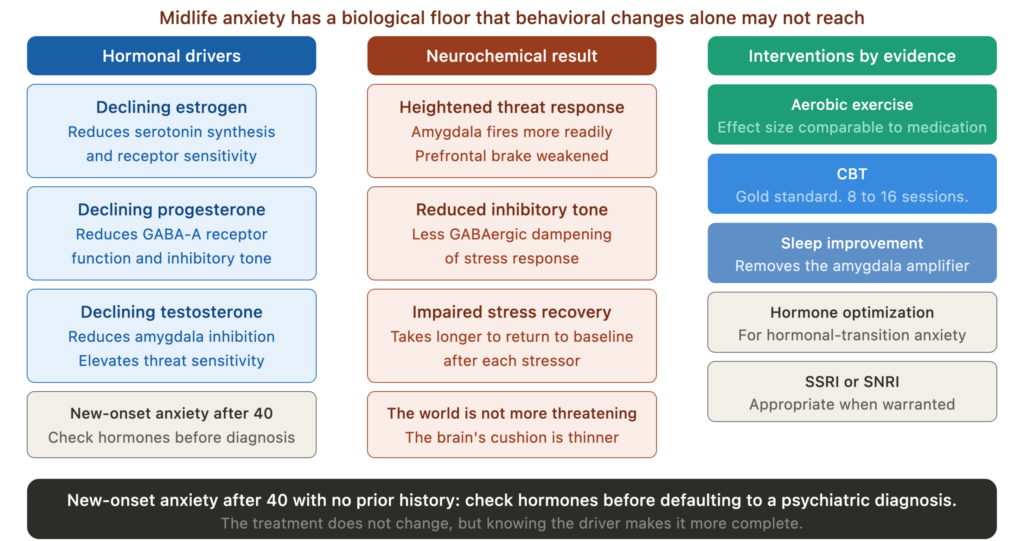
The neurobiological piece is underappreciated. GABA, the primary inhibitory neurotransmitter that puts the brake on threat response, is regulated in part by progesterone metabolites. Serotonin synthesis and receptor sensitivity are modulated by estrogen. Testosterone has anxiolytic properties through androgen receptors in the amygdala and hippocampus. When these hormones decline through the 40s, the neurochemical floor that cushions threat response drops with them. The world has not become more threatening. The brain’s capacity to absorb that threat without alarm has become thinner.
The hormonal driver most anxiety treatment misses
Perimenopause is one of the strongest triggers for new-onset anxiety in women. Research consistently shows that women with no prior anxiety diagnosis develop clinically significant anxiety symptoms during the perimenopausal transition at rates that cannot be explained by life circumstances alone. The mechanism is the fluctuating and ultimately declining estrogen and progesterone that directly affect GABA-A receptor sensitivity and serotonin availability.
In men, the testosterone decline that begins in the 30s and accelerates after 45 is associated with increased anxiety, irritability, and threat sensitivity. The relationship between low testosterone and anxiety is bidirectional: anxiety raises cortisol, which suppresses testosterone. Low testosterone raises threat sensitivity, which drives more anxiety. The loop is self-reinforcing and is often treated as a psychological problem when a hormonal workup would be the more informative first step.
New-onset anxiety after 40 in someone with no prior history is a signal to check hormones before defaulting to a mental health diagnosis. This is not instead of mental health treatment. It is part of the diagnostic picture that too often gets skipped.
What actually works
Aerobic exercise. The evidence is robust. A 2023 meta-analysis found aerobic exercise produced anxiety symptom reductions comparable to first-line medication in adults with mild to moderate generalized anxiety. The mechanism includes acute cortisol regulation, BDNF upregulation, and normalization of the HPA axis with regular training. 30 to 45 minutes of moderate-intensity aerobic exercise three to five times per week is the evidence-based dose.
Cognitive behavioral therapy (CBT). The best-evidenced psychological treatment for generalized anxiety across all age groups. In midlife specifically, CBT that addresses health anxiety and existential concerns shows meaningful benefit. The challenge is access and cost. Digital CBT programs have shown effect sizes approaching in-person therapy for mild to moderate anxiety and are significantly more accessible.
Sleep. Sleep deprivation amplifies amygdala reactivity and reduces prefrontal regulation of threat response. Anxious people sleep poorly, and poor sleep makes anxiety worse. The bidirectional relationship means treating the sleep problem is often the highest-leverage anxiety intervention available, particularly when sleep quality is objectively poor. Treating anxiety without addressing sleep is managing the symptom while leaving the amplifier running.
The Livium recipe
Tool. A hormonal panel is the diagnostic starting point for new-onset midlife anxiety. Function Health covers sex hormones, cortisol, thyroid, and inflammatory markers in a single draw. For magnesium: Thorne Magnesium Bisglycinate is the form with the best evidence for reducing anxiety symptoms; magnesium deficiency, which is common in stressed adults, directly impairs GABA-A receptor function. For ashwagandha, which has the strongest adaptogen evidence for anxiety reduction: KSM-66 standardized extract at 300 to 600 mg daily has multiple RCTs supporting anxiety and cortisol reduction. For wearable HRV tracking to monitor autonomic nervous system recovery: an HRV-capable fitness tracker provides objective data on stress load and recovery that subjective anxiety ratings miss.
Behavior. Schedule aerobic exercise before addressing anything else. This is the intervention with the most evidence and the most immediate effect. Anxiety is a physiological state. Physical exertion produces a competing physiological state that anxiety cannot coexist with at the same intensity. The 20 minutes after hard aerobic exercise is the quietest the anxious brain gets without pharmacology. Do that daily and the baseline shifts over weeks. For sleep: establish a consistent wake time first. This is the single most effective behavioral lever for improving sleep quality and the one with the least friction. Everything else in sleep hygiene is secondary.
Threshold. If anxiety is interfering with work, relationships, or daily function: see a physician or psychiatrist. Anxiety disorder is a clinical condition with effective pharmacological treatments. SSRIs and SNRIs have strong evidence for generalized anxiety disorder. Medication is not a failure. For women with perimenopausal anxiety: a menopause-informed provider who can assess and address the hormonal component is the appropriate referral. Treating perimenopausal anxiety with an SSRI alone, without addressing the estrogen component, is often an incomplete solution.
| Intervention | Evidence quality | Best for | Time to effect |
|---|---|---|---|
| Aerobic exercise | Strong (multiple RCTs) | Mild to moderate anxiety, stress-driven | Acute relief same day; baseline shift over 4 to 8 weeks |
| CBT | Strong (gold standard) | Generalized anxiety, health anxiety, rumination | 8 to 16 weeks |
| Sleep improvement | Strong (bidirectional data) | Anxiety with sleep disruption | 2 to 4 weeks |
| Hormone optimization | Moderate (perimenopause RCTs) | New-onset anxiety coinciding with hormonal transition | 4 to 12 weeks |
| SSRI or SNRI | Strong (first-line clinical) | Moderate to severe GAD, when other approaches are insufficient | 4 to 8 weeks |
Source: NIMH: Anxiety Disorders.
Plan of action
- If anxiety is new in the last one to two years and coincides with hormonal changes: get a full panel before starting any treatment. Function Health covers everything relevant in one draw.
- Start aerobic exercise this week if you are not already doing it. Thirty minutes at a pace that makes conversation difficult, five times per week. Give it four weeks before evaluating. The effect is real and dose-dependent.
- Add magnesium glycinate 400 mg in the evening. The evidence for magnesium in anxiety is moderate but consistent, the risk is essentially zero, and most adults who exercise regularly are running low on it.
- If anxiety is significantly affecting daily life: see a physician or psychiatrist this month, not eventually. Use a validated anxiety tracking app to log daily symptoms before the appointment. Objective symptom data makes the clinical conversation more productive than trying to recall how bad it has been over the past month.
Table of Content

Know your body better.
Trusted By Thousands Daily



FAQs
Is midlife anxiety different from younger anxiety?
Often yes, in content and driver. Midlife anxiety tends to cluster around health, mortality, financial security, and meaning rather than social performance or future uncertainty. The hormonal component is also more prominent after 40. The treatment approach is similar, but a provider who understands the midlife context and hormonal contribution will be more effective than one applying a generic anxiety protocol.
Can I use ashwagandha instead of medication?
For mild stress-related anxiety, ashwagandha KSM-66 has enough RCT data to be a reasonable first-line adjunct. For clinical generalized anxiety disorder, it is not a replacement for CBT or medication. The two approaches are not mutually exclusive, and the supplement does not have the adverse-effect profile that creates hesitation about pharmacological treatment.
Does anxiety increase dementia risk the way depression does?
The emerging data suggests yes, with chronic anxiety associated with elevated cortisol, hippocampal atrophy, and modestly increased dementia risk. The association is less robust than the depression-dementia link but consistent in direction. Treating anxiety is worth doing on its own terms regardless of the dementia data.
Legal Disclaimer
The content published on Livium Health is for informational and educational purposes only. Nothing on this site constitutes medical advice, diagnosis, or treatment. Always consult a qualified healthcare provider before making decisions about your health, including changes to medications, supplements, diet, or exercise.
Livium Health is not a medical practice and does not have a patient-provider relationship with its readers. We do not sell supplements, medications, or treatments, and we have no financial relationship with the products or services we reference.
While we work to ensure the information we publish is accurate and up to date, health and medical guidance evolves. We make no guarantees about the completeness or currency of any content on this site. Reliance on any information provided by Livium Health is solely at your own risk.
If you are experiencing a medical emergency, call 911 or your local emergency services immediately.
We may receive compensation, free products, or affiliate commissions for products mentioned in this post. Opinions are our own.