
Share
Men's Health
Mental Health
Women's Health
Misophonia is more than being annoyed by chewing: What the brain is reacting to
5 min read
Key takeaways
- Misophonia is decreased tolerance to specific sounds or related stimuli, not simply dislike of loud noise.
- Triggers can provoke intense anger, disgust, distress, or an urge to escape.
- Avoidance can provide short-term relief while progressively restricting daily life.
- CBT has randomized-trial evidence for reducing symptoms, although the treatment literature is still developing.
When a normal sound creates an abnormal reaction
Someone chews. A pen clicks. A person breathes through their nose. Nothing about the volume should be a problem, but your body reacts as if the sound crossed a line.
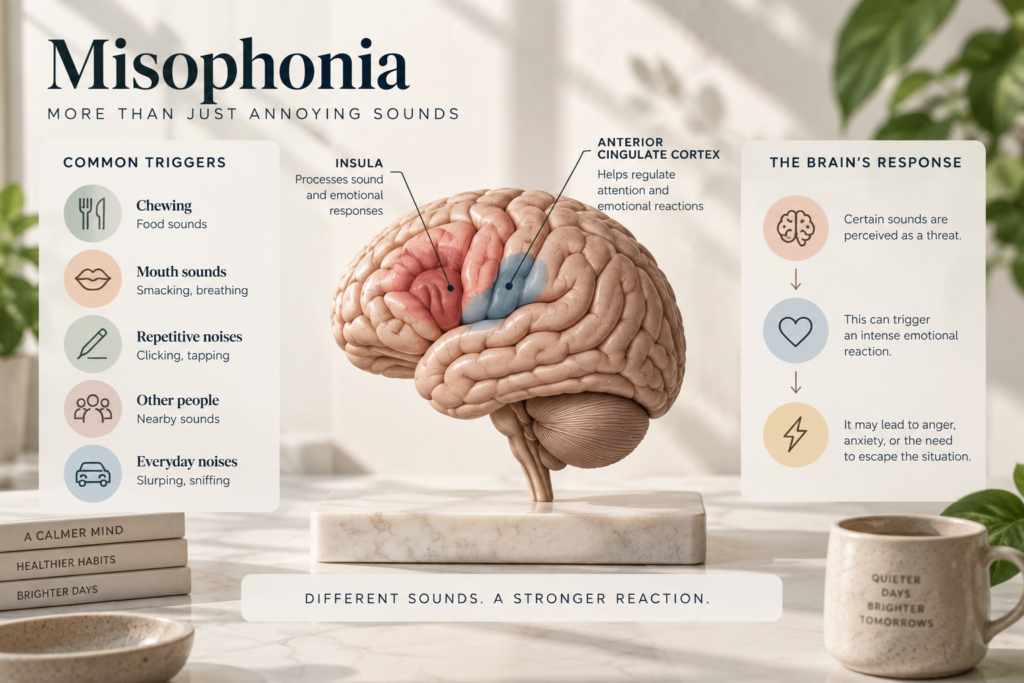
That experience has a name: misophonia. An international consensus definition describes it as decreased tolerance to specific sounds or associated stimuli. Trigger sounds can provoke anger, disgust, distress, or an immediate urge to escape, even when the sound itself is quiet.
The specificity is the clue. A blender can be objectively louder than chewing, yet chewing may feel unbearable while the blender barely registers. The reaction is tied less to decibel level than to the pattern or meaning of the trigger.
Why total sound avoidance can become its own problem
Sound control is useful when you need to function. It becomes less useful when the entire strategy is escape.
Misophonia can progressively reorganize a life. People stop eating with family, avoid offices, choose seats based on who might chew nearby, or spend enormous attention scanning for the next trigger. Escape provides immediate relief, which can make it more likely that escape becomes the default response next time.
That does not mean you should force yourself to sit beside a trigger until you are miserable. Treatment is more deliberate than that. The first randomized CBT trial for misophonia used task concentration, arousal reduction, positive affect labeling, and stimulus manipulation. Participants receiving CBT improved more than those on a waiting list, and gains persisted at follow-up.
The social piece matters too. Many common triggers are generated by other people, which means the reaction can become entangled with blame. A person may know intellectually that a partner is not chewing “at” them while still feeling immediate anger. Treating the reaction as a nervous-system problem rather than a character judgment can reduce unnecessary conflict.
Accommodation can still be reasonable. Choosing a seat farther from a trigger, using background sound during a meal, or taking a short break can preserve function. The concern is not accommodation itself. It is whether the list of situations you can tolerate keeps shrinking.
The Livium recipe
Tool. Keep sound control available without making silence mandatory. Hearing protection belongs in genuinely loud environments. A notebook can track trigger patterns. A cooling cap can be a comfort item when sensory overload comes with tension or headache, and an Owala FreeSip bottle is an easy neutral object for planned breaks. These are coping tools, not misophonia treatments.
Behavior. Track the trigger, reaction intensity from 0 to 10, what you did next, and how long recovery took. Look for context. Fatigue, stress, proximity, relationship dynamics, and feeling trapped can all change the intensity.
Threshold. If trigger sounds are changing where you eat, work, travel, or spend time with other people, the problem has moved beyond ordinary annoyance. That is the point to look for a clinician familiar with misophonia or sensory intolerance.
| Pattern | What it may suggest | Next move |
|---|---|---|
| Specific quiet sounds trigger anger or disgust | Consistent with misophonia pattern | Track trigger specificity |
| Many sounds feel painfully loud | May be a different sound-tolerance problem | Consider hearing evaluation |
| Avoidance keeps expanding | Functional impairment is increasing | Seek targeted care |
| Reaction spikes with fatigue or stress | Arousal may amplify the trigger | Track context as well as sound |
Source: Swedo et al., consensus definition of misophonia, 2022.
What we are ruling out
Misophonia is not the same as hyperacusis, where many sounds can feel excessively loud or physically uncomfortable. It is not proof of autism, ADHD, obsessive-compulsive disorder, or trauma. Those conditions can coexist, but one does not automatically explain the other.
It is also not a moral failure. The reaction can be immediate and involuntary. What remains changeable is how much of your day becomes organized around preventing the next sound.
If you are using hearing protection for hours in ordinary, safe sound environments, bring that pattern up with a clinician. The goal is not to win a toughness contest, but it is also not to let the world get progressively smaller.
What progress actually looks like
Success is not becoming indifferent to every trigger. A more realistic goal is lower intensity, faster recovery, less anticipatory scanning, and fewer situations organized around avoidance. Someone can still dislike chewing sounds while being able to finish a meal and stay connected to the people at the table.
Measure function. Count meals skipped, rooms avoided, headphones worn solely to block ordinary sounds, or arguments triggered by the reaction. Those measures tell you more than asking whether the sound still annoys you.
Plan of action
- Track five trigger episodes before buying another sound-blocking device.
- Rate intensity and recovery time, not just the sound itself.
- Separate genuinely loud environments from ordinary trigger sounds.
- Notice whether avoidance is expanding from one setting to several.
- If meals, work, relationships, or travel are being affected, look for CBT-informed care.
The decision this week. Use hearing protection for sound that needs protection. Do not automatically make total avoidance the only answer to a trigger.
Table of Content

Know your body better.
Trusted By Thousands Daily





FAQs
Is misophonia a real condition?
Yes. An international expert group developed a consensus definition describing decreased tolerance to specific sounds or associated stimuli.
Is misophonia the same as hyperacusis?
No. Misophonia is usually tied to specific trigger sounds and strong emotional reactions. Hyperacusis more often involves sounds being perceived as excessively loud or uncomfortable.
Can misophonia be treated?
Research is still limited, but cognitive behavioral therapy has shown benefit in a randomized clinical trial.
Legal Disclaimer
The content published on Livium Health is for informational and educational purposes only. Nothing on this site constitutes medical advice, diagnosis, or treatment. Always consult a qualified healthcare provider before making decisions about your health, including changes to medications, supplements, diet, or exercise.
Livium Health is not a medical practice and does not have a patient-provider relationship with its readers. We do not sell supplements, medications, or treatments, and we have no financial relationship with the products or services we reference.
While we work to ensure the information we publish is accurate and up to date, health and medical guidance evolves. We make no guarantees about the completeness or currency of any content on this site. Reliance on any information provided by Livium Health is solely at your own risk.
If you are experiencing a medical emergency, call 911 or your local emergency services immediately.
We may receive compensation, free products, or affiliate commissions for products mentioned in this post. Opinions are our own.