
Share
Longevity & Aging
Men's Health
Women's Health
mTOR, rapamycin, and the longevity drug conversation nobody is having with their GP
5 min read

Key takeaways
- mTOR (mechanistic target of rapamycin) is the master growth regulator in cells, controlling protein synthesis, cellular metabolism, autophagy, and aging rate. Chronically overactive mTOR is associated with accelerated aging, cancer, neurodegeneration, and metabolic disease.
- Rapamycin is the most potent mTOR inhibitor available, and the only drug proven to extend lifespan in multiple mammalian species, including mice started on the drug late in life at ages equivalent to 60 in humans.
- A growing number of longevity physicians are prescribing rapamycin off-label at low intermittent doses (2 to 6 mg weekly) for healthy aging. The evidence for this approach in healthy adults is preliminary; the risk-benefit conversation requires significant nuance.
- Lifestyle-based mTOR modulation through fasting, caloric restriction, low-protein cycling, and berberine provides meaningful mTOR inhibition without the immunosuppressive risks associated with pharmacological rapamycin use.
The cellular growth switch that aging keeps stuck in the on position
mTOR evolved as a sensor that integrates nutrient availability, growth factor signaling, and energy status to regulate cellular growth, metabolism, and autophagy. When nutrients are abundant, mTOR is active, driving cell growth and protein synthesis. When nutrients are scarce, mTOR is suppressed, triggering autophagy (cellular self-cleaning) and slowing growth. In youth, this switching works well. With aging, the mTOR switch becomes stuck in the active position even during periods of nutrient restriction, driving the chronic overactivation associated with cancer, neurodegeneration, insulin resistance, and accelerated aging.
Rapamycin inhibits mTORC1, the form of mTOR involved in growth signaling and autophagy suppression. When rapamycin was given to mice at 600 days of age (equivalent to roughly 60 years in humans), it extended their lifespan by 9 to 14 percent. This was the first demonstration that a drug could extend mammalian lifespan when started in middle age, not in youth. The finding has been replicated in flies, worms, and multiple mouse strains, making rapamycin the most robust lifespan-extending compound identified in multiple animal models.
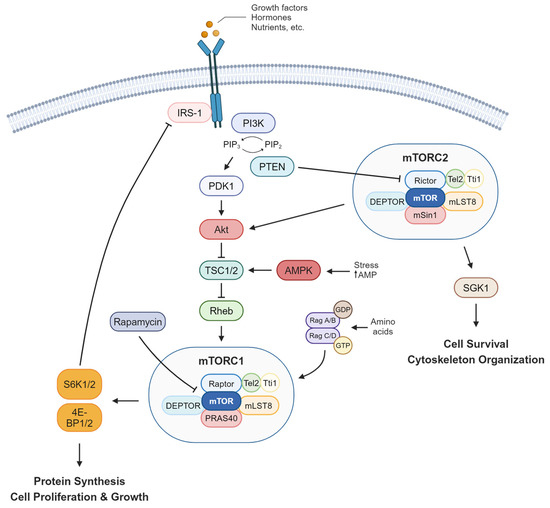
mTOR sits at the center of cellular nutrient sensing, integrating signals from amino acids, insulin, and energy status to control growth, protein synthesis, and autophagy. When mTOR runs chronically high — as it does with age and excess calories — it suppresses the cellular cleanup processes that keep tissues healthy. Rapamycin inhibits this pathway. Source: Abubaker et al., IJMS 2024, 25(11), 6141 — mTOR: Its Critical Role in Metabolic Diseases, Cancer, and the Aging Process. CC BY 4.0.
The rapamycin conversation
The off-label rapamycin movement among longevity-focused physicians is real and growing. The typical protocol is 2 to 6 mg once weekly rather than the daily high-dose regimens used for transplant immunosuppression. Weekly low-dose dosing was selected because it appears to produce mTOR inhibition with less sustained immunosuppression than daily dosing, based on the pharmacokinetics of rapamycin and the recovery of mTOR signaling between weekly doses.
The honest status of the evidence: the human longevity data from weekly low-dose rapamycin in healthy adults consists primarily of observational data from early adopters, small studies, and the preliminary PEARL trial by Rapalogs. There are no large-scale human RCTs in healthy adults. The animal data is compelling. The risk profile at low intermittent doses is likely more favorable than transplant-dose daily rapamycin but not fully characterized. This is a drug requiring a physician conversation, not a supplement decision.
The Livium recipe
Tool. The mTOR pathway is accessible through lifestyle and supplement intervention short of rapamycin. The AMPK-mTOR axis, where AMPK activation suppresses mTOR, can be activated through caloric restriction, fasting, exercise, cold exposure, and berberine. These are meaningful interventions, not consolation prizes. The magnitude of mTOR suppression is smaller than rapamycin, but the safety profile is completely different.
Behavior. Implement time-restricted eating (16-hour fast, 8-hour eating window) three to four days per week. This reliably suppresses mTORC1 through AMPK activation during the fasting period. Cycling protein intake (high protein 4 days per week, lower protein 3 days per week) provides periodic mTOR deactivation during low-protein periods. Two Zone 2 training sessions per week produce AMPK activation with durable mTOR suppression in the hours post-exercise.
Threshold. Lifestyle-based mTOR modulation does not have a convenient consumer biomarker. Proxy markers for the downstream effects: fasting insulin (mTOR drives insulin resistance; suppression improves insulin sensitivity), hs-CRP (mTOR drives inflammation), and body composition (visceral fat drives mTOR activation; reduction reflects improved mTOR regulation).
Life Extension AMPK Activator combines hesperidin and oleuropein to activate AMPK through a plant compound pathway, suppressing mTOR through the same upstream mechanism as fasting and exercise. Thorne Berberine-500 activates AMPK through AMPK kinase stimulation, producing mTOR suppression and improved glucose metabolism through mechanisms overlapping with metformin. Multiple human RCTs support berberine’s metabolic benefits. Solaray Jiaogulan Gynostemma 450 mg provides gypenosides that activate AMPK through a plant compound pathway distinct from berberine, useful for combination AMPK activation. Double Wood Supplements Spermidine activates autophagy through a pathway downstream of mTOR inhibition, producing some of the cellular cleaning effects of mTOR suppression independently.
| mTOR modulator | Mechanism | Evidence level | Accessibility |
|---|---|---|---|
| Rapamycin (weekly low-dose) | Direct mTORC1 inhibition | Strong in animals; preliminary in healthy humans | Prescription; physician required |
| Fasting (16+ hours) | AMPK activation suppresses mTORC1 | Strong human evidence for metabolic effects | No cost; no prescription |
| Berberine (500 mg 2x daily) | AMPK kinase activation | Multiple human RCTs for metabolic outcomes | OTC supplement; no prescription |
| Zone 2 exercise | AMPK activation during and post-exercise | Strong; multiple mechanisms confirmed | No cost; requires time commitment |
Source: Livium editorial synthesis based on NIA Hallmarks of Aging and Harrison et al., Nature (2009), rapamycin and lifespan.
Plan of action
- Implement time-restricted eating three to four days per week this month. The 16-hour fast is the most accessible mTOR modulation tool available and the one with the most published human metabolic benefit data.
- Add berberine 500 mg twice daily with meals. The AMPK activation from berberine combined with fasting and Zone 2 exercise produces meaningful mTOR pathway modulation through complementary mechanisms.
- If interested in rapamycin, find a physician with longevity medicine experience who can provide appropriate oversight, baseline bloodwork, and monitoring. The Healthspan Capital physician directory and AgelessRx telehealth service both offer rapamycin consultation. This is not a self-prescribe situation.
- Track fasting insulin annually. The mTOR-insulin resistance relationship means that improving mTOR regulation produces measurable fasting insulin improvement, which is the most accessible proxy for the mTOR pathway outcome of interest.
Table of Content

Know your body better.
Trusted By Thousands Daily





FAQs
Does rapamycin suppress the immune system at longevity doses?
At daily high doses used in transplant patients, yes, substantially. At weekly low doses within the longevity protocol range, the degree of immunosuppression is much lower, and there is preliminary evidence of immune rejuvenation in aged immune cells from the Novartis/Mannick trials using rapalog compounds. The immunosuppression risk is the primary reason this requires physician supervision, monitoring, and careful patient selection, excluding patients at risk of active infection or with immunocompromising conditions.
Why does mTOR suppression extend life if mTOR is needed for muscle growth?
This is the real tension in rapamycin use. mTORC1 activation after resistance training is required for muscle protein synthesis. Rapamycin timed to the post-exercise window does reduce the anabolic response to training. The longevity community’s practical solution: take rapamycin on non-training days and time resistance training sessions away from dosing. This does not fully resolve the theoretical concern but addresses it pragmatically.
Is metformin a reasonable alternative to rapamycin?
Different mechanism but overlapping goals. Metformin activates AMPK and suppresses mTOR through mitochondrial complex I inhibition. The TAME (Targeting Aging with Metformin) trial is the most important ongoing study in longevity pharmacology and will provide rigorous human data on whether metformin extends healthspan in non-diabetic adults. The evidence for longevity benefit is promising but not yet definitive from TAME.
Legal Disclaimer
The content published on Livium Health is for informational and educational purposes only. Nothing on this site constitutes medical advice, diagnosis, or treatment. Always consult a qualified healthcare provider before making decisions about your health, including changes to medications, supplements, diet, or exercise.
Livium Health is not a medical practice and does not have a patient-provider relationship with its readers. We do not sell supplements, medications, or treatments, and we have no financial relationship with the products or services we reference.
While we work to ensure the information we publish is accurate and up to date, health and medical guidance evolves. We make no guarantees about the completeness or currency of any content on this site. Reliance on any information provided by Livium Health is solely at your own risk.
If you are experiencing a medical emergency, call 911 or your local emergency services immediately.
We may receive compensation, free products, or affiliate commissions for products mentioned in this post. Opinions are our own.