
Share
Longevity & Aging
Men's Health
Women's Health
Noise-induced hearing loss at work: What OSHA’s limits miss and what you should actually track
5 min read
Key takeaways
- Occupational noise-induced hearing loss is the most common work-related illness in the US, affecting an estimated 22 million workers annually. NIOSH estimates that $242 million is spent annually on workers’ compensation for hearing loss disability.
- OSHA’s permissible exposure limit of 90 dB for an 8-hour workday is a compliance standard, not a safety standard. NIOSH recommends a stricter limit of 85 dB. At 90 dB over a full career, significant hearing damage accumulates even among workers who are technically compliant with regulations.
- The damage from occupational noise is permanent, painless, and gradual. The high-frequency notch that appears at 4,000 Hz on an audiogram is the fingerprint of noise exposure and shows up years before the loss becomes noticeable in conversation.
- The two levers that actually protect hearing are attenuation level and consistency of use. A 33 dB NRR earplug worn 50 percent of the time provides less than 3 dB of real-world protection. Full-shift, correctly fitted protection is the only approach that works.
The limit that isn’t actually protective
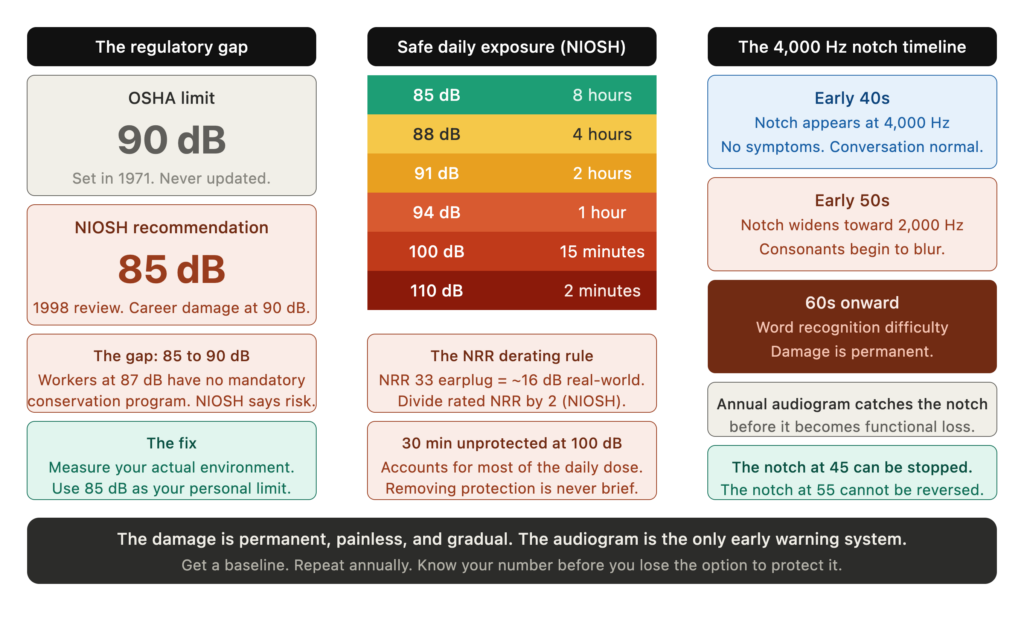
OSHA set its permissible exposure limit at 90 dB in 1971. It has not been updated since. NIOSH reviewed the epidemiological evidence in 1998 and recommended lowering the limit to 85 dB, citing evidence that career exposure at 90 dB produces significant hearing impairment in a substantial proportion of workers. OSHA has not adopted the NIOSH recommendation.
The practical difference: at 90 dB, OSHA requires hearing conservation programs. At 85 dB, NIOSH considers significant risk to begin. Workers in industries with noise levels between 85 and 90 dB are often not covered by mandatory hearing conservation programs, even though their cumulative exposure over a career will result in measurable hearing loss.
The industries most affected: construction, manufacturing, mining, agriculture, military service, and entertainment. White-collar workers with open-plan offices and constant background noise are less discussed but not exempt. NIOSH data shows that even office noise levels in the 70 to 80 dB range, sustained over years, can contribute to cumulative auditory fatigue even if they fall below damage thresholds.
The 4,000 Hz notch: What to look for on your audiogram
Noise-induced hearing loss has a characteristic audiogram signature: a dip in hearing threshold specifically around 4,000 Hz, with relative preservation at lower and higher frequencies. This notch appears because the part of the cochlea that processes 4,000 Hz sounds is disproportionately vulnerable to acoustic trauma due to its position and the cochlea’s mechanical resonance patterns.
The 4,000 Hz notch is typically asymptomatic for years. Conversation happens primarily below 4,000 Hz. The person with an early notch hears speech normally and has no complaint. By the time the loss expands to affect 2,000 and 3,000 Hz, which carry consonant sounds critical for speech clarity, the damage has been accumulating for a decade or more. This is why occupational audiometry matters: it catches the notch before the notch becomes a problem in daily life.
Why NRR ratings are misleading
The noise reduction rating printed on hearing protection packaging is measured under laboratory conditions by trained researchers who fit the device optimally. Real-world attenuation is consistently lower. NIOSH recommends applying a correction factor: divide foam earplug NRR by two to estimate real-world protection. A 33 dB NRR earplug provides approximately 16 dB of real-world attenuation for a typical user.
Consistency of use matters even more than NRR. The math on partial protection is unforgiving: removing protection for even 30 minutes of an 8-hour shift in a 100 dB environment essentially negates the protection from the remaining 7.5 hours. The ear accumulates acoustic energy across the full shift. 30 minutes of unprotected 100 dB exposure accounts for most of the permissible daily dose on its own.
The Livium recipe
Tool. A sound level meter app or dedicated decibel meter is the first tool. Knowing the actual noise level in your work environment is the baseline for every protection decision. For high-noise environments (above 90 dB), over-ear industrial earmuffs with an NRR of 30 or above provide consistent attenuation that does not depend on proper insertion technique. For moderate noise environments or situations requiring communication: high-fidelity flat-attenuation earplugs reduce volume without muffling speech, making them usable in environments where communication is required. For workers needing both protection and situational awareness: electronic hearing protection with pass-through amplification suppresses damaging impulse sounds while allowing normal conversational hearing.
Behavior. Get a baseline audiogram if you regularly work in any environment above 75 dB. This is your reference. Repeat annually. A worsening 4,000 Hz notch on serial audiograms is an early warning system that your current protection is insufficient. Do not remove protection for brief periods in high-noise environments. Brief but intense exposures account for a disproportionate share of cumulative daily dose.
Threshold. If you work in a consistently noisy environment and have never had a formal audiogram: schedule one. Occupational health clinics, ENT offices, and many audiology practices provide baseline audiometry. If your employer operates a hearing conservation program, annual audiograms are provided as part of OSHA compliance. Use them. The notch that shows up on a baseline audiogram at 45 can be prevented from widening. The notch that shows up at 55 after a decade of unmonitored exposure cannot be reversed.
| Noise level | NIOSH safe daily duration | Protection needed |
|---|---|---|
| 85 dB (heavy traffic, lawn mower) | 8 hours | Protection recommended |
| 91 dB (circular saw, motorcycle) | 2 hours | Protection required |
| 100 dB (jackhammer, nightclub) | 15 minutes | High-attenuation protection required |
| 110 dB (power tools, live music) | 2 minutes | Maximum protection, limit exposure |
Source: NIOSH: Noise and Occupational Hearing Loss.
Plan of action
- Download a decibel meter app and measure your actual work environment this week. Most smartphones give reasonably accurate readings above 70 dB. Know your number before deciding what protection is appropriate.
- If you work above 85 dB regularly and are not wearing protection consistently for the full shift: start today. The protection does not work intermittently. Correct fit matters as much as NRR rating.
- Get a baseline audiogram if you have not had one. Use it as a reference. Request a copy of the results. Annual comparison is used to track occupational hearing loss before it becomes irreversible.
- For workplaces without formal hearing conservation programs: a personal noise dosimeter worn through the shift gives an accurate measure of personal noise dose that a single spot measurement cannot provide. If your employer will not measure, measure yourself.
Table of Content

Know your body better.
Trusted By Thousands Daily






FAQs
Can noise-induced hearing loss be reversed?
No. Once cochlear hair cells are destroyed by acoustic trauma, they do not regenerate in humans. The loss is permanent. Prevention and early detection are the only tools available. Research into hair cell regeneration is active but has not produced clinical applications as of 2025.
Is tinnitus a sign of noise damage?
Often yes. Tinnitus (ringing, buzzing, or hissing in the ears) frequently accompanies noise-induced hearing loss and can precede measurable threshold shifts on the audiogram. Tinnitus after exposure to loud noise is a warning sign that the cochlea has been damaged. Repeated episodes of post-noise tinnitus predict cumulative damage even when each individual audiogram appears normal.
Do construction workers have more hearing loss than office workers?
Yes, significantly. NIOSH data shows that construction workers have among the highest rates of occupational hearing loss of any industry. Mining and agriculture also show high rates. Office workers are not at zero risk, particularly in open-plan environments with sustained background noise, but the magnitude of risk is far lower than in high-noise industries.
Legal Disclaimer
The content published on Livium Health is for informational and educational purposes only. Nothing on this site constitutes medical advice, diagnosis, or treatment. Always consult a qualified healthcare provider before making decisions about your health, including changes to medications, supplements, diet, or exercise.
Livium Health is not a medical practice and does not have a patient-provider relationship with its readers. We do not sell supplements, medications, or treatments, and we have no financial relationship with the products or services we reference.
While we work to ensure the information we publish is accurate and up to date, health and medical guidance evolves. We make no guarantees about the completeness or currency of any content on this site. Reliance on any information provided by Livium Health is solely at your own risk.
If you are experiencing a medical emergency, call 911 or your local emergency services immediately.
We may receive compensation, free products, or affiliate commissions for products mentioned in this post. Opinions are our own.