
Share
Hormones
Women's Health
Patch or pill? Why the route of estrogen changes more than convenience
4 min read
Key takeaways
- Estrogen delivered through the skin and estrogen swallowed as a pill reach the circulation differently.
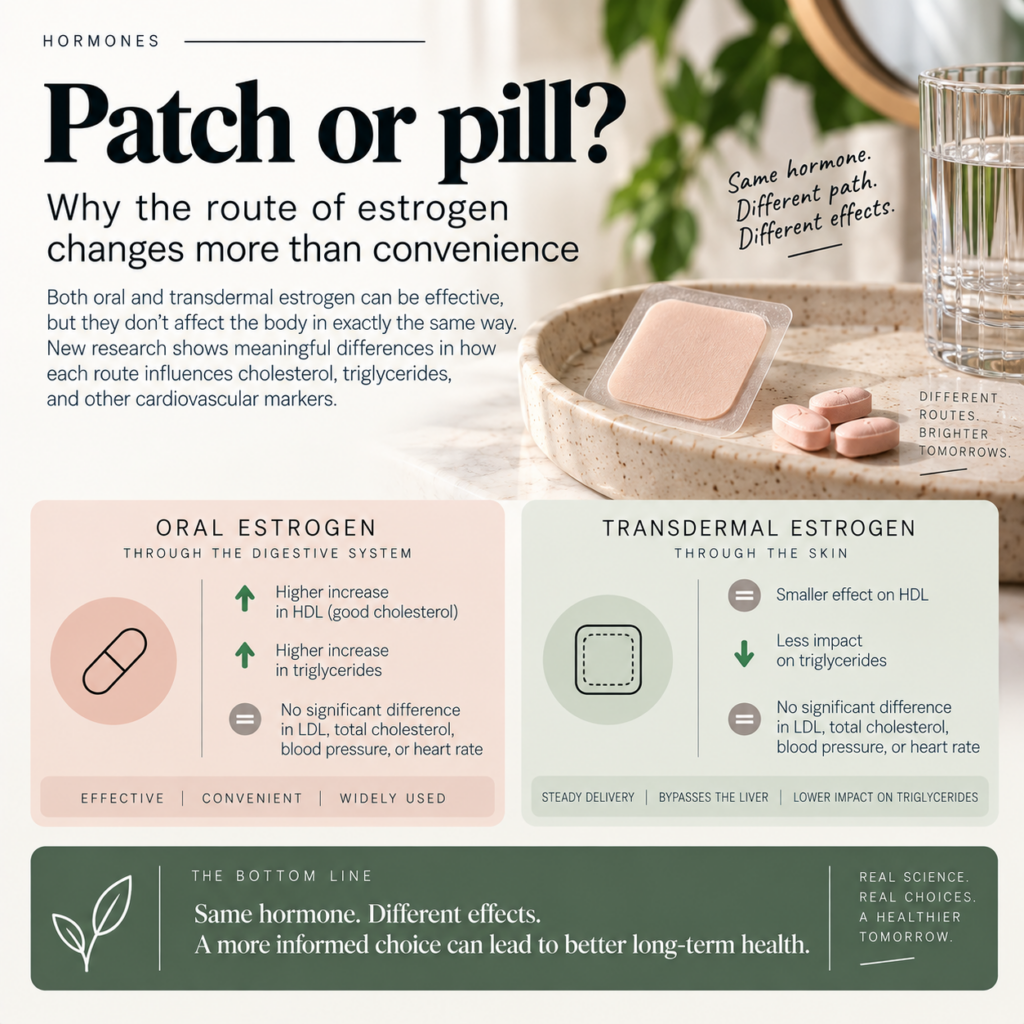
- A 2026 meta-analysis of eight randomized trials found oral estrogen raised HDL more, but also raised triglycerides more, than transdermal estrogen.
- Blood pressure, heart rate, total cholesterol, and LDL changes were not significantly different between routes in the pooled analysis.
- The best route depends on symptoms, medical history, lipid profile, preferences, and the specific prescription.
The liver sees these two routes differently
Estrogen therapy is often discussed as though the active hormone is the only variable. Route matters too. A tablet is absorbed through the gastrointestinal tract and passes through the liver before reaching the systemic circulation. Transdermal estradiol enters through the skin and largely avoids that first-pass hepatic exposure.
That difference can change downstream proteins and lipids even when both routes relieve menopausal symptoms.
The newest randomized-trial synthesis found a lipid split
A 2026 systematic review and meta-analysis included eight randomized clinical trials and 885 postmenopausal participants. Compared with transdermal estrogen, oral estrogen produced a larger rise in HDL cholesterol, but also a significantly larger rise in triglycerides.
The pooled analysis did not find significant route differences for systolic or diastolic blood pressure, heart rate, total cholesterol, or LDL cholesterol. The result is not that one route wins. It is that the metabolic profile differs.
If hot flashes are disrupting the room itself, a quiet bedside fan can help with comfort while treatment decisions are being worked out.
Symptom relief was similar in a separate 2025 trial
A randomized trial of 257 women aged 40 to 55 compared transdermal estradiol with oral estradiol valerate, with both groups also receiving cyclic micronized progesterone. Menopause-specific quality-of-life scores improved substantially with both routes over 24 weeks.
The oral group had a somewhat better vasomotor-domain result at 24 weeks, but overall symptom improvement differed little between groups. That matters because route selection can account for medical context without assuming the patch is weaker.
A symptom notebook can capture hot flashes, sleep, bleeding, headaches, and other changes between appointments without relying on memory.
Route is only one part of the prescription
Dose, estrogen formulation, whether a uterus is present, progestogen use, age, time since menopause, cardiovascular risk, migraine history, clotting risk, and personal preference all affect treatment decisions.
Do not convert a triglyceride finding into a do-it-yourself switch. Hormone therapy is prescription treatment, and changing route can require changes elsewhere in the regimen.
A sleep mask can reduce light during night-sweat awakenings, and a water bottle is useful for normal hydration, but neither addresses the underlying vasomotor physiology.
What a useful decision looks like
Hormone decisions are rarely improved by chasing one laboratory number or one viral claim. Symptoms, goals, medical history, and the quality of the evidence all belong in the same conversation.
A useful plan also has an evaluation point. Know what outcome you are trying to change, when you will reassess it, and which side effects or new symptoms would make you contact the prescriber sooner.
The Livium recipe
Tool. Bring recent lipid results and a symptom record to the prescribing conversation.
Behavior. Ask why a particular route was selected for your medical profile rather than assuming pills and patches are interchangeable.
Threshold. New chest pain, shortness of breath, unilateral leg swelling, severe neurologic symptoms, or other urgent symptoms need immediate medical evaluation.
| 2026 pooled outcome | Oral vs. transdermal estrogen | Interpretation |
|---|---|---|
| HDL cholesterol | +3.48 mg/dL greater change with oral | Oral route raised HDL more |
| Triglycerides | +19.82 mg/dL greater change with oral | Oral route raised triglycerides more |
| Blood pressure | No significant difference | Route did not separate clearly |
| LDL and total cholesterol | No significant difference | Similar pooled changes |
Source: Doma et al., Menopause, 2026.
What this does not mean
The lipid findings do not mean oral estrogen is unhealthy or that transdermal estrogen is automatically safer for every woman. HDL and triglycerides are only two pieces of cardiovascular risk, and the pooled trials were not designed to settle every safety outcome.
The useful interpretation is narrower: route changes hepatic exposure, and that can matter when a prescriber is choosing among otherwise effective options.
Bring the actual formulation to the conversation
Estradiol, conjugated estrogens, progesterone, and synthetic progestogens are not interchangeable labels. When reading research or discussing side effects, write down the exact drug, dose, and route rather than saying only that you are ‘on hormones.’
That detail makes it much easier to understand whether a study actually applies to the treatment in front of you.
Plan of action
- Write down the specific symptom or outcome you want to improve.
- Change one major treatment variable at a time when possible.
- Use follow-up labs or symptom tracking only when they answer a defined question.
- Do not start, stop, or change prescription hormone treatment without appropriate medical guidance.
Table of Content

Know your body better.
Trusted By Thousands Daily





FAQs
Is transdermal estrogen safer than oral estrogen?
Safety depends on the individual and the outcome being considered. The 2026 analysis specifically compared cardiovascular and lipid parameters, not every possible risk.
Why can oral estrogen affect triglycerides differently?
Oral estrogen passes through the liver first, which can alter hepatic protein and lipid metabolism more than transdermal delivery.
Do patches work as well for menopause symptoms?
A 2025 randomized trial found both oral and transdermal estrogen highly effective for overall menopausal symptoms, with little overall efficacy difference.
Legal Disclaimer
The content published on Livium Health is for informational and educational purposes only. Nothing on this site constitutes medical advice, diagnosis, or treatment. Always consult a qualified healthcare provider before making decisions about your health, including changes to medications, supplements, diet, or exercise.
Livium Health is not a medical practice and does not have a patient-provider relationship with its readers. We do not sell supplements, medications, or treatments, and we have no financial relationship with the products or services we reference.
While we work to ensure the information we publish is accurate and up to date, health and medical guidance evolves. We make no guarantees about the completeness or currency of any content on this site. Reliance on any information provided by Livium Health is solely at your own risk.
If you are experiencing a medical emergency, call 911 or your local emergency services immediately.
We may receive compensation, free products, or affiliate commissions for products mentioned in this post. Opinions are our own.