
Share
Energy & Focus
Women's Health
Perimenopause and the energy cliff: What’s hormonal and what isn’t
6 min read

Key takeaways
- Perimenopause begins on average around age 45 to 47 but can start in the late 30s, and its most disruptive effect on energy is not the hot flashes. It is the sleep fragmentation driven by fluctuating estrogen and progesterone that produces the fatigue, cognitive fog, and mood instability that most women in this phase attribute to stress or aging.
- Estrogen supports serotonin and dopamine signaling, mitochondrial efficiency, and insulin sensitivity. As estrogen declines erratically in perimenopause, each of these systems becomes less reliable. The result is energy that feels unpredictable: good days and crashing days with no obvious behavioral explanation.
- Progesterone, which declines earlier and more steeply than estrogen in perimenopause, has GABA-agonist properties that support deep sleep. Its decline is one of the primary drivers of the sleep disruption that precedes and underlies perimenopausal fatigue.
- Hormone therapy (HT) is the most direct intervention for hormonally-driven perimenopausal fatigue and has been significantly rehabilitated in the evidence base since the 2002 WHI study findings were reevaluated. For women under 60 and within 10 years of menopause onset, the benefit-risk profile is favorable for most.
The energy that went somewhere you did not notice
It did not arrive as a dramatic event. There was no morning you woke up exhausted when the day before you were fine. It crept in over months. The afternoon that used to be productive became the hour you were getting through rather than using. Sleep started feeling restorative despite adequate hours. Focus became harder to sustain. You attributed it to the job, the kids, the general load of being a busy adult in your mid-40s. Which was not entirely wrong, but was not the whole picture.
Perimenopause begins years before the final menstrual period, defined as the menopausal transition, and its hormonal fluctuations are erratic rather than linear. Estrogen does not simply decline. It swings: some months high, some months low, occasionally very high, then drops sharply. Progesterone generally declines earlier and more consistently. The unpredictability of the hormonal environment during this phase is precisely what makes perimenopausal energy so difficult to manage with behavioral tools alone.
The sleep connection
Most perimenopausal fatigue is downstream of sleep disruption, not upstream. Estrogen affects the hypothalamic thermoregulatory system, which maintains core body temperature stability during sleep. As estrogen declines erratically, temperature regulation becomes unstable, producing the night sweats and hot flashes that wake women in the second half of the night. Even when hot flashes are mild and not consciously noticed, they produce brief arousals that fragment sleep without full waking.
Progesterone is a neurosteroid with GABA-agonist properties, which is why synthetic progesterone (progestins) are sometimes sedating. Natural progesterone, the bioidentical form, has similar sleep-supportive properties. As progesterone declines in perimenopause, the GABAergic support for deep sleep is removed. Women in early perimenopause frequently report that they sleep the same number of hours but feel substantially less rested. The quantity is the same; the architecture has degraded.
The fatigue that follows is not amenable to behavioral sleep hygiene in the way stress-driven insomnia is, because the root cause is hormonal disruption of the sleep-regulatory system, not hyperarousal or anxiety. This is the distinction that most primary care approaches miss.
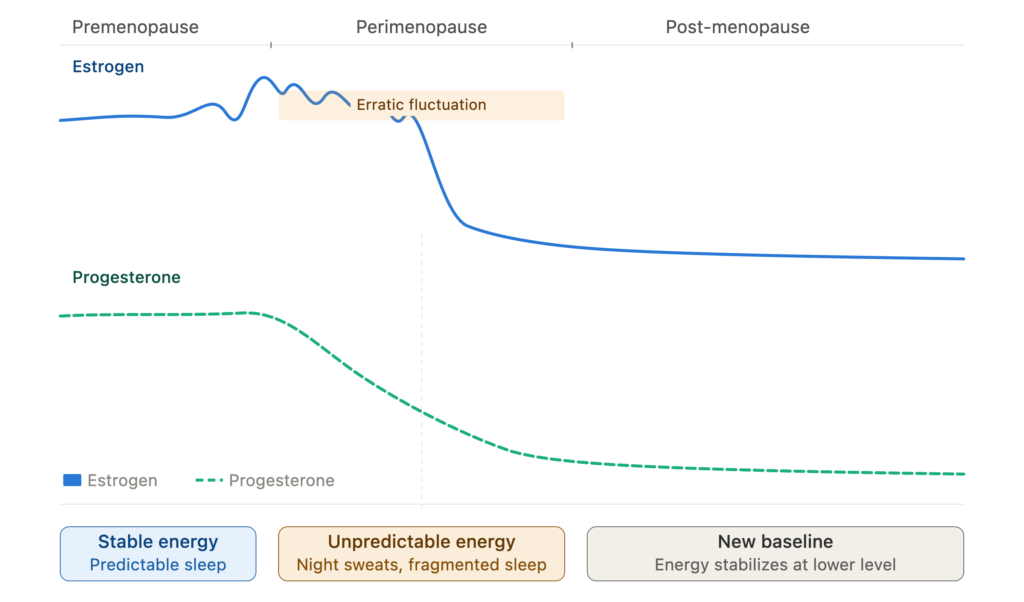
Estrogen fluctuates erratically in perimenopause before its ultimate decline. Progesterone drops earlier and more steeply, removing the GABAergic sleep support that comes with it. The energy instability of perimenopause is a downstream consequence of what happens overnight. Source: Troìa et al., JCM 2025 — Sleep Disturbance and Perimenopause: A Narrative Review.
What is hormonal and what is not
Likely hormonal: fatigue that does not track with sleep hours or stress level; cognitive fog that arrives suddenly and resolves; energy that correlates with menstrual cycle phase; sleep that is unrestorative despite adequate duration; mood instability in the week before menstruation; increased anxiety without an obvious new stressor.
Less likely purely hormonal: fatigue that clearly tracks with sleep deprivation; energy that improves predictably with rest; fatigue accompanied by weight gain and cold sensitivity (thyroid); fatigue with pallor and shortness of breath on exertion (iron deficiency anemia).
The practical problem is that perimenopause frequently coexists with thyroid dysfunction, iron deficiency, and sleep apnea in women in their 40s. All of them produce fatigue. A bloodwork panel that checks ferritin, TSH, free T3, estradiol, progesterone (on day 21 of the cycle, when progesterone should be at its peak), and FSH provides a far more informative picture than any single test in isolation. The FSH value is useful: it rises when the pituitary is working harder to stimulate increasingly resistant ovaries, making it an early marker of the perimenopausal transition, even before estrogen declines significantly.
The Livium recipe
Tool. The panel first: estradiol (days 2-3 of the cycle), progesterone (day 21), FSH, LH, ferritin, TSH, and free T3. Function Health covers the full hormonal and metabolic picture in one draw. For women whose panel confirms perimenopause and whose symptoms are significantly affecting quality of life: a conversation with a menopause-specialized provider about hormone therapy is warranted. The Menopause Society (formerly NAMS) at menopause.org maintains a provider locator for certified menopause practitioners. General gynecologists often lack the same depth of training in perimenopausal hormone management. A wearable thermometer worn at night tracks nocturnal temperature fluctuations and provides a quantified picture of the thermal instability fragmenting sleep.
Behavior. While pursuing clinical evaluation: magnesium glycinate 300-400 mg at bedtime supports GABA signaling and partially compensates for the loss of progesterone-driven GABAergic sleep support. It will not replace progesterone, but it noticeably improves sleep quality in many perimenopausal women. Alcohol significantly worsens night sweats and temperature instability and should be reduced or eliminated during the evaluation period. Resistance training three times weekly supports insulin sensitivity, mood, and body composition in ways that become increasingly important as estrogen declines. Cool sleeping environment: room temperature at 65 to 68°F (18 to 20°C) reduces the thermal triggering of night-time vasomotor events. An active cooling mattress cover is the highest-leverage bedroom change for women with significant night sweats.
Threshold. If perimenopausal symptoms are significantly affecting sleep, energy, cognitive function, or mood: hormone therapy is not a last resort. The 2002 WHI study that scared a generation of women and clinicians away from hormone therapy used conjugated equine estrogen and synthetic progestin in postmenopausal women, not bioidentical estradiol and progesterone in perimenopausal women. The risk profile of the studied population and formulations does not apply to younger perimenopausal women on body-identical hormones. A well-informed conversation with a menopause specialist is worth having before spending years managing symptoms without addressing their cause.
| Hormone | What it does for energy | What its decline produces | Primary intervention |
|---|---|---|---|
| Estradiol | Dopamine and serotonin support; mitochondrial efficiency; thermal regulation | Night sweats; cognitive fog; unpredictable energy; mood instability | Estradiol hormone therapy; sleep environment optimization |
| Progesterone | GABA-agonist; supports deep sleep architecture | Unrestorative sleep; anxiety; increased evening cortisol | Bioidentical progesterone at bedtime; magnesium glycinate |
| Testosterone (women) | Drive, motivation, muscle maintenance | Reduced motivation; muscle loss; fatigue | Low-dose testosterone therapy (off-label); resistance training |
Source: The Menopause Society: Dealing with the Symptoms of Menopause.
Plan of action
- Run the full hormonal panel: estradiol (day 2 to 3 of cycle), progesterone (day 21), FSH, LH, ferritin, TSH, and free T3. Do not accept a single total estrogen measurement as the complete picture. The cycle timing of the draw matters. Function Health covers this in a single panel.
- Start magnesium glycinate 300 mg at bedtime this week. It is low-risk, supports GABA and sleep architecture, and noticeably improves sleep quality for many women in perimenopause within one to two weeks.
- If fatigue is significantly affecting your daily function: find a menopause-certified practitioner. The Menopause Society provider search at menopause.org locates certified specialists. The clinical conversation about hormone therapy should happen with someone who is current on the evidence, not relying on guidance from 2002.
- Eliminate alcohol during the evaluation period. Alcohol significantly worsens vasomotor symptoms and further disrupts sleep architecture. The effect is dose-dependent and reverses quickly; even two weeks without alcohol produces measurable improvement in night-time temperature stability and sleep quality.
Table of Content

Know your body better.
Trusted By Thousands Daily




FAQs
How do I know if I am in perimenopause?
Perimenopause is diagnosed clinically, not from a single lab value. The diagnostic markers include irregular menstrual cycles (cycles that vary by 7 or more days from the usual length), vasomotor symptoms (hot flashes, night sweats), sleep disruption, and in some women, mood changes and cognitive symptoms. An elevated FSH (10-12 IU/L on cycle days 2-3) supports the diagnosis. But FSH can fluctuate significantly in perimenopause, which is why a single FSH value is not definitive. The symptom pattern and cycle irregularity are often more reliable clinical indicators than a single blood test.
Is hormone therapy the same as hormone replacement therapy?
The terminology has shifted. HRT (hormone replacement therapy) has largely been replaced by HT (hormone therapy) in clinical guidelines because the word “replacement” implies restoring hormones to premenopausal levels, which is not the goal. Modern HT uses the lowest effective dose to manage symptoms. The formulations also matter: transdermal estradiol (patch or gel) has a more favorable cardiovascular risk profile than oral estrogen because it bypasses first-pass liver metabolism. Bioidentical (body-identical) progesterone has a better safety profile than synthetic progestins. These distinctions are why the clinician’s expertise matters.
What about black cohosh and other herbal options for perimenopausal symptoms?
Black cohosh has the most published trial data among herbal options for vasomotor symptoms, but the results are inconsistent. A 2012 Cochrane review found some evidence for short-term symptom reduction but noted the quality of the evidence was low. It has a plausible mechanism (serotonergic rather than estrogenic) and may reduce hot flash frequency modestly in some women. It is not equivalent to estrogen in effectiveness and should not be used as a substitute for HT in women with significant symptoms. Phytoestrogens (soy isoflavones) have similarly modest and inconsistent evidence. Neither addresses the sleep disruption that underlies most perimenopausal fatigue.
Legal Disclaimer
The content published on Livium Health is for informational and educational purposes only. Nothing on this site constitutes medical advice, diagnosis, or treatment. Always consult a qualified healthcare provider before making decisions about your health, including changes to medications, supplements, diet, or exercise.
Livium Health is not a medical practice and does not have a patient-provider relationship with its readers. We do not sell supplements, medications, or treatments, and we have no financial relationship with the products or services we reference.
While we work to ensure the information we publish is accurate and up to date, health and medical guidance evolves. We make no guarantees about the completeness or currency of any content on this site. Reliance on any information provided by Livium Health is solely at your own risk.
If you are experiencing a medical emergency, call 911 or your local emergency services immediately.
We may receive compensation, free products, or affiliate commissions for products mentioned in this post. Opinions are our own.