
Share
Men's Health
Nutrition
Women's Health
Protein timing: When you eat it matters as much as how much
7 min read

Key takeaways
- Total daily protein intake is the most important protein variable for muscle protein synthesis and retention. Timing is a secondary variable with real but smaller effects. The timing debate matters more after 40 because anabolic resistance (the blunted muscle protein synthesis response per gram of protein) makes optimizing every available lever more important.
- Muscle protein synthesis is maximally stimulated by approximately 25 to 40 g of high-quality protein per meal in younger adults. In adults over 40, this threshold shifts upward: older muscle requires a larger bolus to achieve the same synthetic response, due to both anabolic resistance and slower amino acid absorption kinetics. Spreading 160 g of protein evenly across four meals is more effective than concentrating it in one or two large doses.
- A protein dose of 25 to 40 g within two hours of resistance training produces a modest but measurable additional anabolic stimulus beyond what total daily intake alone would achieve. This effect is most pronounced in older adults and in people with lower baseline protein intakes. For already high protein consumers, the training window effect is smaller.
- Pre-sleep protein (40 g of casein or a mixed whole food protein source 30 to 60 minutes before bed) stimulates overnight muscle protein synthesis and improves next-morning muscle protein balance. The overnight fasting period is the longest protein gap in most adults’ days, and filling it produces measurable anabolic benefit without disrupting sleep quality.
The question under the question
Most adults who are thinking about protein are thinking about quantity. How much do I need? The answer to that question has become clearer in the past decade: significantly more than government RDA recommendations, which are designed to prevent deficiency rather than to optimize muscle maintenance in aging adults. The evidence increasingly points to 1.6-2.2 g of protein per kg of body weight per day for adults who exercise and want to preserve or build muscle mass.
Fewer people are thinking about distribution: how that protein is spread across the day, and whether the timing relative to meals, training, and sleep matters. The answer is that it does, and the importance of distribution increases with age. When the anabolic machinery becomes less responsive to protein stimulation, getting maximum stimulus from each protein feeding becomes more important. This is the argument for protein timing in midlife that does not apply as strongly in the 20s.
How muscle protein synthesis actually works
Muscle protein synthesis (MPS) is the process by which muscle tissue is built and repaired. It is stimulated by two primary inputs: amino acids from dietary protein (particularly leucine, which directly activates the mTOR pathway) and mechanical loading from resistance training. The two stimuli are additive and synergistic.
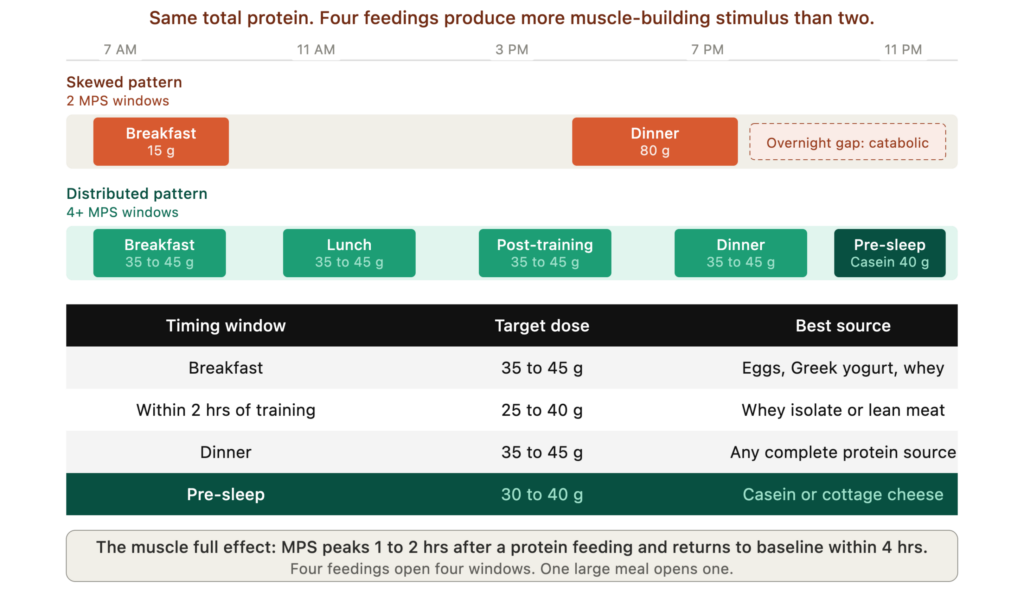
MPS is not continuously elevated after a meal. It is stimulated by aminoacidemia (rise in blood amino acid levels) that follows protein ingestion, peaks approximately 1 to 2 hours after eating, and returns to baseline within 3 to 4 hours, regardless of whether digestion is complete. This is called the muscle full effect: once the synthetic machinery has been maximally activated by a given amino acid stimulus, additional amino acids do not prolong the elevated rate of synthesis. They are either oxidized for energy or contribute to other metabolic processes.
The practical implication is that a single 160 g protein meal activates MPS once. Four 40 g protein meals spaced four to five hours apart activate MPS four times. The total protein is identical; the muscle-building stimulus is significantly greater with the distributed pattern.
The training window
Resistance training sensitizes muscle to protein for approximately 24 to 48 hours post-exercise. During this window, muscle protein synthesis rates are elevated, and the anabolic response to protein ingestion is enhanced. The practical implication is that protein consumed in the hours surrounding a training session produces more MPS per gram than protein consumed at other times of day.
The specific “anabolic window” of 30 to 45 minutes post-workout that dominated supplement marketing for years has been substantially revised downward in importance. A meta-analysis by Brad Schoenfeld (2013, Journal of the International Society of Sports Nutrition) found that when total daily protein is adequate, the timing effect of protein relative to training is small. The window is real but measured in hours, not minutes, and the magnitude of the effect is modest compared to total daily intake.
For older adults, the data are more favorable to peri-workout protein: multiple studies, specifically in adults over 60, find a larger relative benefit of training-adjacent protein than in younger populations. This is mechanistically consistent with anabolic resistance: if the response to protein is blunted at baseline, then timing interventions to optimize the sensitivity window yields greater relative benefit.
Pre-sleep protein: The overnight opportunity
The overnight period, typically seven to nine hours, is the longest protein gap in most adults’ days. During this period, muscle is in net catabolic balance: protein breakdown exceeds synthesis because no amino acid stimulus is arriving. Pre-sleep protein directly addresses this gap.
Research by Luc van Loon’s group at Maastricht University established that 40 g of casein protein consumed 30 minutes before sleep is digested and absorbed overnight, maintaining elevated plasma amino acid levels for up to 7 hours, stimulating overnight MPS, and improving whole-body protein balance the following morning. Casein is recommended for pre-sleep because its slower digestion rate maintains aminoacidemia throughout the night rather than the rapid peak and return of whey.
This finding is particularly relevant for older adults losing muscle: the overnight period is when age-related net catabolism is most pronounced, and pre-sleep protein is a direct intervention at that inflection point. Multiple RCTs have confirmed that regular pre-sleep protein supplementation improves muscle mass and strength outcomes over periods of weeks to months in older adults.
The Livium recipe
Tool. The protein-tracking app (Cronometer, MacroFactor, or similar) is the most useful first tool because most people significantly overestimate how much protein they consume and underestimate how unevenly it is distributed. Run one week of honest tracking before implementing any timing strategy. You need the baseline. A high-quality whey protein isolate for peri-workout and morning use: fast-absorbing, high leucine content, optimal for the training window and for breaking the overnight fast. Casein protein for pre-sleep use: slow-digesting, maintains amino acid availability overnight. If you prefer whole foods over supplements, cottage cheese (high in casein) or Greek yogurt is an effective pre-sleep protein source in 150 to 200 g portions.
Behavior. Four protein feedings per day, each containing 35 to 45 g of protein, spaced 4 to 5 hours apart. This yields the maximum number of MPS-stimulating events per given daily protein intake. The meals do not need to be equal in size or composition; each meal needs to meet the leucine threshold that triggers mTOR activation (approximately 2.5 to 3 g of leucine, achieved with 35 to 45 g of a complete protein source). Within two hours of resistance training: prioritize one of your protein feedings here. Pre-sleep: a casein or mixed protein source, 30 to 60 minutes before bed, does not disrupt sleep quality at doses up to 40 g in the research literature. Breakfast is the most commonly protein-underloaded meal; most adults eat 10 to 15 g at breakfast when the target is 35 to 45 g.
Threshold. If muscle loss is significant despite adequate total protein intake and regular training, a DEXA scan provides body composition data (lean mass, fat mass, bone density) that distinguish muscle loss from other changes in body composition. Available at most imaging centers without a physician referral. Repeat annually to track whether the intervention is working. If lean mass is declining despite optimal nutrition and training: a full hormonal panel is warranted. Testosterone, IGF-1, and thyroid function all affect muscle protein metabolism and may be limiting the response to otherwise adequate nutritional inputs.
| Timing window | Target dose | Best source | Evidence quality |
|---|---|---|---|
| Breakfast | 35 to 45 g | Eggs, Greek yogurt, protein shake | Strong (distribution research) |
| Within 2 hrs of training | 25 to 40 g | Whey isolate or lean meat | Moderate to strong (older adults) |
| Pre-sleep | 30 to 40 g | Casein, cottage cheese, Greek yogurt | Strong (Van Loon group RCTs) |
| Midday or afternoon | 35 to 45 g | Any complete protein source | Strong (distribution research) |
Source: International Society of Sports Nutrition Position Stand: Protein and Exercise.
Plan of action
- Track your protein intake for one week before changing anything. Log it honestly. Most people find they are significantly under their target total, with the shortfall concentrated in one or two meals rather than evenly distributed.
- Fix breakfast first. It is the meal most commonly under-proteinated and the easiest to correct. Add eggs, Greek yogurt, or a whey protein shake to bring your morning meal to 35-45 g. This single change, sustained for four weeks, produces measurable improvements in body composition markers in most people who start from a low breakfast protein baseline.
- Add pre-sleep protein three to four nights per week. A casein shake or 200 g of cottage cheese 30 to 60 minutes before bed. This does not require changing your training program, your diet, or your total protein target; it is an addition to the existing framework that directly addresses the longest catabolic gap in your day.
- On training days: eat a protein meal within two hours of finishing your session. This does not need to be a shake; a full meal with 35-45 g of protein from whole-food sources works equally well. The most important thing is that it happens within the training-sensitized window, not that it arrives in any particular form. Ready-to-drink protein options make this practical when cooking after training is not realistic.
Table of Content

Know your body better.
Trusted By Thousands Daily





FAQs
Does intermittent fasting conflict with protein timing?
Potentially, yes. An 8-hour eating window that begins at noon leaves no room for a breakfast protein feeding, creates a long overnight protein gap (from the last evening meal to noon the next day), and compresses all protein into a narrower distribution. For adults primarily concerned with metabolic health and weight management, intermittent fasting may offer advantages that outweigh the cost of protein timing. For adults whose primary concern is muscle retention in midlife, the evidence more strongly supports distributing protein over a wider eating window. These goals can conflict, and prioritization is an individual decision.
Is plant protein as effective as animal protein for muscle synthesis?
Less so per gram, but the gap is closable by consuming more. Plant proteins have lower leucine content and lower digestibility (bioavailability) than animal proteins on average. A 40 g dose of pea protein delivers less MPS-stimulating leucine than 40 g of whey. The solution is the dose: consuming 50-55 g of a high-quality plant protein source provides a stimulus comparable to that of 40 g of whey. Combining complementary plant proteins (rice and pea, soy and hemp) improves the amino acid profile. Pea protein isolate is the most extensively researched plant protein for muscle synthesis and has the most favorable leucine content of common plant sources.
Does protein timing matter if I am not training?
Yes, but less. Even without resistance training, distributing protein across four meals rather than one or two produces more muscle protein synthesis over 24 hours. The training-specific window effect disappears without training, but the distribution benefit remains. For sedentary older adults, spreading protein intake across three to four meals is still preferable to concentrating it, and pre-sleep protein still stimulates overnight MPS. Training amplifies all of these effects significantly, which is why the combination of adequate protein intake, proper distribution, and resistance training yields outcomes superior to any single intervention alone.
Legal Disclaimer
The content published on Livium Health is for informational and educational purposes only. Nothing on this site constitutes medical advice, diagnosis, or treatment. Always consult a qualified healthcare provider before making decisions about your health, including changes to medications, supplements, diet, or exercise.
Livium Health is not a medical practice and does not have a patient-provider relationship with its readers. We do not sell supplements, medications, or treatments, and we have no financial relationship with the products or services we reference.
While we work to ensure the information we publish is accurate and up to date, health and medical guidance evolves. We make no guarantees about the completeness or currency of any content on this site. Reliance on any information provided by Livium Health is solely at your own risk.
If you are experiencing a medical emergency, call 911 or your local emergency services immediately.
We may receive compensation, free products, or affiliate commissions for products mentioned in this post. Opinions are our own.