
Share
Men's Health
Sleep
Women's Health
REM sleep and emotional regulation: The connection most people don’t know about
5 min read

Key takeaways
- REM sleep is when the brain replays and reprocesses emotional experiences, stripping the emotional charge from difficult memories while consolidating the content itself.
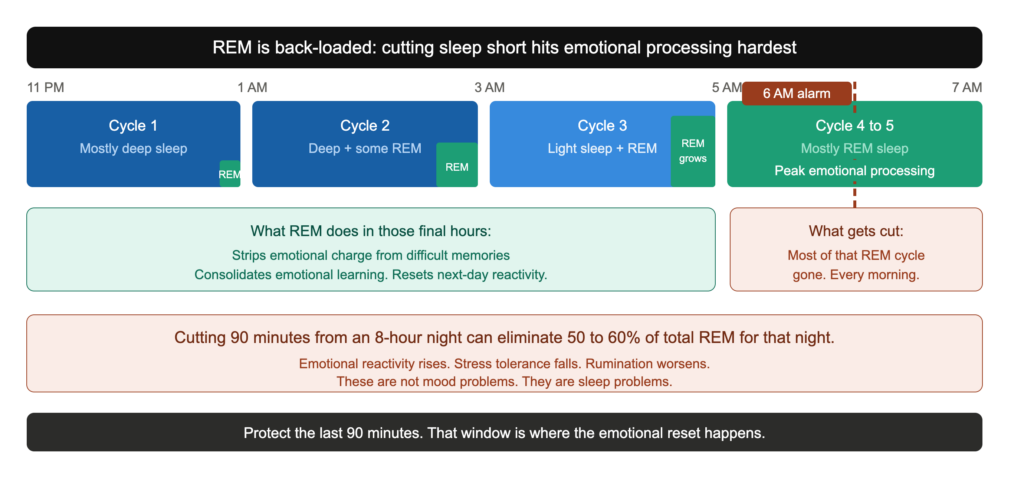
- REM sleep is concentrated in the final hours of a full night of sleep, meaning that cutting sleep short by even 90 minutes disproportionately reduces REM, not slow-wave sleep.
- Chronic REM suppression, from alcohol, sleep restriction, or antidepressants, is consistently associated with increased emotional reactivity, impaired stress tolerance, and higher rates of anxiety and depression.
- Protecting the final 90 minutes of sleep, not just total sleep time, is the specific intervention that preserves REM and its emotional regulation function.
The overnight therapist you keep cutting short
REM sleep is not simply the stage where you dream. It is a neurologically distinct state in which the brain actively processes emotional experiences from the preceding day and from memory. During REM, norepinephrine, the brain’s stress-signaling neurotransmitter, drops to near-zero. This creates a unique neurochemical window in which emotional memories can be replayed and reprocessed without triggering a full stress response. The emotional charge associated with difficult experiences is gradually reduced. The factual content is retained. This is why a night of sleep often makes a problem feel more manageable than it did the evening before, and why sleep deprivation reliably worsens emotional regulation.
Matthew Walker’s “overnight therapy” framing is accurate in mechanistic terms. REM sleep is when the brain does the emotional processing work that people often assume therapy or time alone accomplishes. Therapy accelerates and directs the process. Sleep provides the biological substrate for it. You need both.
Why cutting sleep by 90 minutes costs more than it seems
Sleep architecture is not evenly distributed across the night. Slow-wave (deep) sleep dominates the first half of the night. REM sleep dominates the second half, particularly in the 90-minute cycles between 5 AM and 8 AM for someone sleeping a full eight hours. When you set the alarm 90 minutes early, you are not cutting 90 minutes of even sleep across all stages. You are cutting the REM-heavy final cycles disproportionately, losing perhaps 50 to 60 percent of your total REM sleep for that night.
The consequences are not immediately obvious. You might not notice that your emotional regulation is impaired on a typical day. You notice it when you face a stressor: the irritability comes faster, the anxiety recovers more slowly, the rumination at night runs longer. These are not mood problems. They are REM problems. The difference matters because the intervention is specific: protect your sleep duration, especially the final 90 minutes.
What suppresses REM and why it matters
The list of common REM suppressors is long: alcohol, SSRIs and SNRIs (which suppress REM as a class effect), sleep restriction, beta-blockers, benzodiazepines, and cannabis. This does not mean these substances should never be used. It means the trade-off is real and worth knowing. Adults taking SSRIs for depression who experience blunted emotional responsiveness or emotional flatness may be partly experiencing SSRI-related REM suppression, not just mood improvement. The antidepressant is helping and impairing simultaneously. Knowing this allows for a more complete clinical conversation.
Cannabis is worth noting specifically for midlife adults who use it as a sleep aid. THC reliably suppresses REM sleep. For someone using cannabis to fall asleep, the short-term benefit (faster sleep onset, reduced anxiety at bedtime) comes with a consistent long-term cost (reduced emotional processing, blunted dreaming, potential rebound insomnia on cessation). The substitution may be trading one problem for another.
The Livium recipe
Tool. Protecting full sleep duration is the most direct REM intervention available. Blackout curtains reduce light exposure that prematurely terminates REM cycles in the early morning, when ambient light is most likely to interrupt sleep during the REM-heavy final hours. A white noise machine reduces acoustic disruptions that disproportionately interrupt light-stage and REM sleep. For wearable users: check your REM percentage. Most adults average 20 to 25 percent of total sleep as REM. Consistently below 15 percent warrants attention to REM suppressors.
Behavior. Protect your final 90 minutes of sleep as actively as your first hour. Most sleep hygiene advice focuses on sleep onset. The REM protection problem is a sleep offset problem: what terminates your sleep in the morning matters as much as what initiates it at night. Where possible, use a gradual alarm or a natural-light wake-up rather than an abrupt alarm that cuts short the final REM cycle. Give yourself a fixed bedtime and a flexible wake time rather than the reverse. On days when social commitments force an early wake-up, go to bed earlier rather than trying to extend sleep in the morning.
Threshold. If emotional flatness, blunted affect, or poor emotional resilience is a persistent pattern alongside SSRI use: this is a clinical conversation worth having with your prescriber. Some antidepressants (mirtazapine, for example) are relatively REM-sparing. The conversation is evidence-supported. If you are using cannabis for sleep: taper the dose or shift to CBD-only options and give yourself 30 days to observe whether sleep quality and emotional regulation change. A CBD product without THC may preserve the anxiety-reduction benefit at bedtime without the REM suppression.
| REM suppressor | Mechanism | Practical consideration |
|---|---|---|
| Alcohol | GABA activation, then rebound | Finish drinking 3+ hours before bed |
| SSRIs and SNRIs | Serotonin excess suppresses REM | Discuss with prescriber if emotional flatness is present |
| Cannabis (THC) | Direct REM suppression | Consider CBD-only if using as sleep aid |
| Sleep restriction | Back-loaded REM lost first | Protect final 90 min over total sleep time |
Plan of action
- Check your REM percentage if you track sleep with a wearable. If it is consistently below 18 percent, identify which suppressors from the table above apply to you and address the most modifiable one first.
- Protect the last 90 minutes. Blackout curtains and a cool bedroom prevent the premature morning arousal that cuts REM cycles short. This is more effective than trying to fall asleep earlier.
- If you are consistently emotionally reactive, irritable, or ruminating at night, add 30 minutes to your sleep window before trying any behavioral or pharmacological intervention for mood. The emotional regulation problem is often a sleep-duration problem in disguise.
- A sleep mask for the final hours eliminates light-driven arousal without requiring window coverings, which is useful for travel or shared spaces.
Table of Content

Know your body better.
Trusted By Thousands Daily





FAQs
Do I need to dream to get the emotional regulation benefit?
Not necessarily. Dreaming occurs during REM, but the emotional processing function of REM is not dependent on dream recall. People who rarely remember dreams still receive the REM emotional processing benefit during sleep. Dream recall is a byproduct of how closely the awakening follows a REM period, not a measure of REM quality.
Can naps replace lost REM sleep?
Briefly. Naps longer than 60 minutes can include REM sleep, and regular longer naps provide some REM recovery. But naps are not equivalent to the long uninterrupted REM cycles of the final hours of nocturnal sleep. They are partial mitigation, not a substitute.
Is REM sleep also where long-term memories are consolidated?
Partly. Declarative memory consolidation occurs primarily in slow-wave sleep. REM sleep preferentially consolidates procedural, emotional, and associative memories. Both stages are necessary for complete memory consolidation, which is another reason why cutting total sleep time compromises both physical and cognitive performance.
Legal Disclaimer
The content published on Livium Health is for informational and educational purposes only. Nothing on this site constitutes medical advice, diagnosis, or treatment. Always consult a qualified healthcare provider before making decisions about your health, including changes to medications, supplements, diet, or exercise.
Livium Health is not a medical practice and does not have a patient-provider relationship with its readers. We do not sell supplements, medications, or treatments, and we have no financial relationship with the products or services we reference.
While we work to ensure the information we publish is accurate and up to date, health and medical guidance evolves. We make no guarantees about the completeness or currency of any content on this site. Reliance on any information provided by Livium Health is solely at your own risk.
If you are experiencing a medical emergency, call 911 or your local emergency services immediately.
We may receive compensation, free products, or affiliate commissions for products mentioned in this post. Opinions are our own.