
Share
Energy & Focus
Men's Health
Women's Health
Rhodiola and ashwagandha: Which adaptogens have real data
7 min read
Key takeaways
- Rhodiola rosea has the most consistent published human trial data of any adaptogen for fatigue, stress-related exhaustion, and mental performance under acute cognitive load. The effect is real but modest, and the research quality is variable. It earns its place in the category.
- Ashwagandha (KSM-66 extract specifically) has solid published data for cortisol reduction, subjective stress, and sleep quality in stressed adults. The evidence is better than most of the category. It is not a stimulant; it works by reducing the stress response rather than directly producing energy.
- Most other adaptogens marketed for energy and focus (maca, eleuthero, schisandra, lion’s mane for fatigue) have insufficient human clinical data to recommend with confidence. Plausible mechanisms, animal data, and small, underpowered trials are not evidence.
- Adaptogens address stress-driven fatigue and cortisol dysregulation. They do not address sleep debt, micronutrient deficiency, hormonal decline, or thyroid dysfunction. If the underlying cause is one of those, adaptogens will underdeliver.
The category problem
“Adaptogen” is a marketing category more than a pharmacological one. The term was coined by Soviet pharmacologist Nikolai Lazarev in 1947 to describe substances that increase nonspecific resistance to stress. It is not an FDA-recognized classification. Any supplement brand can call any botanical an adaptogen and typically does.
The wellness industry has expanded the category to include dozens of herbs with little or no human clinical evidence, bundled them into expensive stacks, and positioned them as the solution to modern burnout. Most of them are marketing. A few are not. The distinction matters because they are not cheap and the placebo effect in this category is strong.
Rhodiola rosea: The evidence
Rhodiola rosea has more published randomized controlled trials than any other adaptogen. The most-cited mechanisms: inhibition of monoamine oxidase (MAO), which slows the breakdown of dopamine and serotonin; activation of opioid peptides that modulate the stress response; and effects on cortisol via interactions with the hypothalamic-pituitary-adrenal axis.
A 2012 randomized controlled trial in adults experiencing stress, published in Phytomedicine, found significant improvements in fatigue, exhaustion, and cognitive function after 28 days of rhodiola extract compared with placebo. A 2009 Swedish study of night-shift physicians found improved cognitive performance and reduced fatigue during periods of stress with 170 mg of rhodiola extract. A 2017 Cochrane-adjacent systematic review found positive effects on mental fatigue and physical endurance but noted that the quality of the evidence across studies was moderate at best.
The caveat: rhodiola research is dominated by small trials, inconsistent standardization of the extract, and manufacturer funding. The effect sizes are real but modest. Rhodiola is not a substitute for sleep. What it does is reduce the performance impairment of acute cognitive stress, which is a specific and useful claim.
Effective dose: 200 to 600 mg daily of a standardized extract containing 3 percent rosavins and 1 percent salidroside. Taken in the morning; mild stimulatory effect means evening dosing can disrupt sleep. Standardized rhodiola rosea extract is available as a single-ingredient supplement; avoid proprietary blends where the rhodiola dose is not disclosed.
Ashwagandha: The evidence
Ashwagandha (Withania somnifera) is the most researched adaptogen for cortisol and stress. The strongest evidence is for the KSM-66 extract, a full-spectrum root extract with 5 percent withanolides, which has the best standardization and the most clinical backing of any ashwagandha form.
A 2012 randomized, double-blind, placebo-controlled trial in chronically stressed adults (Chandrasekhar et al., Indian Journal of Psychological Medicine) found that KSM-66 at 300 mg twice daily reduced serum cortisol by 27.9 percent, reduced perceived stress scores by 44 percent, and significantly improved general well-being scores compared to placebo after 60 days. A 2019 study found KSM-66 at 300 mg twice daily improved sleep quality and morning alertness in adults with insomnia. A 2015 study found improvements in cardiorespiratory endurance in healthy adults.
The mechanism is primarily through the HPA axis: withanolides appear to modulate cortisol secretion and reduce the stress-driven elevation in cortisol that depletes energy. This is not stimulant-like. The energy-boosting effect of ashwagandha takes two to four weeks to manifest and works by removing a brake (excess cortisol) rather than by stepping on the accelerator. KSM-66 ashwagandha 300 mg is the specific form with the clinical backing. Generic ashwagandha root powder without standardization is not equivalent.
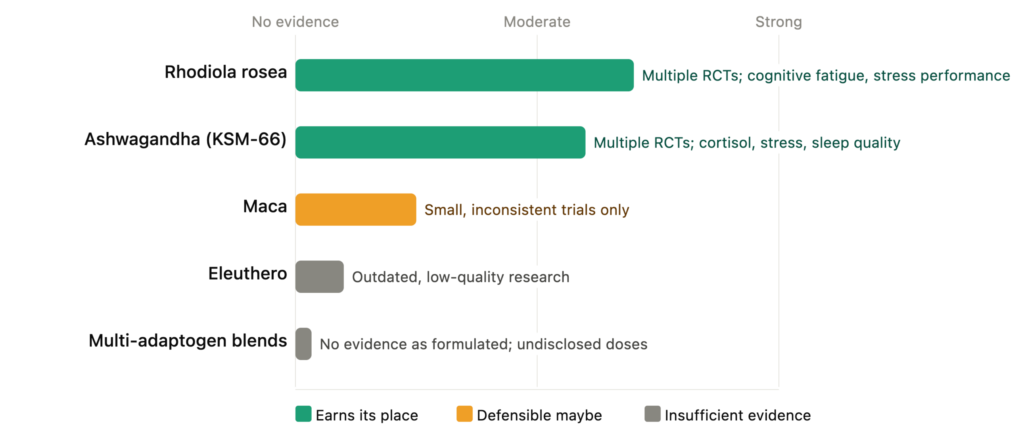
Rhodiola rosea and ashwagandha KSM-66 are the two adaptogens with consistent published human trial data for fatigue and stress. Everything else in the category either has weak, inconsistent evidence or has never been tested as formulated. Source: Ivanova Stojcheva & Quintela, Molecules 2022 — The Effectiveness of Rhodiola rosea L. Preparations in Alleviating Various Aspects of Life-Stress Symptoms and Stress-Induced Conditions. CC BY 4.0.
What does not earn its place
Maca. Libido and subjective energy improvements in some small trials. No convincing evidence for cortisol, cognitive performance, or objective fatigue. The effect may be real; the mechanism is unclear, and the data are thin.
Eleuthero (Siberian ginseng). Part of the original Soviet research on adaptogens. Most of that research was conducted with poor methodology. Modern trials are small and inconsistent. Not enough to recommend.
Lion’s mane for fatigue. The cognitive and nerve growth factor (NGF) evidence for lion’s mane is interesting. The evidence for lion’s mane as a fatigue or energy intervention is thin. It is two separate claims; the one with data is cognition, not energy.
Multi-adaptogen blends. When you cannot verify the dose of any individual ingredient, you cannot evaluate whether any individual ingredient is at an effective dose. Most multi-adaptogen stacks have proprietary blends with undisclosed individual doses. They are sold on category marketing, not on the specific evidence.
The Livium recipe
Tool. Pick one, not both, to start. If fatigue is primarily stress-driven and cortisol-related (worst energy during high-stress periods, poor sleep, feeling wired but tired): start with KSM-66 ashwagandha 300 mg twice daily. Give it 8 weeks. If fatigue is primarily cognitive and performance-related (worst energy during sustained mental work, moderate stress, generally adequate sleep): start with rhodiola rosea 400 mg standardized extract in the morning. Give it 4 weeks.
Behavior. The most common reason adaptogens underdeliver is that the underlying cause of fatigue is not cortisol dysregulation but rather something else: low ferritin, suboptimal thyroid function, sleep apnea, or declining testosterone or estrogen levels. Run bloodwork before spending money on adaptogens. Function Health covers the full panel. If the bloodwork is clean and cortisol rhythm is the suspect, then adaptogens are a reasonable tool. If the bloodwork reveals a deficiency, fix the deficiency first. Adaptogens on top of untreated iron deficiency or low T3 are a waste of money.
Threshold. 8 weeks of consistent use is the minimum evaluation period for ashwagandha. 4 weeks for rhodiola. If there is no subjective improvement after that window, the underlying cause of your fatigue is not in this category. Stop and look upstream. Adaptogens are not a permanent patch; they are a tool for a specific cause of fatigue, backed by decent evidence.
| Adaptogen | Evidence quality | Best for | Effective dose | Livium verdict |
|---|---|---|---|---|
| Rhodiola rosea | Moderate (multiple RCTs) | Cognitive fatigue, acute stress performance | 200–600 mg (3% rosavins) | Yes, for cognitive fatigue |
| Ashwagandha (KSM-66) | Moderate-strong (multiple RCTs, good standardization) | Cortisol, stress, sleep, HPA axis | 300 mg twice daily | Yes, for stress-driven fatigue |
| Maca | Weak (small, inconsistent trials) | Libido, subjective energy | Unclear | Maybe; evidence thin |
| Eleuthero | Weak (outdated, low-quality research) | Nonspecific stress resistance | Unclear | No; insufficient data |
| Multi-adaptogen blends | None as formulated | Marketing | Undisclosed | No |
Source: NIH Office of Dietary Supplements and Chandrasekhar et al., Indian Journal of Psychological Medicine (2012) KSM-66 RCT.
Plan of action
- Run bloodwork before buying adaptogens. Ferritin, TSH, free T3, testosterone or estradiol, vitamin D, and vitamin B12 should all be within optimal ranges before assuming your fatigue is an adaptation problem. Function Health covers the full panel in one draw.
- If bloodwork is clean and fatigue is stress-related: try KSM-66 ashwagandha 300 mg morning and evening for 8 weeks. Keep everything else consistent so you can isolate the effect. The benefit is not dramatic; it is a gradual reduction in stress-driven exhaustion that feels normal until it is not.
- If fatigue is cognitive and performance-focused rather than stress-driven: try rhodiola rosea 400 mg standardized extract in the morning for 4 weeks. Time it to your highest-cognitive-demand periods.
- Avoid proprietary adaptogen blends. Buy single-ingredient supplements with disclosed standardization. If the label does not state the percentage of active compounds (e.g., rosavins in rhodiola, withanolides in ashwagandha), the product is not reliably dosed.
Table of Content
Know your body better.
Trusted By Thousands Daily



FAQs
Can you take rhodiola and ashwagandha together?
There is no known pharmacological reason not to, and some practitioners combine them. The problem is that combining them at the start removes your ability to identify which one is working (or whether either is). Start with one for the relevant evaluation period, then add the second if you want. The typical combination: rhodiola in the morning for cognitive performance, ashwagandha in the evening for cortisol and sleep.
Are adaptogens safe long-term?
Both rhodiola and ashwagandha have been used in traditional medicine for centuries, and the modern trial data shows no significant safety signals at standard doses. That said, long-term (beyond 12 months) human safety data is limited. Ashwagandha should be avoided during pregnancy. Rhodiola’s mild MAO-inhibiting activity means it should not be combined with MAO inhibitor medications. Both are generally well-tolerated at standard doses in healthy adults.
Why does ashwagandha not produce an immediate energy effect?
Because it is not a stimulant. Ashwagandha works by modulating the HPA axis response over time, gradually reducing cortisol dysregulation that depletes energy. The mechanism requires sustained use to express. Most people notice meaningful improvement between weeks 4 and 8. If you are looking for an immediate energy effect, that is caffeine’s job. Ashwagandha is removing a long-term drain, not adding a short-term boost.
Legal Disclaimer
The content published on Livium Health is for informational and educational purposes only. Nothing on this site constitutes medical advice, diagnosis, or treatment. Always consult a qualified healthcare provider before making decisions about your health, including changes to medications, supplements, diet, or exercise.
Livium Health is not a medical practice and does not have a patient-provider relationship with its readers. We do not sell supplements, medications, or treatments, and we have no financial relationship with the products or services we reference.
While we work to ensure the information we publish is accurate and up to date, health and medical guidance evolves. We make no guarantees about the completeness or currency of any content on this site. Reliance on any information provided by Livium Health is solely at your own risk.
If you are experiencing a medical emergency, call 911 or your local emergency services immediately.
We may receive compensation, free products, or affiliate commissions for products mentioned in this post. Opinions are our own.