
Share
Men's Health
Mental Health
Women's Health
Rumination is not problem-solving: How to know when thinking has become the problem
5 min read

Key takeaways
- Rumination repeats a problem without reliably producing a new decision or action.
- A 2025 randomized trial found that rumination-focused CBT reduced repetitive thinking, worry, anxiety, and depression.
- A practical cutoff is whether more thinking produces a new fact, decision, or next step.
- Persistent rumination that disrupts daily life is a reason to seek structured care, not simply journal harder.
The thought loop is the target
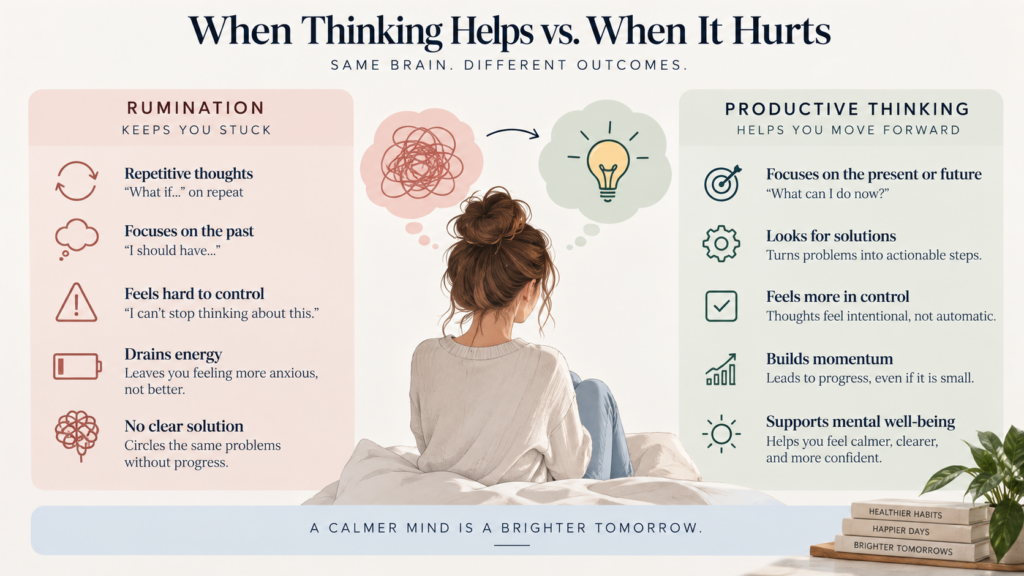
Rumination sounds productive because it borrows the language of problem-solving. You replay the conversation, reconstruct the mistake, predict the next problem, and keep searching for the sentence that will finally make everything feel settled. The problem is that rumination usually does not end with a decision. It ends with another lap.
Researchers often group rumination and worry under repetitive negative thinking. The content can be different, but the process is similar. Attention gets captured by unresolved material, and repetition starts masquerading as progress. That process is associated with both anxiety and depression, which is why newer treatments are increasingly targeting the loop itself rather than only the topic inside it.
A 2025 randomized trial tested therapist-supported, internet-delivered rumination-focused cognitive behavioral therapy in adults with elevated rumination or worry plus depression or anxiety. After seven weeks, the treatment group had lower repetitive thinking, brooding, worry, anxiety, and depression than the waitlist group. Improvements were maintained at follow-up.
The question that separates thinking from looping
Do not ask whether the thought is important. Ask whether another five minutes with it is likely to produce new information.
Useful thinking changes something. You identify a fact, make a decision, schedule a conversation, or choose a next step. Rumination often begins with a real problem, then keeps going after the actionable part is over. The brain continues reviewing the same evidence because uncertainty still feels uncomfortable.
This is why reassurance can become part of the loop. You ask someone whether they think you handled the situation badly. They say no. You feel better for 20 minutes, then a new detail appears and the question returns. The relief was real, but it did not teach your brain that uncertainty could be tolerated.
The loop also has a timing problem. Rumination is especially persuasive at night, when there are fewer competing demands and less opportunity to act. A problem that might take one email at 10 AM can occupy an hour at midnight because action is impossible. That is why postponing the issue until an actionable time is not avoidance. It is better problem-solving.
Another useful distinction is between reflection and rumination. Reflection can be uncomfortable, but it usually broadens perspective. Rumination narrows it. You become more certain that the same detail matters, less able to shift attention, and more convinced that relief depends on reaching certainty.
The Livium recipe
Tool. Give the loop one physical landing place. A notebook and pens are enough. If nighttime loops are the problem, an Owala FreeSip bottle keeps the routine simple, while a cooling weighted blanket can be a comfort item. None of these products treats depression or anxiety.
Behavior. Write the thought once. Under it, answer two questions: “Is there an action here?” and “When will I take it?” If there is an action, schedule it. If there is no action, label the thought as a loop and deliberately move into a concrete task that occupies attention.
Threshold. Give deliberate problem-solving five minutes. If you have not generated a new fact, decision, or action by the end, stop calling repetition analysis. If the same topic returns later, you do not owe it another full investigation unless something materially changed.
| Thought pattern | Useful response | Stop doing |
|---|---|---|
| New information is appearing | Keep solving until a decision is possible | Replaying after the decision |
| A concrete action exists | Schedule the action | Keep mentally rehearsing it |
| No new information appears | Label the loop | Search for impossible certainty |
| Loop returns in bed | Capture it once for tomorrow | Turn bed into a problem-solving desk |
Source: Tulbure et al., Behavior Therapy, 2025.
What we are ruling out
A five-minute notebook exercise is not rumination-focused CBT. The trial used structured therapy and therapist support. The exercise simply borrows one useful principle: separate actionable thinking from repetitive negative thinking.
This also is not an instruction to ignore a real problem. A difficult relationship, financial decision, health symptom, or work conflict may deserve thought. The test is whether thinking is producing decisions or simply extending distress.
If rumination is consuming hours, worsening depression, driving compulsive reassurance-seeking, or interfering with sleep and work, the threshold for professional help has already been crossed.
What progress actually looks like
Progress is not never having the thought again. The more realistic marker is that you notice the loop sooner, spend less time inside it, and return to the rest of your day with less negotiation. A thought can still feel unfinished without requiring another hour of analysis.
Track time rather than perfection. If a familiar loop used to consume 45 minutes and now takes 12 before you disengage, that is meaningful change. If it keeps returning with the same intensity despite repeated attempts to interrupt it, that is useful information for a therapist because it shows where self-guided strategies are reaching their limit.
Plan of action
- Choose one five-minute problem-solving window each day.
- Write recurring thoughts once instead of rehearsing them mentally.
- End with either a scheduled action or the label “no action available.”
- Notice reassurance-seeking that gives relief but restarts the loop later.
- If the loop keeps controlling your day, ask about CBT that targets repetitive negative thinking.
The decision this week. Stop measuring a thought by how urgent it feels. Measure it by whether another five minutes changes what you can do.
Table of Content

Know your body better.
Trusted By Thousands Daily









FAQs
What is the difference between rumination and problem-solving?
Problem-solving moves toward a decision or action. Rumination repeatedly reviews the same material without meaningfully changing what you know or what you can do.
Can journaling stop rumination?
It can help externalize a thought and identify whether an action exists, but it is not a substitute for treatment when rumination is persistent or severe.
What therapy is used for rumination?
Cognitive behavioral approaches can directly target repetitive negative thinking. Rumination-focused CBT is one structured approach with recent randomized-trial evidence.
Legal Disclaimer
The content published on Livium Health is for informational and educational purposes only. Nothing on this site constitutes medical advice, diagnosis, or treatment. Always consult a qualified healthcare provider before making decisions about your health, including changes to medications, supplements, diet, or exercise.
Livium Health is not a medical practice and does not have a patient-provider relationship with its readers. We do not sell supplements, medications, or treatments, and we have no financial relationship with the products or services we reference.
While we work to ensure the information we publish is accurate and up to date, health and medical guidance evolves. We make no guarantees about the completeness or currency of any content on this site. Reliance on any information provided by Livium Health is solely at your own risk.
If you are experiencing a medical emergency, call 911 or your local emergency services immediately.
We may receive compensation, free products, or affiliate commissions for products mentioned in this post. Opinions are our own.