
Share
Sleep
Women's Health
Sleep apnea in women: The symptoms your doctor isn’t looking for
6 min read
Key takeaways
- Obstructive sleep apnea (OSA) in women is massively underdiagnosed. Women represent roughly 50 percent of adults with OSA but account for only 24 percent of diagnosed cases. The gap is not epidemiological; it is diagnostic. Women present differently, and the clinical questionnaires and referral criteria were built on male data.
- The classic OSA presentation: loud snoring, witnessed apneas, obesity, excessive daytime sleepiness, describes men more than women. Women with OSA more commonly present with insomnia, fatigue, headaches, depression, anxiety, and restless sleep. Many are treated for the psychiatric symptoms for years before anyone thinks to check their airway.
- Menopause is a major inflection point. Progesterone stimulates upper airway muscle tone and acts as a respiratory stimulant. As progesterone declines in perimenopause and menopause, OSA risk rises substantially. Women’s OSA risk roughly triples after menopause and approaches male rates.
- A home sleep test is the starting point and is available without a physician referral. If OSA is confirmed, treatment options include CPAP, oral appliance therapy, positional therapy, and weight management. Hormone therapy in postmenopausal women also appears to reduce OSA severity.
The wrong prototype
The clinical picture of sleep apnea that most physicians learned in training is a middle-aged overweight man who snores loudly, stops breathing according to his bed partner, and falls asleep at red lights. That prototype is real. It is also male. And it is the reason that women with OSA spend years undiagnosed while their physicians investigate depression, chronic fatigue, hypothyroidism, and anxiety, all of which are real comorbidities of untreated OSA, and none of which are the root cause.
A 2019 study in the journal SLEEP found that women with OSA reported significantly higher rates of insomnia symptoms, depression, anxiety, and restless sleep than men with the same apnea-hypopnea index (AHI). They were also significantly more likely to have seen multiple physicians before receiving a sleep referral. The average diagnostic delay in women with OSA is several years longer than in men.
This is not subtle. It is a systemic failure of a diagnostic framework built on one sex’s symptom profile.
How women’s OSA presents differently
Insomnia rather than hypersomnia. Men with OSA typically report excessive daytime sleepiness. Women more commonly report difficulty maintaining sleep, frequent nighttime waking, and feeling unrefreshed despite time in bed; a profile that overlaps almost entirely with primary insomnia and perimenopause. The Epworth Sleepiness Scale, which is the most commonly used OSA screening questionnaire, performs significantly worse as a screening tool in women for this reason.
Mood and cognitive symptoms first. Depression, anxiety, morning headaches, difficulty concentrating, and irritability are the symptoms women with undiagnosed OSA most frequently present with to their primary care physicians. Each of these is a legitimate consequence of fragmented sleep and hypoxia, but none triggers a sleep referral the way “my husband says I stop breathing” does.
REM-predominant apnea. Women are more likely than men to have OSA that occurs predominantly during REM sleep, when airway muscle tone is naturally lowest. Because REM sleep is concentrated in the second half of the night, REM-predominant OSA produces waking in the early morning hours rather than snoring throughout the night, and may not show up on an overnight sleep study that captures insufficient REM time.
Less snoring, fewer witnessed apneas. Women with OSA are less likely to snore loudly or have witnessed episodes of stopped breathing, in part because of differences in upper airway anatomy and the distribution of apnea events across sleep stages. The absence of the cardinal male symptoms leads partners and clinicians alike to dismiss OSA as a possibility.
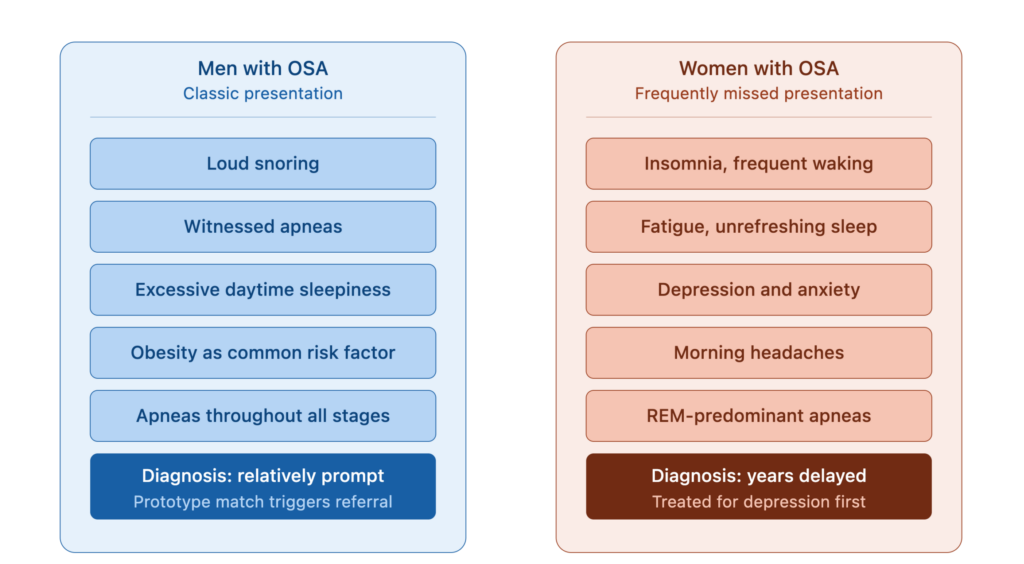
Men with OSA present with the symptoms that trigger referral: loud snoring, witnessed apneas, excessive daytime sleepiness. Women present with the symptoms that get treated as something else: insomnia, fatigue, depression, morning headaches. The diagnostic gap is not a coincidence. It is a prototype problem. Source: Castelnuovo et al., Neurology International 2025 — Gender Differences in Obstructive Sleep Apnea: A Preliminary Clinical and Polysomnographic Investigation. CC BY 4.0.
Menopause and the inflection point
Progesterone stimulates hypoglossal nerve activity, which maintains upper airway muscle tone during sleep, and acts directly as a respiratory stimulant on the brainstem. Pre-menopausal women have substantially lower rates of OSA than age-matched men, in part because progesterone provides this protective airway effect. As progesterone declines in perimenopause and postmenopause, this protection is removed.
Multiple large epidemiological studies, including the Wisconsin Sleep Cohort, have found that postmenopausal women have OSA rates 2.6 to 3.5 times higher than premenopausal women of the same age. Hormone therapy appears to reduce this risk: a study by Shahar et al. (2003, AJRCCM) found that postmenopausal women on hormone therapy had significantly lower rates of OSA than those not on therapy. The mechanism is consistent with progesterone’s known airway protective effects.
This means that a perimenopausal woman presenting with new insomnia, fatigue, and mood changes should have OSA on the differential alongside perimenopause itself, because she may have both, and they amplify each other.
The Livium recipe
Tool. A home sleep test is the starting point. Lofta’s home sleep test does not require a physician referral, delivers results within days, and is reviewed by a board-certified sleep physician who provides a written report. A limitation of home sleep testing for women is that it may underdetect REM-predominant OSA if the test captures insufficient REM time. If the home sleep test is negative but symptoms are strong, request an in-lab polysomnography that includes full REM stage capture. A pulse oximeter worn overnight gives a preliminary indication of oxygen desaturation events before formal testing.
Behavior. If OSA is confirmed, CPAP is the first-line treatment. The RespiraX AirSense 11 is the current standard, with an auto-adjusting pressure algorithm and a patient app that provides nightly compliance and efficacy data. For women who cannot tolerate CPAP, an oral appliance (mandibular advancement device) is an evidence-based alternative. Positional therapy (avoiding supine sleep) is effective for positional OSA. For perimenopausal and postmenopausal women: discussing hormone therapy with a menopause-informed provider is appropriate, as progesterone’s airway-protective effect is a legitimate therapeutic consideration alongside the symptom management benefits.
Threshold. If you are a woman over 40 with any three of the following: unrefreshing sleep despite adequate hours, frequent nighttime waking, morning headaches, unexplained fatigue, new or worsening depression or anxiety, difficulty concentrating, you should request a sleep study regardless of whether you snore. The Epworth Sleepiness Scale score, which your physician may use as a screening tool, performs poorly in women. Your symptom picture is the more reliable indicator.
| Symptom | More common in men with OSA | More common in women with OSA |
|---|---|---|
| Primary complaint | Excessive daytime sleepiness | Insomnia, fatigue, unrefreshing sleep |
| Bed partner report | Loud snoring, witnessed apneas | Restless sleep, absent or mild snoring |
| Psychiatric symptoms | Less common as presenting complaint | Depression, anxiety, irritability frequently primary |
| Apnea distribution | Throughout all sleep stages | Predominantly REM-related |
| Diagnostic delay | Shorter; prototype match | Significantly longer; multiple prior diagnoses common |
Source: AASM Practice Guidelines and Koo et al., JCM 2023.
Plan of action
- If you have unrefreshing sleep, frequent nighttime waking, or morning headaches: request a home sleep test or in-lab polysomnography regardless of whether your physician brings it up. A fingertip pulse oximeter worn overnight gives you a preliminary read on oxygen desaturation events before formal testing. Lofta’s home sleep test is available without a referral. Ask for REM-stage-specific AHI data in the results, not just the overall AHI.
- If you have been treated for depression, anxiety, or insomnia without significant improvement, and your physician has not mentioned sleep apnea: raise it explicitly. Say: “I’ve read that women with sleep apnea often present with depression and insomnia rather than snoring. Has OSA been ruled out?”
- If you are perimenopausal or postmenopausal with new sleep symptoms: discuss both sleep apnea and hormone therapy with a menopause-informed provider. They are not mutually exclusive, and both may be relevant.
- If OSA is confirmed and you are prescribed CPAP: CPAP mask liner products improve comfort and compliance, particularly for women who find the standard mask fit problematic. CPAP adherence drives outcomes; the equipment adjustment is worth pursuing.
Table of Content

Know your body better.
Trusted By Thousands Daily






FAQs
I’m not overweight. Can I still have sleep apnea?
Yes. Body weight is a risk factor, not a requirement. Women at normal weight develop OSA, particularly after menopause when hormonal protection declines. Upper airway anatomy, jaw structure, and neck anatomy are all relevant. The absence of obesity does not rule out OSA and should not be used as a reason to skip testing.
Can a wearable sleep tracker detect sleep apnea?
Consumer wearables (Oura, Fitbit, Apple Watch, Garmin) can detect sleep fragmentation, reduced oxygen saturation in some models, and disturbed sleep architecture, all of which may signal OSA. They cannot diagnose OSA, which requires measuring airflow, respiratory effort, and oxygen desaturation with medical-grade equipment. If a wearable flags frequent nighttime disturbances or low oxygen readings, treat that as a reason to pursue a formal sleep study, not a diagnosis.
Is hormone therapy recommended specifically for OSA treatment?
Hormone therapy is not currently indicated as a primary OSA treatment in clinical guidelines, but the evidence for its protective effect on airway function in postmenopausal women is real. For women who are considering hormone therapy for menopausal symptoms and also have mild-to-moderate OSA, the airway benefit is an additional consideration in the benefit-risk calculation, one worth discussing with a menopause-informed provider who is familiar with the sleep literature.
Legal Disclaimer
The content published on Livium Health is for informational and educational purposes only. Nothing on this site constitutes medical advice, diagnosis, or treatment. Always consult a qualified healthcare provider before making decisions about your health, including changes to medications, supplements, diet, or exercise.
Livium Health is not a medical practice and does not have a patient-provider relationship with its readers. We do not sell supplements, medications, or treatments, and we have no financial relationship with the products or services we reference.
While we work to ensure the information we publish is accurate and up to date, health and medical guidance evolves. We make no guarantees about the completeness or currency of any content on this site. Reliance on any information provided by Livium Health is solely at your own risk.
If you are experiencing a medical emergency, call 911 or your local emergency services immediately.
We may receive compensation, free products, or affiliate commissions for products mentioned in this post. Opinions are our own.