
Share
Men's Health
Thyroid Health
Women's Health
Subclinical hypothyroidism: When your TSH is ‘normal’ and you still feel terrible
7 min read

Key takeaways
- Subclinical hypothyroidism (SCH) is defined as a TSH level above the normal range with normal free T4. It is present in 4 to 10 percent of adults and becomes significantly more prevalent with age. Many people with SCH are symptomatic, particularly when TSH is in the upper half of the conventional reference range, despite being technically “normal.”
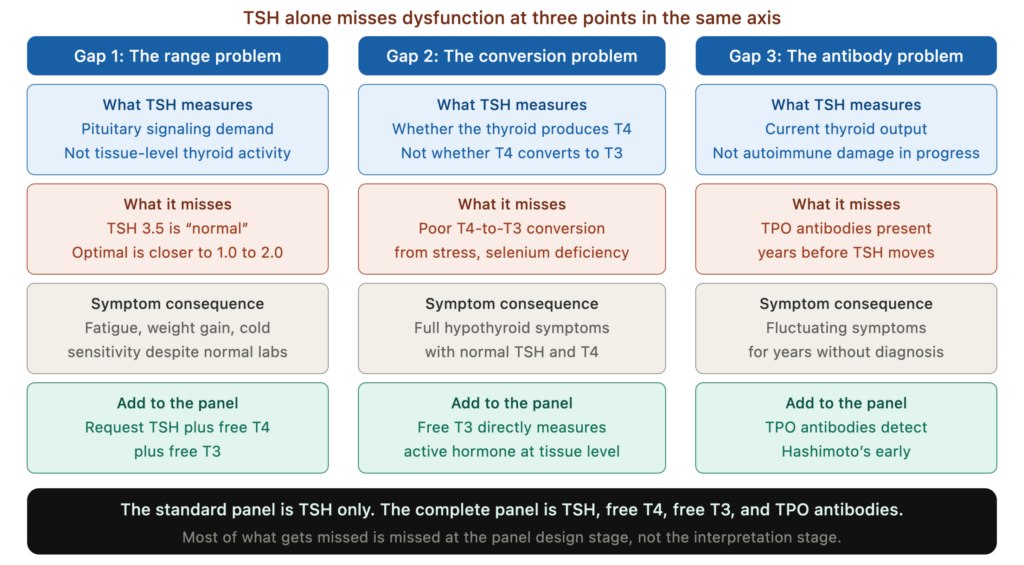
- The conventional TSH reference range (0.4 to 4.0 or 0.5 to 4.5 mIU/L, depending on the laboratory) is population-derived and includes many people who feel unwell. Research suggests the optimal TSH for most adults without known thyroid disease is 1.0 to 2.0 mIU/L. A TSH of 3.8 is technically normal. In many people, it is also associated with fatigue, cold sensitivity, weight gain, constipation, hair loss, and cognitive slowing.
- TSH alone is an incomplete thyroid picture. TSH measures pituitary signaling, not thyroid hormone availability at the tissue level. Free T3, the active form of thyroid hormone, and free T4, the precursor, should both be measured. Some people convert T4 to T3 poorly despite normal TSH and normal T4, producing tissue-level hypothyroidism that TSH testing misses entirely.
- Hashimoto’s thyroiditis, the autoimmune condition that is the most common cause of hypothyroidism, can produce years of fluctuating symptoms before TSH rises above the reference range. Thyroid peroxidase antibodies (TPO-Ab) detect the autoimmune process before it has damaged enough thyroid tissue to affect TSH. Most standard thyroid panels do not include TPO-Ab.
“Your thyroid is fine”
You went to your doctor with fatigue, weight gain despite no dietary changes, persistent cold sensitivity, brain fog, constipation, and hair that is coming out in the shower. Your doctor ordered thyroid labs. The TSH came back at 3.6. The reference range tops out at 4.0. You were told your thyroid is fine.
Three months later, the symptoms are the same. You return. The labs are repeated. TSH is 3.8. Still normal. You are told to consider your diet, your sleep, your stress levels. You leave with nothing.
This is one of the most common and most frustrating clinical encounters in adult medicine. The problem is not that your doctor is wrong about the lab value. A TSH of 3.8 is within the reference range. The problem is that the reference range is an inadequate screening tool, TSH alone is an incomplete thyroid assessment, and the gap between “within normal limits” and “functioning optimally” is where a significant number of people with genuine thyroid dysfunction spend years.
The reference range problem
TSH reference ranges are established by measuring TSH in a large population and defining normal as the middle 95 percent of results. The population used to establish these ranges includes people with subclinical thyroid dysfunction who were not excluded. This means the upper end of the “normal” range includes people who are actually hypothyroid; their TSH is high because their pituitary is working harder to stimulate a failing thyroid.
The American Association of Clinical Endocrinologists proposed in 2003 that the upper limit of normal for TSH be revised to 3.0 mIU/L, based on observations that population studies excluding people with thyroid antibodies or a family history of thyroid disease yield a much narrower reference range. This proposal was not universally adopted, and most laboratories continue to use reference ranges with upper limits of 4.0-4.5.
For practical purposes: a TSH above 2.0 to 2.5 mIU/L in a symptomatic adult warrants further investigation, not reassurance. Symptomatic is the operative word. A TSH of 3.5 in someone with no thyroid symptoms is different from the same value in someone with fatigue, cold sensitivity, and hair loss.
The T3 conversion problem
Thyroid hormone exists in two main forms: T4 (thyroxine), which is secreted by the thyroid gland and is relatively inactive, and T3 (triiodothyronine), which is the active form that binds to receptors in every cell of the body. Most T4 is converted to T3 in peripheral tissues, particularly the liver and kidney, by enzymes called deiodinases.
This conversion step is where a significant number of thyroid-symptomatic people with normal TSH fall through the cracks. Chronic inflammation, high cortisol (from stress or poor sleep), nutrient deficiencies (selenium, zinc, iron), and genetic variants in the DIO2 gene (which encodes the deiodinase enzyme) all impair the conversion of T4 to T3. The result: normal TSH, normal T4, low free T3, and a full set of hypothyroid symptoms driven by insufficient active thyroid hormone at the tissue level. Standard thyroid testing (TSH only, or TSH plus T4) completely misses this picture.
The solution in these cases is not levothyroxine (T4 medication), which these patients are already converting poorly. It is either the addition of low-dose liothyronine (T3 medication) or switching to a combination T4/T3 preparation. Many conventional endocrinologists do not routinely prescribe T3, as clinical guidelines for hypothyroidism are built on TSH normalization with T4. This is where functional medicine and integrative endocrinology approaches diverge from conventional practice.
Hashimoto’s: The autoimmune driver most panels miss
Hashimoto’s thyroiditis is the most common cause of hypothyroidism in iodine-sufficient populations, affecting an estimated 5 percent of adults. It is an autoimmune condition in which the immune system attacks thyroid tissue, gradually destroying thyroid function over years to decades. In its early stages, TSH may be entirely normal as the thyroid compensates for immune damage. The autoimmune process is detectable by measuring thyroid peroxidase antibodies (TPO-Ab) long before TSH rises.
Many people with Hashimoto’s experience symptom fluctuation because the thyroid is being intermittently damaged and then partially recovering. They may have periods of hypothyroid symptoms and then periods of relative normality. The symptom pattern is described as unpredictable. Standard thyroid testing at a single time point may fall within the normal range and miss the diagnosis entirely.
Management of Hashimoto’s extends beyond thyroid hormone replacement. Dietary interventions (gluten elimination shows benefit in the subset of Hashimoto’s patients who also have celiac disease or non-celiac gluten sensitivity), selenium supplementation (200 mcg daily reduces TPO antibody levels in multiple RCTs), and optimizing vitamin D (consistently low in autoimmune thyroid disease) all have evidence for reducing the autoimmune activity driving ongoing thyroid damage.
The Livium recipe
Tool. The complete thyroid panel: TSH, free T4, free T3, reverse T3, TPO antibodies, and thyroglobulin antibodies. This panel provides a comprehensive picture of thyroid function across the HPT axis and identifies autoimmune activity. Most standard GP panels measure only TSH. Function Health covers the full thyroid panel, along with the metabolic and hormonal context that informs interpretation. Selenium 200 mcg has the best-evidenced direct impact on Hashimoto’s autoimmune activity of any supplement and is appropriate as a first-line adjunct while clinical evaluation is underway.
Behavior. If TSH is above 2.0 and you have symptoms, ask your physician specifically for free T3, free T4, and TPO antibodies. Frame the request around your symptoms, not just the lab value. If your physician declines, an integrative or functional medicine provider who specializes in thyroid disorders will order the full panel and interpret the results in the context of your clinical picture. Optimize the conversion environment: selenium, zinc, and iron deficiency all impair T4-to-T3 conversion. Zinc 30 mg daily supports deiodinase function. Ferritin below 70 ng/mL impairs thyroid hormone metabolism; check iron alongside thyroid testing. Reduce chronic cortisol elevation (sleep, stress management), as high cortisol levels directly suppress T3 production. Vitamin D3 2000 to 4000 IU daily is appropriate for the majority of Hashimoto’s patients who test deficient.
Threshold. TSH above 4.0, with symptoms, warrants a discussion of treatment with your physician, regardless of the free T4 level. TSH above 10.0 is clinical hypothyroidism by any standard and requires treatment. For TSH between 2.5 and 4.0, with significant symptoms and elevated TPO antibodies, a physician experienced in Hashimoto’s management is the appropriate conversation partner. The treatment decision depends on the complete clinical picture, not on TSH alone.
| Test | What it measures | What it misses | Optimal range |
|---|---|---|---|
| TSH alone | Pituitary signaling demand | T3 conversion problems, early Hashimoto’s | 1.0 to 2.0 mIU/L for most adults |
| Free T4 | Thyroid hormone production | T4-to-T3 conversion efficiency | Mid to upper half of reference range |
| Free T3 | Active thyroid hormone at tissue level | Rarely ordered; explains most symptoms | Upper half of reference range |
| TPO antibodies | Autoimmune activity against thyroid | Not ordered in standard panels | Ideally below 35 IU/mL |
Source: American Thyroid Association Clinical Practice Guidelines.
Plan of action
- Request the full thyroid panel at your next appointment: TSH, free T4, free T3, TPO antibodies, and ferritin. If your physician will not order free T3 and TPO antibodies, use Function Health to run the complete panel independently.
- Start selenium 200 mcg daily. This is the supplement with the strongest evidence for Hashimoto’s specifically (multiple RCTs show TPO antibody reduction), and the risk of supplementing at 200 mcg is low. Take it with food. Brazil nuts provide approximately 70-90 mcg per nut; two per day is a dietary equivalent, but standardized supplementation ensures consistent dosing.
- Check your vitamin D. Low vitamin D is associated with higher TPO antibody levels and worse autoimmune thyroid outcomes. Vitamin D3 2000-4000 IU is appropriate for most adults deficient at baseline. Retest in 90 days to confirm adequacy.
- If you have Hashimoto’s confirmed by elevated TPO antibodies: a 90-day strict gluten elimination trial is worth considering if other interventions have not produced improvement. The evidence is strongest in patients with Hashimoto’s who also test positive for celiac antibodies, but non-celiac benefit has also been documented.
Table of Content

Know your body better.
Trusted By Thousands Daily



FAQs
Does subclinical hypothyroidism always progress to clinical hypothyroidism?
Not always. In people without thyroid antibodies, subclinical hypothyroidism often remains stable or even resolves spontaneously. In people with elevated TPO antibodies, progression to clinical hypothyroidism occurs in 4 to 5 percent of cases per year. The presence of antibodies is the strongest predictor of progression, which is why TPO testing is clinically relevant even in subclinical disease.
Should everyone with subclinical hypothyroidism take levothyroxine?
No. The treatment decision for subclinical hypothyroidism (TSH elevated but free T4 normal) depends on the TSH level, the symptom burden, the presence of antibodies, and the individual’s age and cardiovascular risk profile. Treatment is more clearly indicated when TSH is above 10, when the patient is pregnant or planning to become pregnant, or when significant symptoms are present alongside elevated antibody levels. For TSH between 4 and 10 without symptoms, the evidence for benefit from levothyroxine is less clear, and watchful waiting with monitoring may be appropriate.
Is desiccated thyroid extract (Armour Thyroid) better than levothyroxine?
For most patients, levothyroxine is the first-line treatment and produces adequate outcomes. Desiccated thyroid extract (Armour, NP Thyroid) contains both T4 and T3 in the ratio found in the pig thyroid gland, which is not identical to the human ratio. For patients who do not convert T4 to T3 adequately, adding T3 (either as liothyronine or via desiccated extract) can yield better symptomatic outcomes than T4 alone. This is a patient-specific decision that should be made with a physician familiar with thyroid hormone optimization, not a general recommendation.
Legal Disclaimer
The content published on Livium Health is for informational and educational purposes only. Nothing on this site constitutes medical advice, diagnosis, or treatment. Always consult a qualified healthcare provider before making decisions about your health, including changes to medications, supplements, diet, or exercise.
Livium Health is not a medical practice and does not have a patient-provider relationship with its readers. We do not sell supplements, medications, or treatments, and we have no financial relationship with the products or services we reference.
While we work to ensure the information we publish is accurate and up to date, health and medical guidance evolves. We make no guarantees about the completeness or currency of any content on this site. Reliance on any information provided by Livium Health is solely at your own risk.
If you are experiencing a medical emergency, call 911 or your local emergency services immediately.
We may receive compensation, free products, or affiliate commissions for products mentioned in this post. Opinions are our own.