
Share
Longevity & Aging
Men's Health
Women's Health
Sudden hearing loss: Why the window closes faster than you think
7 min read
Key takeaways
- Sudden sensorineural hearing loss (SSHL) is defined as a loss of 30 decibels or more across three consecutive frequencies, occurring within 72 hours. It affects roughly 5 to 27 per 100,000 people annually and is almost always mistaken for something benign.
- There is a 72-hour treatment window. High-dose oral or injected corticosteroids, administered within 72 hours of onset, significantly improve the odds of full or partial hearing recovery. After that window, the odds of recovery drop substantially and worsen with each passing day.
- Most people wait. The typical delay between onset and medical evaluation is four to five days, according to the AAO-HNS clinical practice guidelines. The most common explanations people give themselves: blocked ears, a cold coming on, fluid from swimming. By the time they see an ENT, the window is gone.
- SSHL is almost always idiopathic: no identifiable cause in roughly 85 to 90 percent of cases. That does not mean untreatable. It means the treatment targets the inflammatory and vascular pathway rather than an underlying pathogen or lesion.
You wake up, and one ear is gone
The most common onset is overnight. You go to bed hearing normally. You wake up, and one ear has a muffled quality, or a ringing, or simply less sound than the other. Sometimes it happens mid-sentence during a conversation. Sometimes in the shower. The onset can be so quiet and gradual over the course of a morning that the first reaction is to clean your ear with a cotton swab and assume it’s wax.
That assumption costs people their hearing.
Sudden sensorineural hearing loss is not earwax. It is not a head cold. It is an acute medical event affecting the cochlea or auditory nerve, treated in the same time-sensitive way that a stroke or heart attack is treated. The window is 72 hours. After that, whatever hearing was lost tends to stay lost.
What is actually happening
The cochlea is supplied by the labyrinthine artery, a small end artery with no collateral circulation. When blood flow is disrupted, even briefly, cochlear hair cells begin dying within minutes. The proposed mechanisms include microvascular ischemia (a small clot or spasm that cuts off the blood supply to the inner ear), viral labyrinthitis (reactivation of a latent virus, most commonly herpes simplex, in the cochlear nerve), and autoimmune inflammation targeting inner ear structures.
In roughly 85 to 90 percent of cases, no underlying cause is ever identified despite workup. This is called idiopathic SSHL. The remaining 10 to 15 percent have an identifiable cause: acoustic neuroma, Meniere’s disease, autoimmune inner ear disease, or, in rare cases, a systemic illness. This is why the evaluation for SSHL includes gadolinium-enhanced MRI, not just a hearing test: ruling out an acoustic neuroma of the auditory nerve is non-negotiable, even when the clinical picture appears idiopathic.
The rationale for corticosteroid treatment is anti-inflammatory, regardless of the underlying mechanism. Steroids reduce cochlear inflammation, support vascular permeability, and create the conditions in which surviving but damaged hair cells can recover. They do not reverse cell death. They prevent additional death in cells that are injured but not yet gone, which is why the first 72 hours are the window that matters.
The 72-hour rule
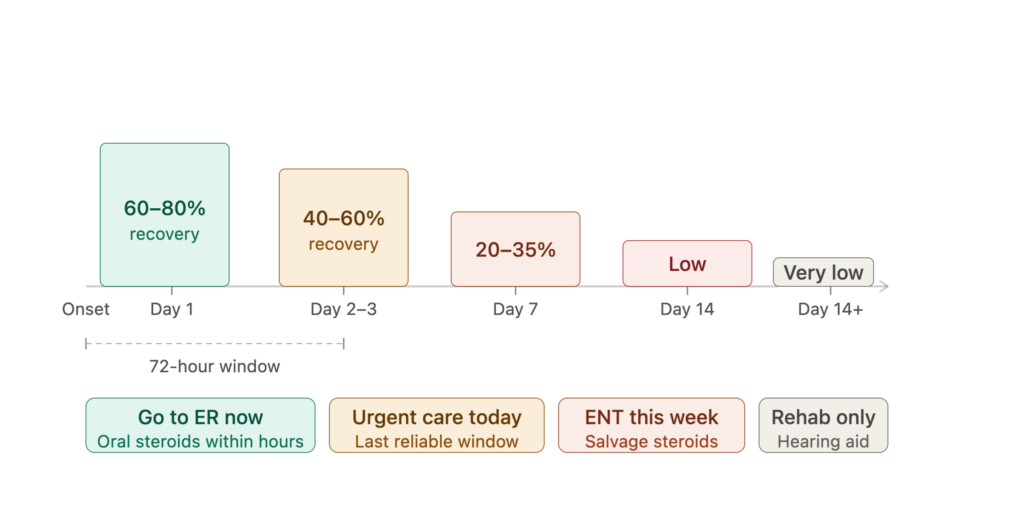
The 2019 AAO-HNS Clinical Practice Guideline on Sudden Hearing Loss recommends initiating steroid treatment within 14 days of onset for full benefit, but the evidence for recovery is strongest when treatment begins within 72 hours. Multiple meta-analyses confirm that outcomes are significantly better with early rather than delayed treatment, and several studies show a sharp inflection point on day 3.
Standard treatment is high-dose oral prednisone (typically 1 mg/kg/day, up to 60 mg, for 10 to 14 days with a taper). Intratympanic corticosteroid injection, delivered directly through the eardrum into the middle ear space, is an alternative for patients who cannot tolerate systemic steroids or as a salvage option when oral steroids have failed. The evidence for intratympanic steroids as a primary treatment is mixed; as salvage therapy after failed oral treatment, the evidence is stronger.
Hyperbaric oxygen therapy is a second-line adjunct with moderate evidence, particularly when combined with steroid treatment within the first two weeks. It is not universally available or first-line, but it is worth discussing with an ENT for patients presenting early.
How to recognize it
The clinical definition is technical (30 dB loss across three frequencies in 72 hours) but the practical test is simpler. Cover one ear and then the other. Listen to the same sound (the TV, a voice, background noise) through each ear separately. If one ear sounds meaningfully quieter or more muffled than it did yesterday, or sounds different from the other ear in a way that is new, that is enough reason to go to an emergency room or urgent care today. Not tomorrow. Today.
Accompanying symptoms that increase urgency: tinnitus in the affected ear, a sensation of fullness or pressure, dizziness or vertigo, facial numbness. Any of these, alongside sudden hearing loss in one ear, is an ER presentation, not a call to your GP to schedule an appointment next week.
The self-check that actually works: the Rinne and Weber tuning fork tests, which a clinician can perform in two minutes, distinguish sensorineural from conductive hearing loss and confirm that what you are experiencing is not earwax. Any emergency room can do this. Most urgent care clinics can too.
The Livium recipe
Tool. There is no supplement, device, or home intervention for SSHL. The tool is access to a physician who can prescribe corticosteroids and order an audiogram within hours of onset. If your primary care physician cannot see you the same day, go to an emergency room. If you are uncertain whether what you are experiencing is SSHL, do the one-ear cover test described above and err on the side of urgency. The cost of going to the ER unnecessarily is a few hours and a copay. The cost of waiting to see if it clears up is the potential for permanent hearing loss in one ear.
Behavior. Know the signs in advance. The reason most people miss the window is that they have never heard of SSHL and have no framework for what they are experiencing when it happens. Reading this piece is the preparation. The behavior change is: any sudden, unexplained, one-sided hearing reduction gets same-day medical evaluation. Not a wait-and-see. Not a home remedy. Same-day evaluation. If it turns out to be earwax, you lost an afternoon. If it turns out to be SSHL and you waited, the math is different.
Threshold. Spontaneous recovery occurs in roughly 32 to 65 percent of SSHL cases without treatment, which is the basis for the “wait and see” approach some physicians still take. This is not the correct framework. The recovery rate with treatment is substantially higher, the treatment is low-risk at the doses used for SSHL, and there is no way to know prospectively who will recover spontaneously and who will not. Treatment first, observe second.
| Time from onset | Estimated recovery rate (treated) | What to do |
|---|---|---|
| 0–24 hours | Highest (60–80% partial or full recovery) | Emergency room or same-day ENT. Do not wait. |
| 24–72 hours | Still strong if treated now | Urgent care or ER today. This is the last reliable window. |
| 3–14 days | Declining but treatment still recommended | ENT same week. Intratympanic steroids if oral failed. |
| Beyond 14 days | Low; spontaneous recovery unlikely after this point | ENT for workup, MRI, and hearing aid evaluation. |
Source: AAO-HNS Clinical Practice Guideline: Sudden Hearing Loss (2019 update).
Plan of action
- Memorize the one-ear cover test. Cover each ear separately and compare what you hear. Do this right now so you know your baseline. A home hearing screening test gives you a more precise baseline between clinical visits. If you ever notice a meaningful new asymmetry, you have a reference point and know what it means.
- Tell the people closest to you about SSHL. The partner or roommate who hears you say “I can’t hear out of this ear” and knows what that means is the person who will drive you to the ER at 7 AM when you are still trying to convince yourself it is wax.
- If you experience sudden one-sided hearing reduction with or without tinnitus, dizziness, or ear fullness: go to an emergency room. A sound level meter is worth keeping at home to monitor your noise environment going forward once you have been evaluated and treated. Not urgent care if you can access an ER. The ER can order an immediate audiogram, provide IV or oral steroids, and arrange ENT follow-up that day. Urgent care may not have audiometry on-site and cannot administer intratympanic steroids.
- If your physician takes a wait-and-see approach without offering steroids within the first 72 hours: ask explicitly for high-dose corticosteroid treatment in line with the 2019 AAO-HNS clinical practice guideline. After any SSHL event, protecting remaining hearing becomes a priority. High-fidelity earplugs belong in your pocket for any loud environment going forward. The guideline recommends offering steroids as an initial treatment option. You are entitled to ask for it by name.
Table of Content

Know your body better.
Trusted By Thousands Daily




FAQs
Can SSHL happen in both ears at once?
Bilateral SSHL is rare, affecting roughly 2 to 4 percent of SSHL cases. When it does occur, an underlying systemic cause (autoimmune disease, bilateral acoustic neuromas in neurofibromatosis type 2, ototoxic drug exposure) is more likely than in unilateral cases, and the workup is more extensive. Bilateral sudden hearing loss is a more urgent presentation than unilateral and warrants immediate hospital evaluation.
What if I have diabetes or another condition that makes corticosteroids risky?
Intratympanic corticosteroid injection delivers steroid directly to the middle ear with minimal systemic absorption, making it the preferred route for patients with diabetes, hypertension, or other conditions that make high-dose systemic steroids problematic. The efficacy data for intratympanic steroids as primary treatment (versus salvage) have improved substantially in the past five years. Mention your conditions explicitly when you present: the ENT can adjust the treatment route rather than defaulting to oral prednisone.
If I missed the window, is recovery possible at all?
Spontaneous partial recovery does occur in some patients beyond 14 days. Supporting cochlear vascular health after an SSHL event with omega-3 fatty acids is a low-risk adjunct, given the vascular mechanism underlying many SSHL cases. However, direct RCT evidence for omega-3 in SSHL recovery is limited, and it becomes increasingly unlikely after a month. An ENT evaluation is still warranted to rule out acoustic neuroma and other structural causes, establish an audiometric baseline, and discuss hearing rehabilitation options (hearing aid, eventually cochlear implant candidacy for severe unilateral loss). The missed window is not the end of the clinical conversation; it is only the end of the acute treatment window.
Legal Disclaimer
The content published on Livium Health is for informational and educational purposes only. Nothing on this site constitutes medical advice, diagnosis, or treatment. Always consult a qualified healthcare provider before making decisions about your health, including changes to medications, supplements, diet, or exercise.
Livium Health is not a medical practice and does not have a patient-provider relationship with its readers. We do not sell supplements, medications, or treatments, and we have no financial relationship with the products or services we reference.
While we work to ensure the information we publish is accurate and up to date, health and medical guidance evolves. We make no guarantees about the completeness or currency of any content on this site. Reliance on any information provided by Livium Health is solely at your own risk.
If you are experiencing a medical emergency, call 911 or your local emergency services immediately.
We may receive compensation, free products, or affiliate commissions for products mentioned in this post. Opinions are our own.