
Share
Energy & Focus
Men's Health
Women's Health
Take your break outside: Why a nature walk can sharpen your focus
4 min read
Key takeaways
- Natural and urban environments can place different demands on executive attention.
- A randomized trial found a larger positive-affect boost after a nature walk than an urban walk.
- The EEG findings were consistent with greater attentional demand after the urban walk.
- A practical nature break can be shorter than the research protocol and still be worth testing.
A break outside is different
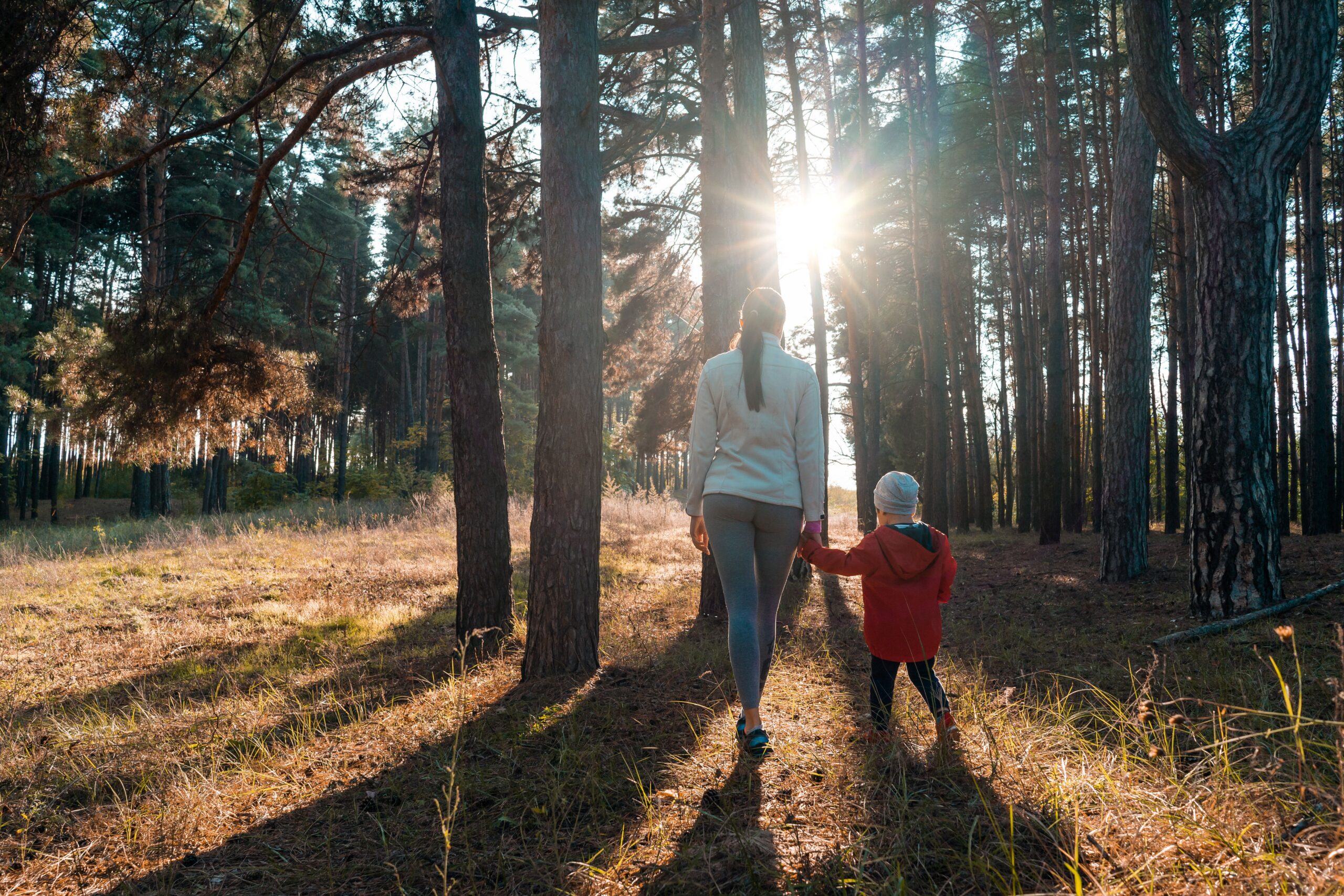
A break outside can sound like wellness fluff until you look at what the brain is being asked to process. Urban environments contain traffic, signage, crossings, noise, and constant small decisions. Natural environments can engage attention without demanding the same kind of directed control.
In a randomized controlled trial, 92 adults completed either a 40-minute nature walk or an urban walk matched for time and distance. Both groups improved in affect, but the nature group had a larger boost in positive affect.
The EEG results were especially interesting. The urban walk produced a larger increase in frontal midline theta, a neural signal associated with executive attention. The researchers interpreted the difference as greater attentional demand in the urban environment and more attentional rest in nature.
The environment is part of the break
This does not mean a tree emits focus chemicals or that every park walk makes cognition better. The more defensible idea is that environments differ in how much directed attention they demand.
A break spent navigating traffic, checking notifications, and making decisions may be physically away from work while still keeping the control system busy. A quieter natural setting can change both the task and the sensory environment.
That makes the break itself a design problem. If the only outdoor option is a noisy sidewalk, it can still provide movement and daylight. If a greener route is available without adding much time, the research gives you a reason to test it.
Make outside easy
Keep the friction low. A reusable water bottle can live by the door so leaving does not become a preparation ritual. If you want to sit rather than walk, a folding outdoor blanket makes grass or a park edge more usable.
For a short reset on a patio or porch, a portable seat pad can make an ordinary outdoor spot comfortable enough to use. If sound is overwhelming rather than restorative, foam earplugs can reduce harsh noise, although the goal is not to erase the environment completely.
Notice that none of these is a focus supplement. They simply remove small reasons not to take the break you intended to take.
The Livium recipe
Tool. Choose one nearby outdoor route or sitting spot that requires almost no planning.
Behavior. Use the outdoor break after a demanding block, not only when you are already completely depleted. Leave the work screen behind when possible.
Threshold. If the outdoor setting is unsafe, extremely hot, smoky, or otherwise stressful, do not force a nature break. The intervention is supposed to lower demand, not create another hazard.
| Break setting | Attentional demand | Useful when |
|---|---|---|
| Nature walk | Lower in the randomized trial | You need a deeper reset |
| Urban walk | More executive demand | Movement is the priority |
| Outdoor sitting | Low physical demand | You need quiet, not exercise |
| Phone scrolling outside | Still high information input | Less restorative for attention |
Source: McDonnell and Strayer, Scientific Reports, 2024.
You do not need 40 minutes every time
The trial used a 40-minute walk because research protocols need standardized exposure. That does not establish 40 minutes as a minimum effective dose for every real-world break.
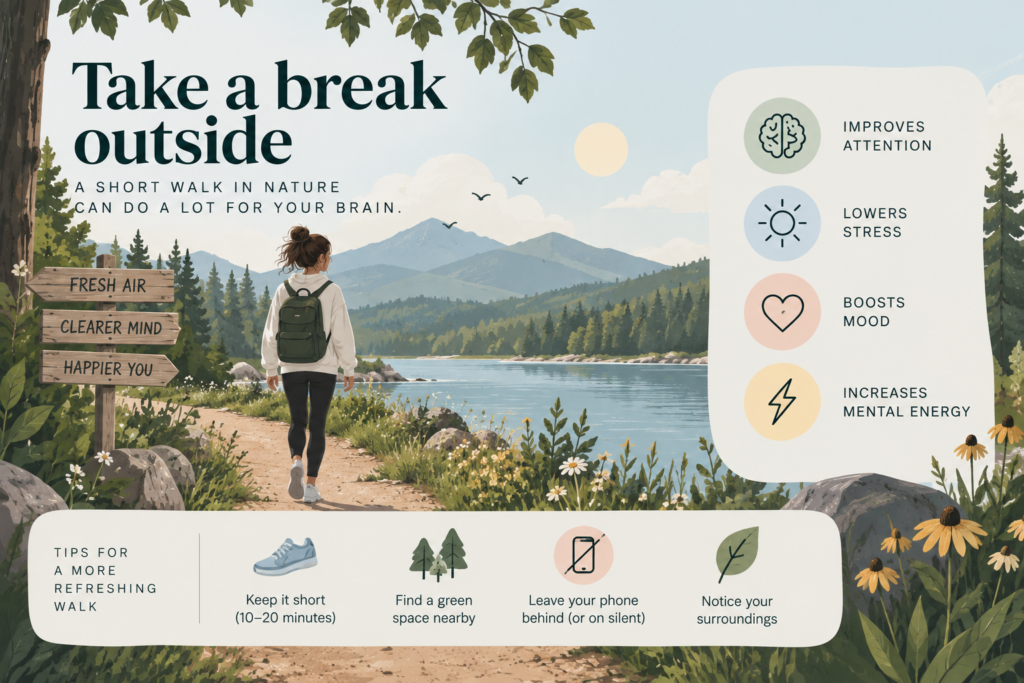
A practical workday experiment can start with 10 to 15 minutes. If a longer nature walk is available at lunch, use it. If you have seven minutes between calls, go outside for seven minutes rather than deciding it is not enough to count.
What to track
Do not ask whether you felt transformed. Ask whether you returned with less urge to switch tasks, less mental noise, and a clearer next action. Those are more useful outcomes for an Energy & Focus article than vague calm.
Compare the same kind of workday. On one day, take the usual indoor scrolling break. On another, take a short outdoor break without the phone. The goal is not a perfect experiment. It is enough consistency to notice whether the environment changes the quality of your return.
Nature is not a treatment for exhaustion
A park cannot repair chronic sleep deprivation, untreated depression, anemia, or another cause of low energy. Nature exposure is a way to structure a break, not an explanation for why you are exhausted.
The same applies to attention disorders. If concentration problems are persistent across settings and tasks, a greener lunch break may feel good without addressing the underlying condition.
Plan of action
- Pick one nearby outdoor route or sitting spot.
- Take the phone only if you need it for safety, and keep it off the screen.
- Try a 10-to-15-minute outdoor break after demanding work.
- Compare how you return to the task versus your usual indoor break.
Table of Content
Know your body better.
Trusted By Thousands Daily



FAQs
How long should a nature break be?
The randomized trial used 40 minutes, but that does not establish a minimum effective dose. Shorter real-world breaks are reasonable to test.
Does sitting outside count?
It can still change the sensory environment and reduce screen input, although the cited trial specifically studied walking.
Is a nature video the same as going outside?
No. Virtual nature may have benefits, but it is not equivalent to the real outdoor exposure used in this trial.
Legal Disclaimer
The content published on Livium Health is for informational and educational purposes only. Nothing on this site constitutes medical advice, diagnosis, or treatment. Always consult a qualified healthcare provider before making decisions about your health, including changes to medications, supplements, diet, or exercise.
Livium Health is not a medical practice and does not have a patient-provider relationship with its readers. We do not sell supplements, medications, or treatments, and we have no financial relationship with the products or services we reference.
While we work to ensure the information we publish is accurate and up to date, health and medical guidance evolves. We make no guarantees about the completeness or currency of any content on this site. Reliance on any information provided by Livium Health is solely at your own risk.
If you are experiencing a medical emergency, call 911 or your local emergency services immediately.
We may receive compensation, free products, or affiliate commissions for products mentioned in this post. Opinions are our own.