
Share
Men's Health
Sleep
Women's Health
Temperature and sleep: Why your bedroom is probably too warm
5 min read
Key takeaways
- Sleep onset requires a drop in core body temperature of approximately 1 to 1.5 degrees Celsius, a process that depends on the environment being cool enough to allow heat to dissipate from the skin.
- The ideal bedroom temperature for sleep in adults is 15 to 19 degrees Celsius (60 to 67 degrees Fahrenheit). Most people sleep warmer than this, particularly in summer or in centrally heated homes.
- A 5-degree Celsius increase in bedroom temperature reduces total sleep time by approximately 23 minutes and increases sleep onset latency, based on objective actigraphy data.
- Thermoregulation becomes less efficient with age, making temperature management increasingly important for midlife and older adults who may no longer cool as effectively as they once did.
How temperature initiates sleep
Sleep is not simply a behavior you choose. It is a physiological state that the brain initiates in response to specific conditions. One of the most critical is a drop in core body temperature. In the hours before sleep, the hypothalamus triggers vasodilation in the hands and feet, redistributing heat from the body’s core to its periphery, where it can radiate into the environment. Core temperature drops. Melatonin rises. The combination signals sleep onset to the brain.
This process requires the environment to be cool enough to accept the heat the body is trying to shed. When the bedroom is too warm, the body cannot offload heat efficiently, core temperature remains elevated, and sleep onset is delayed. The brain is trying to initiate sleep. The environment is not cooperating. The result is the feeling of lying awake too long even when you are genuinely tired.
The same mechanism operates across the night. Sleep fragmentation and early-morning waking are both associated with increases in core body temperature during the second half of the night, when thermoregulation is at its most demanding. A warm bedroom makes the second-half disruption more likely.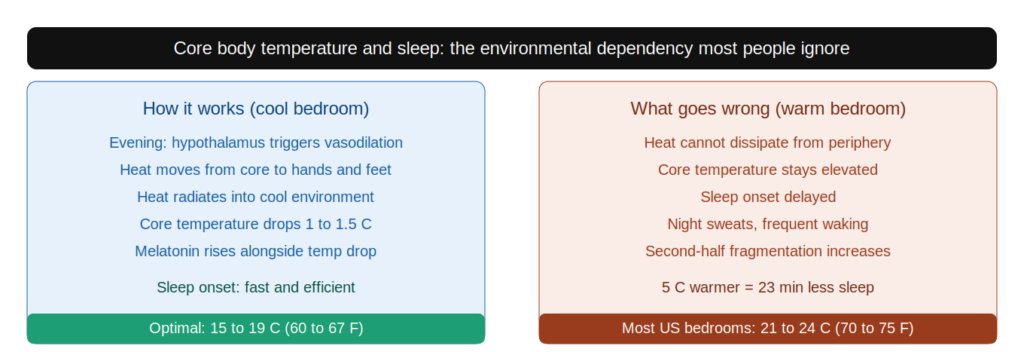
The midlife complication
Thermoregulatory efficiency declines with age. The hypothalamic circuitry that orchestrates the pre-sleep temperature drop becomes less precise. For women in perimenopause and menopause, the estrogen withdrawal directly disrupts thermoregulatory signaling, producing vasomotor symptoms (hot flashes) that override normal nighttime cooling. The bedroom temperature that was comfortable at 35 may be actively interfering with sleep at 48.
Perimenopausal women who wake during the night sweating and then feel cold are experiencing vasomotor instability: the thermoregulatory system is oscillating rather than maintaining the steady low-temperature state that deep sleep requires. Lowering the ambient bedroom temperature reduces the amplitude of these oscillations and the frequency of the associated awakenings. This is one of the most effective non-pharmacological interventions for perimenopausal sleep disruption and one of the least used.
The Livium recipe
Tool. The target is 15 to 19 degrees Celsius (60 to 67 Fahrenheit). Set the thermostat and test it for 14 nights. If a partner runs warmer or colder, separate duvets solve the conflict without requiring a temperature compromise. A cooling mattress pad or topper actively conducts heat away from the body through the sleep surface, often more effectively than air temperature alone, because the contact surface is constant. For night sweats specifically, moisture-wicking bedding prevents the wet-then-cold cycle that disrupts sleep after a night-sweat episode. A bedroom fan serves double duty: it lowers ambient temperature and provides the white noise that reduces acoustic sleep fragmentation.
Behavior. A warm bath or shower 60 to 90 minutes before bed is counterintuitive but evidence-based: it warms the skin, triggers compensatory vasodilation, and accelerates the drop in core temperature when you step into a cool bedroom afterward. The drop is faster and steeper than without pre-sleep heating, resulting in faster sleep onset. This is why a hot bath before bed reliably improves sleep, even though it might feel like it should do the opposite. Avoid vigorous exercise within two hours of bed: it significantly elevates core temperature and delays the cooling sleep requires.
Threshold. For women with significant vasomotor disruption: temperature management alone is a partial solution. Hone Health provides evaluation for hormonal contributors to night sweats and sleep disruption, which, when addressed, eliminate the underlying thermoregulatory instability rather than managing its downstream effects. A bedroom thermometer is the cheapest intervention in this space: know what your bedroom temperature actually is before trying more expensive solutions.
| Intervention | Effect | Notes |
|---|---|---|
| Lower thermostat to 15 to 19 C | Fastest and highest impact | Most people are sleeping 3 to 5 C too warm |
| Cooling mattress pad | Conducts heat from body contact surface | Particularly effective for night sweats |
| Hot bath 90 min before bed | Accelerates post-bath core temp drop | Fastest sleep onset improvement |
| Moisture-wicking bedding | Prevents wet-then-cold disruption | Targeted for night sweat sufferers |
Source: Koopman et al., JCM 2026 — Thermoregulation in Sleep Disorders: Comprehensive Review. CC BY 4.0.
Plan of action
- Tonight: measure your bedroom temperature. If it is above 19 C (67 F), lower it before anything else. This is the highest-leverage, lowest-cost sleep intervention available, and most people have not made it.
- Take a warm bath or shower 60 to 90 minutes before your target sleep time, then step into a cool bedroom. Run this experiment for one week and note the difference in time-to-sleep.
- If night sweats are disrupting sleep: address the bedding surface first with moisture-wicking sheets, then the room temperature, then consider whether the hormonal driver warrants clinical evaluation.
- If you share a bed and your partner runs hotter: separate duvets with different weights solve the temperature disagreement without requiring a compromise that works for neither person. This is a minor logistics decision, not a relationship statement.
Table of Content

Know your body better.
Trusted By Thousands Daily





FAQs
Should I sleep with a fan even if the room is already cool?
Yes, for two reasons. Moving air carries heat away from the skin more efficiently than still air at the same temperature. And the white noise a fan produces reduces acoustic sleep fragmentation, which is an independent benefit. A fan aimed at the bed rather than directly at the face is the most effective positioning.
Why do I feel cold when I wake up at 3 AM but hot when I go to bed?
Core body temperature reaches its lowest point around 3 to 4 AM, then begins rising as the cortisol awakening response prepares the body for waking. The chill you feel at 3 AM is your core temperature at its nadir. The warmth you feel at bedtime is residual heat from the day that has not yet dissipated. Both are normal. A cool bedroom helps both transitions go smoothly.
Does the temperature rule apply to children?
The same thermoregulatory mechanism applies, though children’s optimal sleep temperature is slightly warmer than adults’, typically 18 to 21 °C (65 to 70 °F). The principle of “cooler is better” holds across all ages.
Legal Disclaimer
The content published on Livium Health is for informational and educational purposes only. Nothing on this site constitutes medical advice, diagnosis, or treatment. Always consult a qualified healthcare provider before making decisions about your health, including changes to medications, supplements, diet, or exercise.
Livium Health is not a medical practice and does not have a patient-provider relationship with its readers. We do not sell supplements, medications, or treatments, and we have no financial relationship with the products or services we reference.
While we work to ensure the information we publish is accurate and up to date, health and medical guidance evolves. We make no guarantees about the completeness or currency of any content on this site. Reliance on any information provided by Livium Health is solely at your own risk.
If you are experiencing a medical emergency, call 911 or your local emergency services immediately.
We may receive compensation, free products, or affiliate commissions for products mentioned in this post. Opinions are our own.