
Share
Hormones
Women's Health
Testosterone in women: Why it matters, why it declines, and what to do about it
6 min read

Key takeaways
- Testosterone is not a male hormone. Women produce it in the ovaries and adrenal glands, and it is essential for libido, energy, muscle mass, bone density, mood, and cognitive function.
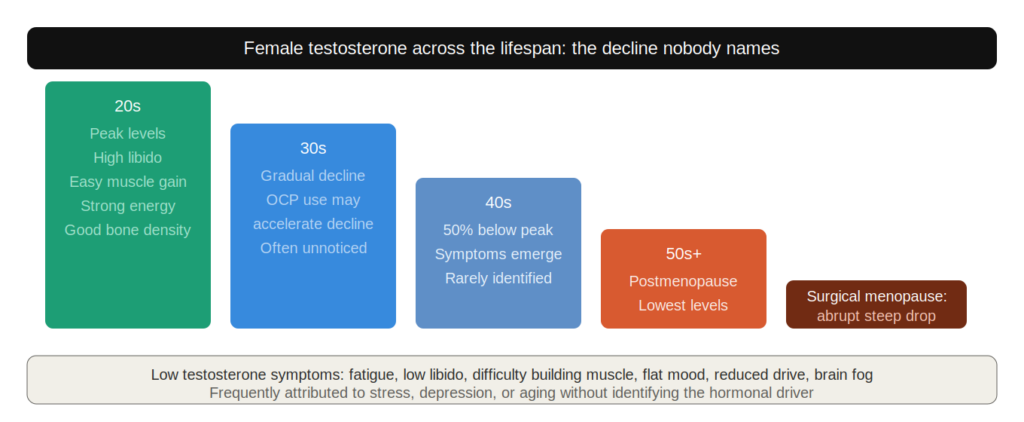
- Female testosterone peaks in the mid-20s and declines steadily thereafter, falling by 50 percent or more by the time a woman reaches menopause. The decline is gradual enough that most women attribute the symptoms to stress, aging, or perimenopause without identifying the hormonal driver.
- There is no FDA-approved testosterone product for women in the United States. Most women with symptomatic low testosterone are treated off-label with compounded transdermal preparations or go untreated entirely.
- Testing matters. There is no established cutoff for female testosterone deficiency, but free testosterone (the active fraction) and SHBG (sex hormone-binding globulin, which determines how much testosterone is biologically available) together give a more useful picture than total testosterone alone.
The hormone nobody talks about in women
The menopause conversation in women’s health is dominated by estrogen and progesterone. These are real and important. But there is a third hormone that receives almost no attention in standard clinical practice: testosterone. Women produce it. They need it. They lose it. And when they do, the symptom list is specific, recognizable, and treatable.
Female testosterone is produced primarily in the ovaries and adrenal glands and circulates at levels roughly one-tenth of male levels. The absolute numbers are lower, but the receptors are equally present and equally sensitive. Testosterone drives libido, maintains muscle mass and bone density, supports energy and motivation, and significantly affects mood and cognitive function in women. Low testosterone in women looks like low testosterone in men: fatigue, reduced drive, difficulty building or maintaining muscle, reduced libido, flat affect. The symptom profile is not subtle. It is just rarely attributed to the right cause.
Why it declines and when
Female testosterone peaks in the mid-20s and declines at roughly one to two percent per year thereafter. By 40, most women have total testosterone levels 50 percent below their peak. By menopause, particularly in women who undergo surgical menopause (ovary removal), the decline is more abrupt and often more symptomatic.
Oral contraceptive use accelerates the effective decline. Oral estrogen-containing contraceptives increase SHBG (sex hormone-binding globulin), which binds testosterone and reduces the free fraction available to tissues. A woman on oral contraceptives may have a normal total testosterone and a significantly reduced free testosterone, producing symptoms of deficiency while testing in the normal range. This is a common and underrecognized presentation.
Chronic stress also suppresses testosterone production through cortisol’s competitive relationship with the adrenal hormone production pathway (the “cortisol steal”). Women under sustained high stress commonly experience testosterone suppression independent of age-related decline.
The FDA gap and what women actually do
More than 30 FDA-approved testosterone products exist for men in the United States. The number for women is zero. This is not because testosterone does not work in women or because the evidence is thin. The British Menopause Society and The Menopause Society both recommend testosterone for hypoactive sexual desire disorder (low libido) in postmenopausal women, citing substantial evidence. The FDA gap exists because no pharmaceutical company has pursued approval of a female-specific product, largely due to liability concerns stemming from earlier estrogen trial results.
Women who are treated are treated off-label, typically through compounding pharmacies producing transdermal creams or gels at female-appropriate doses. The doses used in women are significantly lower than those for men. When dosed appropriately, the safety profile is favorable across multiple years of data.
The Livium recipe
Tool. The right panel: total testosterone, free testosterone, SHBG, and DHEA-S, drawn in the morning when testosterone is highest. SHBG is critical: a high SHBG binds most of the testosterone, leaving little free for tissues regardless of total level. Low total testosterone with normal SHBG is different from normal total testosterone with very high SHBG. Function Health covers all of these alongside the broader hormonal context. For resistance training, which is the most evidence-based lifestyle intervention for supporting endogenous testosterone production, adjustable dumbbells for home resistance training remove the gym barrier that prevents consistent training.
Behavior. Resistance training three times per week is the most powerful modifiable lifestyle factor for supporting testosterone in women. It directly enhances androgen receptor sensitivity and supports muscle retention even as circulating testosterone declines. Adequate sleep (below seven hours suppresses testosterone production) and stress management (chronic cortisol elevation directly reduces testosterone production) are the two behavioral levers most commonly ignored. Zinc deficiency is consistently associated with lower testosterone in both sexes; 25-30 mg of zinc daily is worth checking and supplementing if dietary intake is low.
Threshold. If free testosterone is low and symptoms are present: a menopause-informed gynecologist or endocrinologist with experience in female androgen therapy is the right referral. Hone Health provides hormone-aware telehealth evaluation for women and can assess whether testosterone replacement is appropriate. This is a clinical decision that requires context: symptoms, full hormonal panel, cardiovascular history, and treatment goals all factor in.
| Symptom | Testosterone link | What to check |
|---|---|---|
| Low libido | Strongest association; RCT evidence for treatment | Free testosterone, SHBG |
| Fatigue and low drive | Consistent association; less specific | Full panel including thyroid and cortisol |
| Muscle loss and weakness | Testosterone supports muscle protein synthesis | DEXA scan baseline plus full hormone panel |
| Mood flatness and low motivation | Androgen receptors present in prefrontal cortex | Rule out thyroid and cortisol first |
Source: Donovitz, Journal of Personalized Medicine 2022 — Testosterone Therapy in Women. CC BY 4.0.
Plan of action
- Get a morning hormone panel that includes free testosterone and SHBG. Most standard panels ordered by GPs measure only total testosterone, which misses the high-SHBG presentation. Explicitly request the full panel, or use Function Health.
- Start resistance training three times per week if you are not already. This is not optional as a supporting intervention. It is the most evidence-based lifestyle lever for androgen receptor sensitivity and muscle retention in the context of declining testosterone.
- If you are on oral contraceptives and experiencing low libido, fatigue, or flat mood: discuss with your provider whether a non-oral method (IUD, patch, ring) that does not elevate SHBG might be appropriate. This is not a blanket recommendation against contraception. It is a mechanistic conversation worth having.
- For women with confirmed low free testosterone and significant symptoms: Hone Health provides evaluation and, where appropriate, prescription. The conversation about testosterone replacement in women is no longer fringe. It is mainstream in menopause medicine. Finding a provider who knows the evidence is the practical challenge. A DHEA supplement (25 to 50 mg) is available over the counter and is a precursor to both estrogen and testosterone; some women with adrenal-driven low testosterone respond to DHEA supplementation while awaiting clinical evaluation.
Table of Content

Know your body better.
Trusted By Thousands Daily




FAQs
Will testosterone therapy make women grow facial hair or develop a deeper voice?
At physiological replacement doses, these side effects are uncommon. They occur primarily with supraphysiological dosing (doses intended to produce male-range testosterone levels). Female testosterone therapy uses doses that restore levels to the low-normal female range, not the male range. Monitoring and dose adjustment prevent overdosing.
Is testosterone safe for women with a history of breast cancer?
This is an area of active research. Some observational data suggest testosterone does not increase breast cancer risk and may have a protective effect in hormone-receptor-positive cancer survivors. The evidence is not conclusive. Women with a cancer history should have this conversation with an oncologist and a menopause-informed clinician together.
What is the difference between DHEA and testosterone supplementation?
DHEA is a precursor hormone converted to both testosterone and estrogen in peripheral tissues. It is available over the counter. Testosterone therapy directly delivers the hormone. DHEA conversion to testosterone is variable and depends on individual enzyme activity, making it a less predictable intervention than direct testosterone therapy. It is a reasonable first step while pursuing clinical evaluation.
Legal Disclaimer
The content published on Livium Health is for informational and educational purposes only. Nothing on this site constitutes medical advice, diagnosis, or treatment. Always consult a qualified healthcare provider before making decisions about your health, including changes to medications, supplements, diet, or exercise.
Livium Health is not a medical practice and does not have a patient-provider relationship with its readers. We do not sell supplements, medications, or treatments, and we have no financial relationship with the products or services we reference.
While we work to ensure the information we publish is accurate and up to date, health and medical guidance evolves. We make no guarantees about the completeness or currency of any content on this site. Reliance on any information provided by Livium Health is solely at your own risk.
If you are experiencing a medical emergency, call 911 or your local emergency services immediately.
We may receive compensation, free products, or affiliate commissions for products mentioned in this post. Opinions are our own.