
Share
Men's Health
Mental Health
Women's Health
The case for doing nothing: Why the brain needs unstructured time
6 min read

Key takeaways
- The default mode network (DMN) activates during mental rest and is responsible for memory consolidation, creative problem-solving, self-referential processing, and future planning. It requires unstructured time to do its work.
- Most adults in 2026 have effectively eliminated DMN activation time by filling every available mental moment with a podcast, a scroll, or a notification response. The brain’s maintenance processes are being blocked by the relentless supply of external stimulation.
- Boredom, specifically the uncomfortable phase before the mind settles into unstructured thought, is the gateway to creative insight and memory consolidation. Eliminating boredom eliminates those processes.
- Twenty minutes of genuine mental rest daily, not sleep, not meditation, just undirected mental activity, produces measurable improvements in memory, creativity, and problem-solving performance in published research.
The brain network that only works when nothing else is happening
The default mode network was discovered in 2001 by Marcus Raichle at Washington University, who noticed that certain brain regions consistently deactivated during focused task performance and consistently activated during rest. The DMN includes the medial prefrontal cortex, the posterior cingulate cortex, and the angular gyrus. Its activation pattern correlates with mind-wandering, autobiographical memory retrieval, theory of mind (the ability to model other people’s mental states), and prospective thinking about the future.
The DMN does not activate during passive consumption of external content. A person watching a video, listening to a podcast, or scrolling a feed is not in DMN mode. They are in task mode, because external input continuously demands attentional processing. The DMN requires the absence of external demands. Not reduced demands. Absence.
The practical consequence: a person who fills every idle moment with external content is blocking the brain’s access to a critical processing mode. Memory consolidation (which happens during both sleep and DMN activation), creative insight (which emerges from DMN-driven association across disparate stored memories), and emotional processing (which requires the self-referential capacity the DMN provides) are all being suppressed by constant stimulation.
The science of boredom
Boredom is not an absence of experience. It is a specific experiential state characterized by low engagement and a search for meaningful stimulation. The uncomfortable transition into boredom, the fidgeting, the impulse to reach for the phone, the restlessness, is the brain’s resistance to shifting from external-task mode into DMN mode. Most people terminate this discomfort by reaching for stimulation before the transition completes.
Research on boredom and creativity consistently shows that subjects allowed to sit with boredom before a creativity task outperform subjects who engaged in active entertainment before the same task. The bored subjects generated more creative solutions and more unusual associations. The interpretation: boredom successfully triggered DMN activation, which in turn produced the associative cognitive state most conducive to creative insight.
A 2016 study in Psychological Science found that subjects who were given a boring task to complete before a creative task generated significantly more creative ideas than subjects who rested passively or engaged in an enjoyable task. Boredom specifically, not rest, produced the creative enhancement.
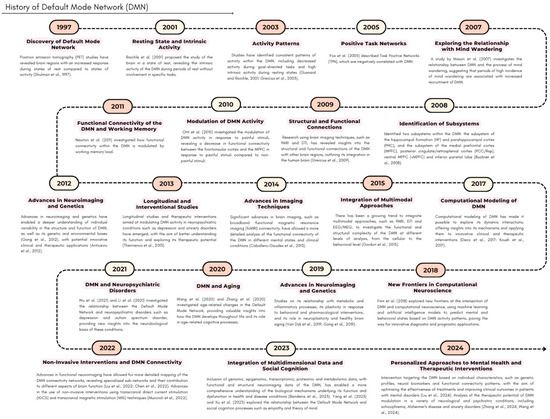
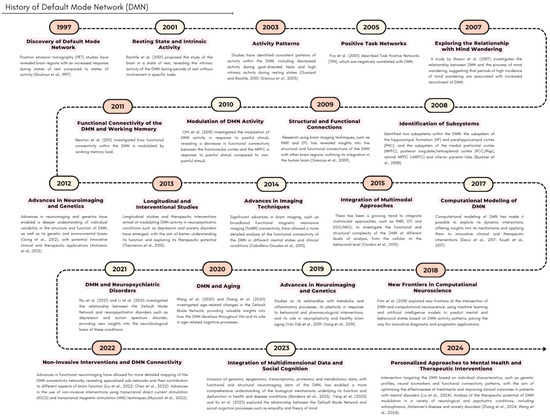
The default mode network activates during wakeful rest and disengages during focused external tasks. Its core regions — medial prefrontal cortex, posterior cingulate cortex, and angular gyrus — support self-referential thought, memory consolidation, and creative association. Suppressing it with constant external input blocks these processes entirely. Source: Maria, Biology 2025 — The Journey of the Default Mode Network. CC BY 4.0.
What counts as unstructured time and what does not
Does activate the DMN: walking without headphones, showering without a podcast, sitting without a device, staring out a window, cooking a familiar recipe on autopilot, gardening without an audiobook, lying in bed awake after waking before reaching for the phone.
Does not activate the DMN: any content consumption regardless of the medium, structured meditation with a guided instruction track, any activity requiring focused attention on an external input.
Note on meditation: some forms of meditation do activate the DMN, specifically open-monitoring meditation where the practitioner observes arising thoughts without directing attention to a specific object. The guided meditation that most people use from apps is primarily focused attention meditation, which suppresses the DMN. Both have value; they are not the same thing.
The Livium recipe
Tool. A Muse 2 meditation headband provides EEG-based feedback on brain state during rest periods, distinguishing focused, active, and neutral brain activity. For people who want to verify that they are actually achieving DMN-compatible rest rather than just sitting with anxiety, the EEG feedback closes the loop. A Moleskine notebook for capturing ideas and insights that reliably emerge during unstructured time: having a capture mechanism available makes the practice more productive and provides a record of what the DMN generates.
Behavior. Twenty minutes of daily intentional unstructured time. Scheduled, not residual. Morning walk without headphones. Ten minutes in a chair without a device between tasks. Cooking dinner without a podcast. The format is irrelevant. The requirement is the absence of external input demanding attention. Schedule it like any other appointment. It will not happen accidentally in a life where every gap is currently filled.
Threshold. After two weeks of consistent daily unstructured time: creative problem-solving at work should feel qualitatively different. The “I’ll think about it in the shower” phenomenon will begin happening more reliably because the shower will again be genuinely unstructured. Memory for recent events and conversations may improve. The specific problems that arrive unbidden during the unstructured periods are the DMN identifying what it considers unresolved and important, which is itself useful information.
The cognitive support stack for DMN function
NOW Foods Phosphatidyl Serine 100 mg supports the neuronal membrane integrity that underlies optimal DMN connectivity. The DMN requires efficient synaptic transmission across widely distributed brain regions; phosphatidylserine supports the membrane fluidity that enables this. Three capsules daily is the dose used in cognitive research. A Calm app subscription provides structured access to open-monitoring meditation sessions specifically designed to facilitate DMN activation, alongside sleep stories and nature sounds for the falling-asleep window.
Unstructured time: what it produces and what blocks it
| DMN process | What it does for you | What blocks it |
|---|---|---|
| Memory consolidation | Integrates recent experience into long-term memory | Immediate re-engagement with external input after learning |
| Creative association | Connects disparate stored memories to generate novel solutions | Constant task engagement; content consumption |
| Emotional processing | Integrates emotionally significant events into autobiographical narrative | Avoidance via distraction; phone as emotional escape |
| Future simulation | Models possible futures for planning and decision-making | Reactive mode from constant notifications |
| Theory of mind | Models other people’s mental states; supports empathy and social judgment | Social media (parasocial contact without true theory-of-mind demand) |
Source: Livium editorial synthesis based on Raichle et al., PNAS (2001) and NIMH Brain Basics resources.
Plan of action
- This week: take one daily walk without headphones or a phone. Twenty minutes minimum. Notice the discomfort in the first five minutes and do not resolve it with the phone. Let the DMN activate.
- Identify the three moments in a typical day when external content is reflexively consumed. Commute, lunch, cooking. Convert one of them to intentionally unstructured time this week.
- Keep a notebook nearby during unstructured time. The ideas and insights that emerge are worth capturing. They also reinforce the habit by demonstrating that the unstructured time is producing something.
- After two weeks, assess whether the quality of creative and strategic thinking at work has shifted. Most people notice within two weeks if they are honest about the comparison.
Table of Content

Know your body better.
Trusted By Thousands Daily







FAQs
Is listening to music the same as listening to a podcast?
Largely no, with nuance. Instrumental music at a moderate volume without lyrics allows more DMN activation than verbal content because it does not make language processing demands. Familiar instrumental music in particular engages the brain minimally and can coexist with productive mind-wandering. Lyrics require language processing that competes with DMN activation. Podcasts require sustained language processing and are effectively task-state input.
Can children and teenagers benefit from this too?
Significantly. Unstructured play time in children is the DMN-activating equivalent and is associated with better creativity, emotional regulation, and social problem-solving. The same principle applies to adolescents. The developmental literature on boredom tolerance and creative development in children is consistent with the adult DMN research.
What if unstructured time produces anxiety rather than creative thought?
This is common and diagnostically useful. If the brain reliably produces anxiety when given unstructured time, it is flagging unresolved material that the constant stimulation is suppressing. The anxiety is the content of the DMN, not a dysfunction of the system. The resolution is not more stimulation. It is addressing the unresolved material through journaling, therapy, or direct action on the source of the anxiety, so the DMN has something other than threat to work with.
Legal Disclaimer
The content published on Livium Health is for informational and educational purposes only. Nothing on this site constitutes medical advice, diagnosis, or treatment. Always consult a qualified healthcare provider before making decisions about your health, including changes to medications, supplements, diet, or exercise.
Livium Health is not a medical practice and does not have a patient-provider relationship with its readers. We do not sell supplements, medications, or treatments, and we have no financial relationship with the products or services we reference.
While we work to ensure the information we publish is accurate and up to date, health and medical guidance evolves. We make no guarantees about the completeness or currency of any content on this site. Reliance on any information provided by Livium Health is solely at your own risk.
If you are experiencing a medical emergency, call 911 or your local emergency services immediately.
We may receive compensation, free products, or affiliate commissions for products mentioned in this post. Opinions are our own.