
Share
Longevity & Aging
Men's Health
Women's Health
The connection between hearing loss and dementia: What the research shows and what it doesn’t
6 min read

Key takeaways
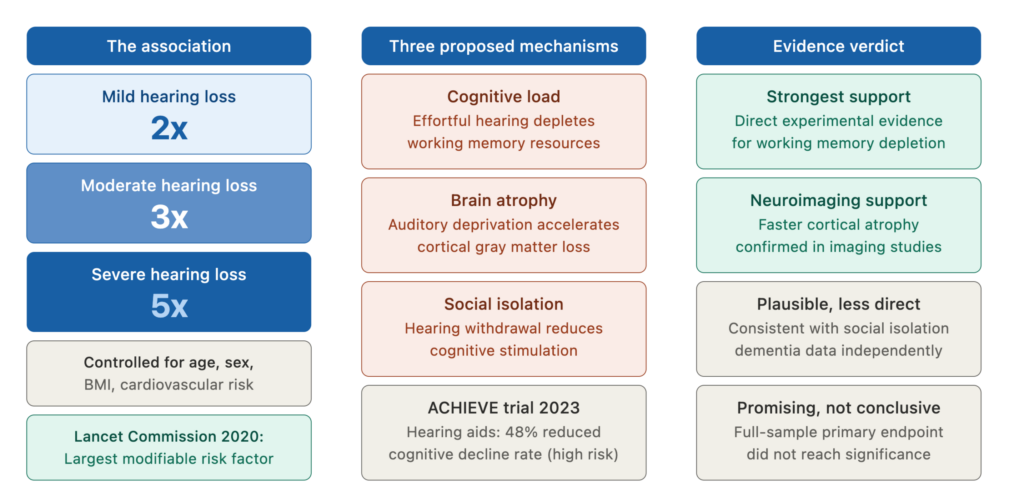
- The association between hearing loss and dementia is one of the most robust findings in aging research. Adults with untreated moderate hearing loss have roughly twice the risk of dementia compared to those with normal hearing. Severe hearing loss raises that risk to approximately five times.
- The mechanisms proposed are cognitive load, brain atrophy, and social isolation. None has been definitively established as primary. Most researchers believe all three contribute. The cognitive load hypothesis (the brain exhausting resources on effortful hearing that should go to memory and executive function) has the most direct experimental support.
- The evidence that hearing aids reduce dementia risk is promising but not conclusive. A 2023 randomized controlled trial found a 48 percent reduction in the rate of cognitive decline over three years among high-risk adults who received hearing intervention. The finding is significant but has not yet been replicated at scale.
- Treating hearing loss is currently the highest-evidence single intervention for dementia risk reduction among modifiable factors identified by the Lancet Commission. That does not mean it prevents dementia. It means it reduces risk, which is worth doing on its own terms regardless of dementia.
The number that changed how researchers think about hearing
Frank Lin at Johns Hopkins published the paper that shifted the conversation in 2011. Adults with mild hearing loss had a twofold increased risk of dementia. Moderate loss: threefold. Severe loss: fivefold. The association held after controlling for age, sex, race, education, diabetes, smoking, and hypertension. Hearing loss was not just associated with dementia. It appeared to be an independent risk factor for it.
The 2020 Lancet Commission on Dementia Prevention, Intervention, and Care synthesized the global evidence and identified 12 modifiable risk factors responsible for approximately 40 percent of dementia cases. Hearing loss topped the list, accounting for 8 percent of the modifiable burden. More than physical inactivity. More than smoking. More than hypertension.
This does not mean hearing loss causes dementia. Association is not causation, and the dementia research literature is filled with associations that failed to translate into causal relationships or effective interventions. But the consistency of the finding across multiple independent research groups, countries, and methodologies lends it greater weight than most associations in this space.
Three mechanisms, one outcome
Cognitive load. Effortful listening consumes working memory and executive function resources that would otherwise support memory encoding, attention, and reasoning. When understanding speech requires conscious effort rather than automatic processing, the brain is allocating resources to a task it should not need to go to. Over years, this chronic reallocation may accelerate decline in the cognitive domains that depend on those resources.
Brain atrophy. Neuroimaging studies show faster gray matter atrophy in the auditory cortex and associated regions in adults with hearing loss than in age-matched controls with normal hearing. The sensory deprivation hypothesis proposes that reduced auditory input reduces the stimulation that normally maintains cortical tissue. Use it or lose it, applied to the auditory brain.
Social isolation. Hearing loss drives social withdrawal. Hearing-impaired adults avoid social situations where they struggle to follow conversation, reduce attendance at group activities, and report higher rates of loneliness. Social isolation is itself an independent dementia risk factor. Hearing loss may be partially mediating its dementia risk through the social isolation pathway rather than through direct neurological effects.
What the 2023 RCT found and what it didn’t prove
The ACHIEVE trial, published in The Lancet in 2023, randomized 977 cognitively normal adults aged 70 to 84 with hearing loss to either hearing intervention (hearing aids plus audiological support) or a healthy aging education control. Over three years, the hearing intervention group showed a 48 percent reduction in cognitive decline rate compared to controls in a pre-specified subgroup of adults at elevated dementia risk.
The limitations matter. The primary analysis in the full sample did not reach statistical significance. The significant finding was in the pre-specified higher-risk subgroup. The study was three years, which is a relatively short window for dementia research. The cognitive decline rate is not the same as dementia incidence. The trial is promising, not conclusive.
The Livium take: the evidence is strong enough to act on. Treating hearing loss has direct benefits for communication, quality of life, social participation, and cognitive reserve that are independent of any effects of dementia. If the dementia risk reduction is real, treating hearing loss is one of the highest-leverage longevity interventions available to midlife adults. If it is not, you still hear better. The downside of acting on this evidence is zero.
The Livium recipe
Tool. Hearing assessment first. A validated home hearing screening tool gives a starting point before committing to a clinic visit. For cognitive tracking alongside hearing: a cognitive assessment that tracks processing speed and working memory over time provides the baseline that makes change visible. For full bloodwork context on dementia-adjacent markers (ApoE status, if desired; inflammatory markers; metabolic panel), Function Health provides a comprehensive panel that includes the metabolic and inflammatory context relevant to brain health.
Behavior. Treat hearing loss if it is present. This is the intervention. All three proposed mechanisms (cognitive load, brain atrophy, social isolation) are directly addressed by restoring hearing function. Hearing aids reduce listening effort, restore auditory cortex stimulation, and enable social participation. The mechanism debate does not change the intervention. Separately: maintain the other Lancet Commission modifiable factors. Physical activity, blood pressure control, social connection, sleep quality, and smoking cessation all reduce dementia risk through independent pathways. Hearing is one lever among several that compound.
Threshold. If you are 50 or older and have not had a hearing assessment in the past five years: get one. Not because you think you have a problem. Because the 4,000 Hz notch that precedes functional hearing loss by a decade is asymptomatic, and catching it early is the entire point of surveillance.
| Hearing loss degree | Relative dementia risk | Intervention |
|---|---|---|
| Normal hearing | Baseline | Protect with annual audiograms and noise avoidance |
| Mild loss (25 to 40 dB) | 2x baseline | OTC hearing aid, audiologist evaluation |
| Moderate loss (41 to 55 dB) | 3x baseline | Prescription hearing aids, consistent use |
| Severe loss (71 dB+) | 5x baseline | Prescription aids, consider cochlear implant evaluation |
Source: Livingston et al., The Lancet 2020 — Dementia Prevention, Intervention, and Care.
Plan of action
- Get a hearing assessment if you have not had one in the past five years. The evidence for the hearing-dementia link is strong enough to make this a routine step in longevity screening, not just a response to a complaint.
- If hearing loss is confirmed: treat it. The ACHIEVE trial enrolled adults who were resistant to hearing aids. Many reported improved social participation and cognitive confidence within the first year. The device is not the obstacle. The willingness to use it consistently is.
- Add the other Lancet Commission levers: exercise, blood pressure control, sleep quality, social connection. A blood pressure monitor at home tracks the cardiovascular risk factor most tightly linked to dementia alongside hearing loss. These are not competing interventions. They stack.
- If a parent or partner has untreated hearing loss: this article is the argument. The seven-year delay is happening in someone you know right now. The combination of communication difficulty, social withdrawal, and cognitive risk is not inevitable. A captioned telephone or amplified phone can reduce daily communication strain immediately while the hearing aid conversation is ongoing.
Table of Content

Know your body better.
Trusted By Thousands Daily






FAQs
Does treating hearing loss actually prevent dementia?
The honest answer is: probably reduces risk, not yet proven to prevent. The ACHIEVE trial showed a reduced rate of cognitive decline, not dementia prevention. The association data is strong; the causal and intervention evidence is still accumulating. Treating hearing loss is worth doing on its own merits, and the reduction in dementia risk is a significant bonus if the causal relationship holds.
What age should I start worrying about the hearing-dementia link?
The research is primarily conducted in adults over 60, but the hearing loss that drives the risk often begins in the 40s and 50s. The earlier the loss is identified and treated, the longer the intervention has to modify the risk trajectory. Starting surveillance at 50 is reasonable.
Is the hearing-dementia link stronger in men or women?
The association appears in both sexes, but men have higher rates of hearing loss overall due to greater occupational and recreational noise exposure. Women with hearing loss may face a different risk profile because their hearing loss often begins later and progresses differently. The intervention rationale applies equally to both.
Legal Disclaimer
The content published on Livium Health is for informational and educational purposes only. Nothing on this site constitutes medical advice, diagnosis, or treatment. Always consult a qualified healthcare provider before making decisions about your health, including changes to medications, supplements, diet, or exercise.
Livium Health is not a medical practice and does not have a patient-provider relationship with its readers. We do not sell supplements, medications, or treatments, and we have no financial relationship with the products or services we reference.
While we work to ensure the information we publish is accurate and up to date, health and medical guidance evolves. We make no guarantees about the completeness or currency of any content on this site. Reliance on any information provided by Livium Health is solely at your own risk.
If you are experiencing a medical emergency, call 911 or your local emergency services immediately.
We may receive compensation, free products, or affiliate commissions for products mentioned in this post. Opinions are our own.