
Share
Men's Health
Mental Health
Women's Health
The cortisol-depression link: When stress becomes something harder to shake
5 min read

Key takeaways
- Chronic elevated cortisol is one of the most well-established biological contributors to depression. It damages the hippocampus, suppresses neurogenesis, impairs serotonin signaling, and produces the flattened affect, cognitive slowing, and anhedonia that are the hallmarks of major depression.
- The trajectory from chronic stress to depression is not immediate. It unfolds over months to years of sustained HPA axis dysregulation. The person who says “I have been stressed for years, and now I am depressed” is often describing this exact biological progression, not a coincidence.
- Elevated cortisol in midlife adults is not always driven by psychological stress. Poor sleep, metabolic dysfunction, subclinical hypothyroidism, and chronic inflammation all dysregulate the HPA axis. Treating depression without investigating and addressing these drivers produces incomplete and often temporary responses to antidepressants.
- The cortisol-depression link runs in both directions. Depression elevates cortisol, which worsens depression. Breaking the cycle requires addressing both ends simultaneously, not just treating the mood symptoms.
The stress that does not lift
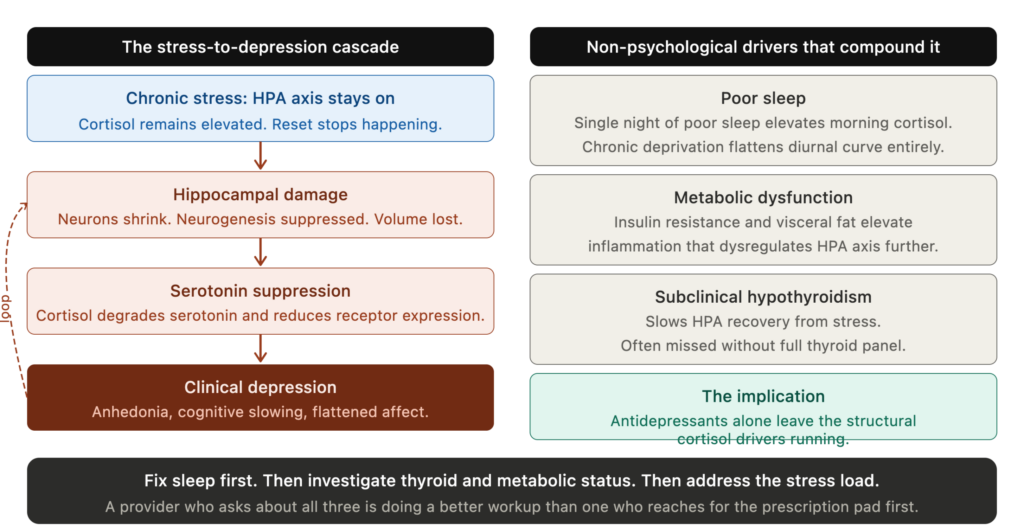
Stress is supposed to be temporary. Cortisol fires; the threat is resolved; cortisol clears; the system resets. This is how the HPA axis is designed to work. In midlife, for a significant proportion of adults, the reset stops happening. The stressors do not resolve. The cortisol stays elevated. The system that was designed for acute responses gets locked into a chronic output that wears down every system it touches.
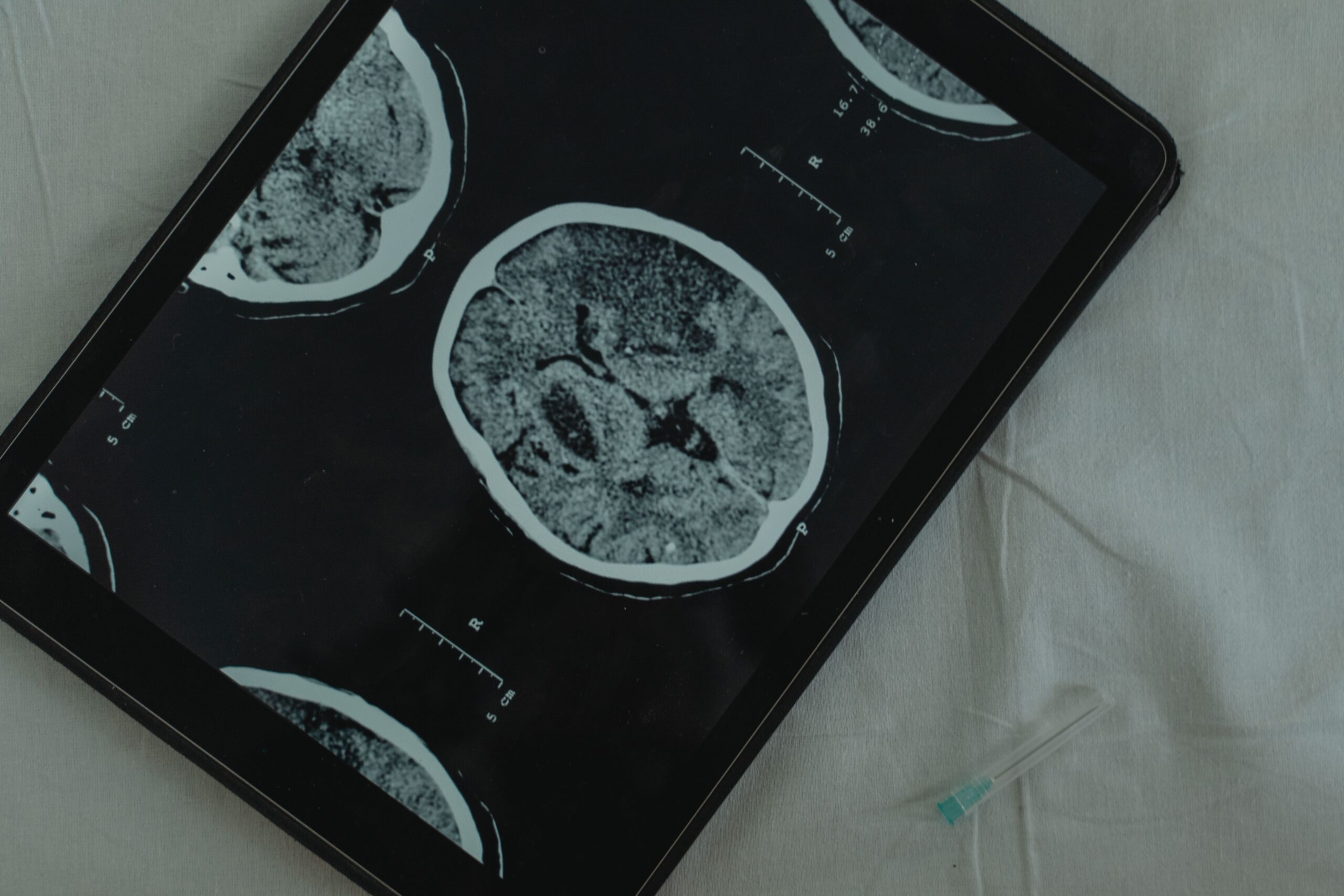
The hippocampus is the first casualty. It is the brain structure responsible for memory consolidation, emotional regulation, and HPA axis feedback. It is also densely packed with glucocorticoid receptors, which makes it highly responsive to cortisol and highly vulnerable when cortisol is chronically elevated. Sustained cortisol exposure causes hippocampal neurons to shrink and die, and suppresses the neurogenesis that would normally replace them. Hippocampal volume loss is one of the most consistent neuroimaging findings in major depression.
The serotonin connection is equally direct. Cortisol increases the activity of the enzyme that degrades serotonin, thereby reducing the amount of serotonin available at synapses. It also reduces the expression of serotonin receptors in the prefrontal cortex. This is why the stress-to-depression progression feels like a slow dimming: the neurochemical infrastructure for positive mood, motivation, and reward is being systematically dismantled.
The non-psychological drivers that get missed
Sleep deprivation is the strongest non-psychological driver of cortisol. A single night of poor sleep significantly elevates morning cortisol. Chronic sleep deprivation produces a persistently dysregulated diurnal cortisol pattern with blunted morning peak and elevated evening levels. Adults with insomnia and depression who treat only the depression often find incomplete response because the cortisol dysregulation from poor sleep is still running.
Metabolic dysfunction, particularly insulin resistance, is bidirectionally linked to HPA axis dysregulation. Elevated cortisol drives insulin resistance; insulin resistance, in turn, elevates inflammatory markers that further dysregulate the HPA axis. Visceral fat is itself an inflammatory tissue. The midlife adult with expanding waistline, poor sleep, and depressive symptoms is often caught in a metabolic-neuroendocrine loop that requires simultaneous metabolic and psychological intervention.
Subclinical hypothyroidism slows HPA axis recovery from stress and is associated with elevated evening cortisol. Adults with treatment-resistant depression and fatigue who have never had a full thyroid panel including free T3 are missing a workup step that could explain why antidepressants have not worked as expected.
The Livium recipe
Tool. Cortisol testing informs the picture. A four-point salivary cortisol test (morning, noon, afternoon, evening) maps the diurnal pattern and identifies whether the dysregulation is morning hyperactivation, evening elevation, or a flat pattern. Function Health includes cortisol, along with metabolic and thyroid markers, to provide context. For sleep tracking: an Oura Ring or equivalent HRV tracker provides nightly readiness and recovery scores that make the sleep-cortisol-mood relationship visible over time. For phosphatidylserine, which has the most direct evidence among supplements for reducing cortisol response to stress: 100 mg three times daily has RCT data showing blunted cortisol response to psychological stress in adults under chronic load.
Behavior. The three behaviors with the strongest evidence for lowering chronic cortisol: aerobic exercise (lowers baseline HPA axis reactivity with regular training), sleep consolidation (fixing the sleep-cortisol loop is often the highest-leverage single intervention), and social connection (social support is one of the most potent cortisol buffers identified in stress research). Meditation and breathwork have consistent but smaller effect sizes on cortisol. Worth doing, not sufficient alone. For the metabolic component: reducing refined carbohydrate and alcohol intake removes two significant HPA axis stressors. Alcohol in particular disrupts overnight cortisol regulation even in moderate amounts.
Threshold. Depression is a clinical condition. If low mood, anhedonia, fatigue, and cognitive slowing have persisted for more than two weeks: see a physician or psychiatrist. The cortisol framework is additive information, not a replacement for clinical assessment and treatment. A provider who asks about sleep, metabolic health, and thyroid function alongside the mood history is doing a better workup than one who reaches immediately for an SSRI prescription.
| Driver of cortisol dysregulation | Signal | Intervention |
|---|---|---|
| Chronic psychological stress | Elevated morning cortisol, elevated reactivity | CBT, exercise, social support, adaptogens |
| Poor sleep | Elevated evening cortisol, flat diurnal curve | Sleep consolidation as priority intervention |
| Metabolic dysfunction | Elevated fasting insulin, visceral fat, inflammation | Dietary improvement, resistance training, CGM |
| Subclinical hypothyroidism | Fatigue, cold sensitivity, slow HPA recovery | Full thyroid panel, treatment if indicated |
Source: NIMH: Depression.
Plan of action
- If you have been under sustained stress for more than six months and are noticing depressive symptoms: get a full panel before attributing everything to circumstance. TSH, free T3, fasting insulin, and hs-CRP, alongside standard metabolic markers, will identify the physiological contributors amplifying the psychological load.
- Fix sleep first. Everything else in this article is secondary to sleep consolidation. The cortisol dysregulation from chronic sleep deprivation is sufficient to produce depressive symptoms independently of psychological stress. A consistent wake time, reduced evening alcohol intake, and reduced evening light exposure are the three highest-leverage sleep interventions.
- Add ashwagandha KSM-66 300 mg morning and evening. The adaptogen evidence for HPA axis normalization is the most consistent in this category, with multiple RCTs showing reduced cortisol and improved mood outcomes in chronically stressed adults.
- See a physician or psychiatrist if depressive symptoms persist beyond two weeks. Bring your lab results. Ask specifically about the thyroid and metabolic context. A mood and symptom-tracking journal kept for two to four weeks before the appointment gives the clinician a more accurate picture than self-reported memory.
Table of Content

Know your body better.
Trusted By Thousands Daily




FAQs
Does high cortisol always cause depression?
No. Elevated cortisol is one pathway to depression, not the only one. Many people with chronically elevated cortisol do not become depressed. Individual resilience factors, social support, genetic variation in HPA axis regulation, and the duration and predictability of the stress all influence the outcome. The cortisol pathway is relevant because it is modifiable.
Can antidepressants fix the cortisol problem?
Partially. SSRIs reduce cortisol reactivity and normalize HPA axis feedback over time as mood improves. But if the structural drivers of cortisol elevation (poor sleep, metabolic dysfunction, chronic stress load) are not addressed, the cortisol dysregulation persists alongside the medication, which is one reason antidepressant response is often partial rather than complete.
Is cortisol testing useful for diagnosing depression?
Not for diagnosis, which remains clinical. But cortisol testing is useful for identifying the biological load that is amplifying depression and for tracking whether lifestyle and treatment interventions are normalizing HPA axis function. Diurnal salivary cortisol is the most informative format.
Legal Disclaimer
The content published on Livium Health is for informational and educational purposes only. Nothing on this site constitutes medical advice, diagnosis, or treatment. Always consult a qualified healthcare provider before making decisions about your health, including changes to medications, supplements, diet, or exercise.
Livium Health is not a medical practice and does not have a patient-provider relationship with its readers. We do not sell supplements, medications, or treatments, and we have no financial relationship with the products or services we reference.
While we work to ensure the information we publish is accurate and up to date, health and medical guidance evolves. We make no guarantees about the completeness or currency of any content on this site. Reliance on any information provided by Livium Health is solely at your own risk.
If you are experiencing a medical emergency, call 911 or your local emergency services immediately.
We may receive compensation, free products, or affiliate commissions for products mentioned in this post. Opinions are our own.