
Share
Energy & Focus
Men's Health
Women's Health
The energy cost of sleep debt: Why you can’t just catch up on weekends
6 min read

Key takeaways
- Sleep debt accumulates across the week and cannot be fully repaid on weekends; the cognitive and metabolic consequences of weekday sleep restriction persist even after extended recovery sleep.
- People who are chronically sleep-restricted reliably overestimate their own alertness and performance, meaning most adults operating on six hours per night do not know how impaired they are.
- Weekend catch-up sleep that extends more than 90 minutes beyond the weekday wake time produces social jetlag, which introduces its own circadian disruption and undermines the recovery benefit.
- Chronic sleep debt is not just a performance problem: it is associated with elevated cortisol, insulin resistance, immune suppression, and accelerated biological aging.
The debt you are running and cannot see
Sleep debt works like financial debt in one specific way: it compounds. Five nights of six-hour sleep create a 5-hour cumulative deficit that impairs cognitive performance equivalent to 24 hours of total sleep deprivation. The person does not feel this way. They feel somewhat tired. They feel manageable. The subjective experience of sleep restriction diverges from the objective performance impairment after the first few nights, as the brain adapts to the altered state and no longer reports it accurately. This is the most dangerous feature of sleep debt: it makes itself invisible.
A 2004 study by Van Dongen and colleagues demonstrated this clearly. Adults restricted to six hours of sleep per night showed cognitive impairments that worsened linearly across 14 days. By day 10, their performance on sustained attention tasks was equivalent to adults who had been awake for 24 hours straight. But their subjective sleepiness ratings had plateaued. They stopped feeling as tired as they were. They were functionally impaired and did not know it.
Why weekends do not solve it
Weekend recovery sleep is real. Two extended nights of sleep partially restore some cognitive functions and reduce subjective sleepiness. But they do not fully reverse the metabolic consequences of the weekday deficit. Insulin sensitivity, inflammatory markers, and cortisol regulation that deteriorate during a week of short sleep are not fully restored after a weekend of long sleep. The 2019 Science study by Depner and colleagues found that weekend recovery sleep did not prevent metabolic dysregulation and was associated with additional circadian disruption from the shift in sleep timing.
The other problem is the circadian shift. Sleeping until 10 AM on Saturday when you normally wake at 6:30 AM shifts your circadian phase backward by several hours. Monday morning arrives and your biology is still on a later schedule. This is social jetlag, and it produces the characteristic Monday tiredness that most people attribute to not wanting to be at work. It is largely biology. The weekend sleep that was meant to help has partly reproduced the problem it was meant to solve.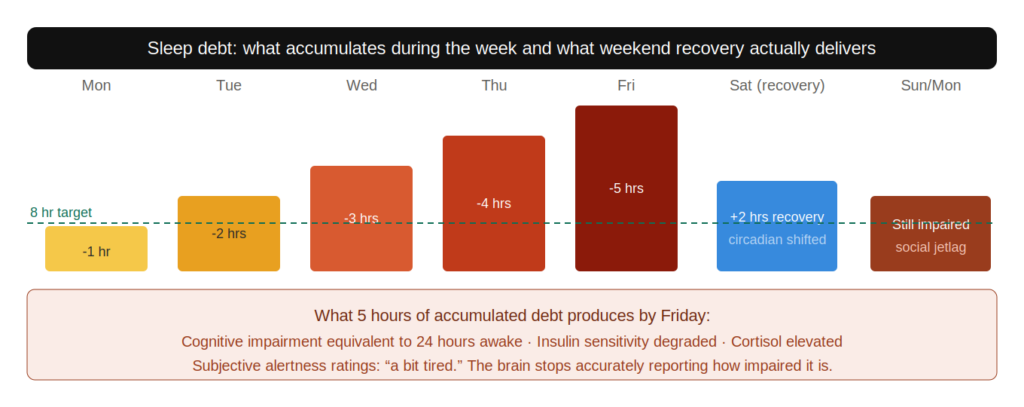
The metabolic cost that does not show up in how you feel
Chronic sleep restriction does measurable biological damage that is independent of subjective tiredness. Cortisol rises. Insulin sensitivity falls. Inflammatory markers (IL-6, TNF-alpha, CRP) increase. Testosterone drops. Leptin (satiety hormone) falls and ghrelin (hunger hormone) rises, driving increased caloric intake. The person carrying chronic sleep debt is not just tired. They are running hotter metabolically, hungrier, storing fat more efficiently, healing more slowly, and aging their cells faster than their rested peers. None of this is visible in how tired they feel on a Tuesday afternoon. It shows up in bloodwork, body composition, and long-term disease risk.
The Livium recipe
Tool. Measure your sleep debt. A sleep tracker that monitors total sleep time and HRV gives you an objective picture of your actual sleep architecture and debt accumulation rather than your subjective estimate, which will be too optimistic. Track for 30 days before drawing conclusions. If your average weekday sleep is below 7 hours: the debt is real, and the subjective experience is not a reliable guide. For daytime recovery when debt is significant: a 20-minute nap timed before 2 PM partially restores alertness without entering slow-wave sleep (which causes grogginess) and does not significantly delay nighttime sleep onset.
Behavior. The solution to sleep debt is not weekend catch-up. It is reducing the weekday deficit. Treat sleep duration as a non-negotiable constraint, not a variable that adjusts to everything else. Most adults who sleep six hours on weeknights are making a choice (late screens, late work, early alarm) that they have framed as necessity. Audit the actual constraints. Often, the last 45 to 60 minutes of the night are spent on nothing important. Move the bedtime forward, not the wake time earlier. Protect sleep on weekdays and limit weekend sleep extension to 60 to 90 minutes past the weekday wake time to avoid circadian shifting.
Threshold. If you are sleeping 7 to 8 hours and still feel chronically unrefreshed: rule out sleep apnea before blaming sleep quantity. Sleep apnea can fragment sleep severely enough to produce all the consequences of sleep debt while maintaining normal total sleep time. A home sleep test through Lofta costs approximately $150 and provides a diagnosis-grade reading of sleep-disordered breathing without requiring an overnight lab study. If bloodwork shows elevated cortisol, impaired insulin sensitivity, or elevated inflammatory markers alongside chronic tiredness: sleep is the intervention to address first.
| Common sleep debt behavior | The problem | The fix |
|---|---|---|
| 6 hrs on weeknights | Accumulates 5 to 7 hr deficit by Friday | Move bedtime earlier, not wake time later |
| Sleep until 10 AM Saturday | Shifts circadian phase; produces Monday jetlag | Cap weekend sleep extension at 60 to 90 min |
| Feel “fine” on 6 hrs | Subjective impairment detection fails after day 3 | Track objective HRV and performance data |
| Unrefreshed despite 8 hours | Sleep apnea fragmenting sleep silently | Home sleep test before other interventions |
Plan of action
- Track your actual sleep time for the next 14 days without changing any behavior. Most people discover they are getting 90 minutes less sleep than they estimate. The data is the first intervention.
- Identify the last activity before bed and ask honestly whether it is worth the debt it costs. Usually it is screens. Usually, the content is not worth a 2-point increase in cortisol and 40 minutes of delayed sleep onset every night for a week.
- Cap weekend sleep extension at 60 minutes past your weekday wake time. Use the extra rest as genuine recovery, not as a circadian reset that creates Monday problems. A 20-minute nap before 2 PM on Saturday provides cognitive recovery without the phase-shifting cost of sleeping until 10.
- If you are on a high-pressure schedule that genuinely cannot accommodate 7 to 8 hours on weeknights: use Function Health to track cortisol, fasting insulin, and inflammatory markers quarterly. Sleep debt is running a tab. The bloodwork tells you how large the tab has gotten.
Table of Content

Know your body better.
Trusted By Thousands Daily








FAQs
Can some people genuinely function well on 6 hours of sleep?
A small fraction of the population (fewer than 3 percent) carries a DEC2 gene variant that allows genuine functional adequacy on short sleep. This is a rare mutation, not a common individual difference. Most adults who believe they function well on 6 hours have adapted to the impaired state and lost the ability to accurately self-assess their performance. They function well relative to their baseline. Their baseline has declined.
Is there a maximum amount of sleep debt that is unrecoverable?
For acute sleep debt (one bad week), most cognitive functions recover with 2 to 3 nights of adequate sleep. The metabolic consequences take longer. For chronic sleep debt accumulated over months or years, some cognitive deficits appear to persist even after extended recovery periods. The implication is that consistent adequate sleep is more protective than recovery sleep. Prevention over treatment.
Does napping count toward sleep debt repayment?
A 20-minute nap restores alertness and improves performance for 2 to 3 hours. It does not produce the slow-wave and REM sleep that overnight sleep provides, meaning it is a performance tool, not a debt repayment tool. A longer nap (60 to 90 minutes) can enter slow-wave sleep and provide more complete recovery, but it can introduce grogginess and significantly interfere with nighttime sleep if taken after 2 PM.
Legal Disclaimer
The content published on Livium Health is for informational and educational purposes only. Nothing on this site constitutes medical advice, diagnosis, or treatment. Always consult a qualified healthcare provider before making decisions about your health, including changes to medications, supplements, diet, or exercise.
Livium Health is not a medical practice and does not have a patient-provider relationship with its readers. We do not sell supplements, medications, or treatments, and we have no financial relationship with the products or services we reference.
While we work to ensure the information we publish is accurate and up to date, health and medical guidance evolves. We make no guarantees about the completeness or currency of any content on this site. Reliance on any information provided by Livium Health is solely at your own risk.
If you are experiencing a medical emergency, call 911 or your local emergency services immediately.
We may receive compensation, free products, or affiliate commissions for products mentioned in this post. Opinions are our own.