
Share
Gut Health
Men's Health
Women's Health
The gut-brain axis: How your microbiome affects mood, focus, and stress response
6 min read

Key takeaways
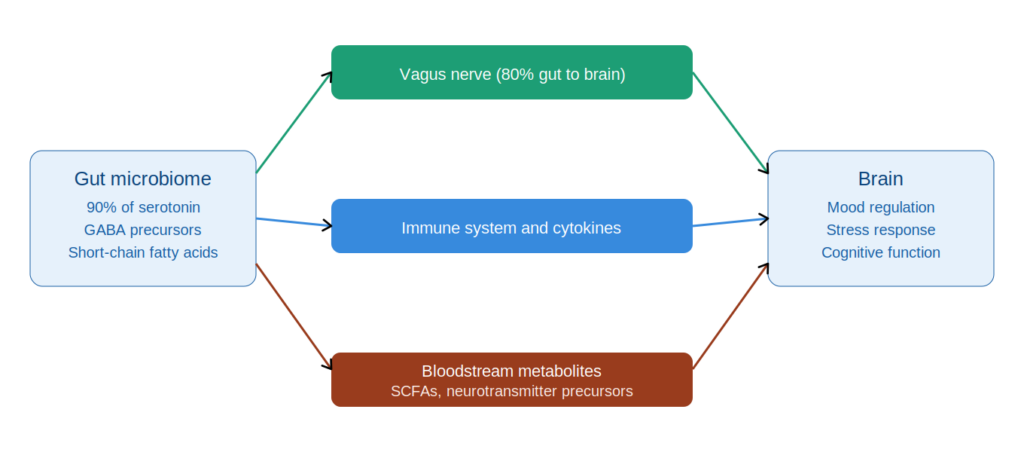
- The gut contains 500 million neurons and produces 90 percent of the body’s serotonin. It communicates with the brain in both directions through the vagus nerve, the immune system, and circulating metabolites.
- Gut microbiome composition directly influences anxiety, depression, and cognitive performance. Adults with greater microbiome diversity consistently show better mood outcomes and stress resilience than those with lower diversity.
- The microbiome is modifiable. Dietary fiber, fermented foods, and targeted probiotic strains all measurably shift gut composition within weeks.
- Midlife is when the gut microbiome naturally loses diversity. Chronic stress, poor sleep, antibiotics, and a low-fiber diet all accelerate that loss.
The second brain you have been ignoring
Most people think of the gut as a digestive organ. It is also a neurological one. The enteric nervous system embedded in the gut wall contains more neurons than the spinal cord. It produces neurotransmitters. It monitors and responds to its environment independently of the brain. And it maintains a continuous bidirectional communication channel with the brain through the vagus nerve, the immune system, and the bloodstream.
The trillions of microorganisms living in the gut are not passive passengers. They produce neurotransmitters, short-chain fatty acids (SCFAs), and other metabolites that cross the blood-brain barrier or signal through the vagus nerve to influence mood, stress response, and cognitive function. When that microbial community is healthy and diverse, the signaling supports mental function. When it is not, the signaling does not.
What the research actually shows
Human studies consistently find that adults with depression and anxiety have measurably different gut microbiome compositions than mentally healthy controls. The differences are not subtle: certain genera (Lactobacillus, Bifidobacterium, Faecalibacterium prausnitzii) are consistently lower in depressed populations. Bacteroides and Proteobacteria tend to be higher. The direction of causality is not fully established, but animal research shows that transplanting gut bacteria from depressed humans into germ-free rodents produces depression-like behavior in the recipients. The bacteria carry something.
The mechanism is not one pathway but several. Gut bacteria produce roughly 95 percent of the body’s serotonin. They synthesize GABA and dopamine precursors. They produce short-chain fatty acids (butyrate, propionate, acetate) that reduce neuroinflammation and support the blood-brain barrier. When the microbiome is disrupted, serotonin production drops, GABA availability falls, and neuroinflammatory signaling rises. The brain notices.
What destroys it after 40
Microbiome diversity peaks in early adulthood and declines from midlife onward. The decline is not inevitable but it is common, and the things that accelerate it are exactly the things that accumulate in midlife: chronic psychological stress (raises cortisol, which suppresses beneficial bacteria), poor sleep (disrupts circadian microbiome rhythms), dietary simplification (less variety means less microbial diversity), antibiotic exposure (broad-spectrum antibiotics cause measurable diversity losses that can take months to partially recover), and the standard Western diet (low fiber, high refined carbohydrate, high processed food).
The Livium take: most adults treating anxiety and depression are addressing the brain end of the gut-brain axis exclusively. They are changing medications, improving sleep, managing stress. These matter. But none of them directly addresses the microbial composition that is producing or withholding the neurotransmitter precursors the brain is trying to work with. The gut is a lever that most mental health treatment protocols still ignore.
The Livium recipe
Tool. Dietary fiber is the primary input the microbiome runs on. The gut bacteria that produce butyrate and GABA precursors feed on fermentable fiber. Most adults eat 10 to 15 g of fiber per day. The target is 25-38 g. The gap is the problem. A psyllium husk supplement (5-10 g daily) closes part of that gap immediately, feeds Bifidobacterium and Lactobacillus populations, and improves bowel regularity in parallel. For probiotic supplementation: strain specificity matters. The strains with the most published human data for mood and anxiety outcomes are Lactobacillus rhamnosus JB-1, Bifidobacterium longum 1714, and Lactobacillus acidophilus NCFM. A multi-strain probiotic containing Lactobacillus and Bifidobacterium at 10-50 billion CFU is the evidence-based starting dose. For fermented foods: high-quality kefir provides live cultures alongside protein and is one of the most studied fermented foods for microbiome diversity improvement in adults.
Behavior. Eat 30 different plant foods per week. This is the evidence-based threshold from the American Gut Project that correlates with the highest microbiome diversity. It sounds difficult; it is not. Every distinct vegetable, fruit, legume, whole grain, nut, seed, herb, and spice counts. The variety of plant inputs is a more powerful driver of diversity than the quantity of any single fiber source. Add one fermented food daily: yogurt, kefir, kimchi, sauerkraut, kombucha, or miso. A 2021 Stanford study found that 10 weeks of fermented food consumption increased microbiome diversity and reduced inflammatory markers significantly more than a high-fiber diet alone.
Threshold. If mood symptoms are significant and persistent alongside GI symptoms (bloating, irregular bowel, abdominal discomfort), a comprehensive gut microbiome test provides a baseline and identifies specific imbalances. This data makes the probiotic selection more targeted than off-the-shelf multi-strain options. Function Health includes inflammatory markers and gut-relevant biomarkers that provide context for interpreting microbiome data.
| Intervention | Target bacteria | Mental health benefit | Time to effect |
|---|---|---|---|
| 30+ plant foods per week | Broad diversity increase | Reduced anxiety, improved resilience | 4 to 8 weeks |
| Daily fermented food | Lactobacillus, Bifidobacterium | Reduced inflammation, improved mood | 4 to 10 weeks |
| Psyllium husk 5 to 10 g daily | Bifidobacterium, butyrate producers | GABA support, reduced gut inflammation | 2 to 4 weeks |
| Targeted probiotic strains | L. rhamnosus, B. longum | Reduced cortisol, improved anxiety scores | 4 to 8 weeks |
Plan of action
- Count your plant food variety this week, not quantity. If you are below 15 distinct plant foods per week, doubling that number is the highest-leverage dietary change for microbiome diversity and mood.
- Add one fermented food to your daily routine. Greek yogurt at breakfast, kimchi with lunch, kefir as an evening drink. Pick whichever fits your food preferences and sustain it for 30 days before evaluating.
- Start psyllium husk 5 g daily with a large glass of water. Increase to 10 g over two weeks. The initial adjustment period produces some bloating; this normalizes. By week three, most people notice meaningful improvements in regularity and reduced bloating.
- If anxiety or mood symptoms are significant alongside GI irregularity: add a clinical-grade multi-strain probiotic for 60 days. Give it the full course before evaluating. Probiotic effects on mood take longer to appear than GI effects. A prebiotic supplement alongside it feeds the incoming bacteria and accelerates colonization.
Table of Content

Know your body better.
Trusted By Thousands Daily



FAQs
Can probiotics treat depression?
Not as a standalone treatment. The evidence supports probiotics as adjuncts that reduce symptom severity and cortisol in people with mild to moderate depression, not as replacements for clinical treatment. They address one driver among several.
How quickly does the microbiome respond to dietary changes?
Composition shifts are measurable within days of significant dietary change. Meaningful functional improvements in mood and inflammation markers take four to eight weeks of sustained change. Short-term dietary experiments do not produce lasting microbiome benefits.
Does stress directly damage the microbiome?
Yes. Elevated cortisol alters gut motility, reduces mucosal immune function, and directly suppresses populations of beneficial bacteria, including Lactobacillus. The gut-brain relationship runs in both directions: a disrupted microbiome worsens stress response, and chronic stress worsens microbiome composition.
Legal Disclaimer
The content published on Livium Health is for informational and educational purposes only. Nothing on this site constitutes medical advice, diagnosis, or treatment. Always consult a qualified healthcare provider before making decisions about your health, including changes to medications, supplements, diet, or exercise.
Livium Health is not a medical practice and does not have a patient-provider relationship with its readers. We do not sell supplements, medications, or treatments, and we have no financial relationship with the products or services we reference.
While we work to ensure the information we publish is accurate and up to date, health and medical guidance evolves. We make no guarantees about the completeness or currency of any content on this site. Reliance on any information provided by Livium Health is solely at your own risk.
If you are experiencing a medical emergency, call 911 or your local emergency services immediately.
We may receive compensation, free products, or affiliate commissions for products mentioned in this post. Opinions are our own.