
Share
Longevity & Aging
Men's Health
Women's Health
The gut microbiome and longevity: What centenarian studies actually show
5 min read

Key takeaways
- Studies of centenarian gut microbiomes consistently show higher microbial diversity, elevated Akkermansia muciniphila levels, increased butyrate-producing Clostridiales, and lower Enterobacteriaceae compared to younger adults with typical Western microbiomes.
- Butyrate, the short-chain fatty acid produced by Clostridiales fermentation of dietary fiber, is the primary energy source for colonocytes and simultaneously produces systemic anti-inflammatory, immunoregulatory, and epigenetic effects through histone deacetylase inhibition.
- The centenarian microbiome is not the cause of extreme longevity; it is a marker of the sustained dietary patterns, physical activity, and stress management that simultaneously preserve the microbiome and drive longevity through multiple other mechanisms.
- Dietary fiber is the single most impactful variable for microbiome longevity profile, with 30 to 38 grams of daily fiber from diverse plant sources producing the most consistent centenarian-like microbiome characteristics in intervention studies.
What 100-year-old gut bacteria look like
Japanese centenarian studies (Okinawa), Italian centenarian studies (Sardinia and Calabria), and studies of supercentenarians in Sardinia and other Blue Zones consistently find elevated microbial alpha diversity compared to younger comparison populations. High diversity is a marker of ecological resilience: a diverse microbial ecosystem is more resistant to colonization by pathogens and more capable of maintaining function when individual species decline.
Beyond diversity, specific species patterns recur. Akkermansia muciniphila is consistently elevated in centenarians across studies and populations. Akkermansia maintains the integrity of the intestinal mucus layer, preventing LPS leakage and reducing systemic endotoxemia. Bifidobacterium longum, associated with anti-inflammatory cytokine production and gut barrier integrity, is also consistently enriched. Enterobacteriaceae, producers of LPS and associated with gut barrier dysfunction, are consistently reduced.
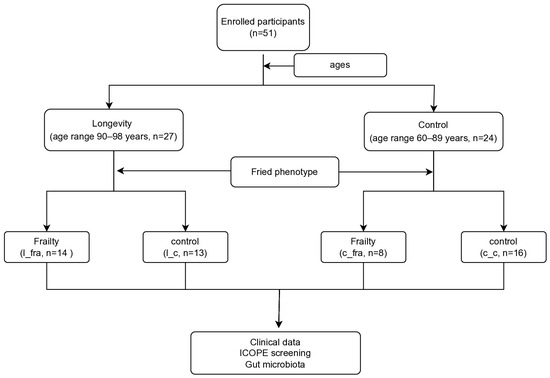
Centenarians consistently show higher microbial diversity, elevated butyrate-producing bacteria, and enriched Akkermansia muciniphila compared to younger old adults — a gut composition profile that is associated with reduced systemic inflammation, preserved intestinal barrier function, and lower frailty scores. Source: Wang et al., Microorganisms 2025, 13(7), 1657 — Healthy Ageing and Gut Microbiota: A Study on Longevity. CC BY 4.0.
Butyrate: the HDAC inhibitor in the colon
Butyrate is produced by the fermentation of dietary fiber by Clostridiales species in the colon. It is the primary energy source for colonocytes (colon lining cells) and is essential for maintaining gut barrier integrity. Beyond its local effects, butyrate is a histone deacetylase (HDAC) inhibitor that produces systemic epigenetic effects, suppressing inflammatory gene expression throughout the body through a mechanism that partially explains the systemic anti-inflammatory effects of high-fiber diets.
Low dietary fiber intake reliably reduces butyrate-producing Clostridiales populations within days to weeks, reducing butyrate production, compromising gut barrier integrity, increasing systemic LPS exposure, and reducing the epigenetic anti-inflammatory signaling that butyrate mediates. The typical Western adult consuming 12 to 15 grams of fiber daily is producing a fraction of the butyrate of a centenarian consuming 35 grams.
The Livium recipe
Tool. A gut microbiome test (Viome, Ombre, or Thorne Gut Health Test) provides a personalized baseline including Akkermansia level, butyrate-producer abundance, and Enterobacteriaceae load. The baseline guides both dietary and probiotic interventions more precisely than generic recommendations. A food diary for one week quantifies current fiber intake. Most adults consuming a Western diet are at 12 to 18 grams daily; the centenarian longevity profile target is 30 to 38 grams from diverse plant sources.
Behavior. Increase dietary fiber to 30 to 38 grams daily from diverse plant sources. Plant diversity matters: aim for 30 or more different plant species weekly. Each different plant species provides different prebiotic substrates that selectively feed different bacterial species, building the diverse microbiome associated with centenarian longevity profiles. Legumes, vegetables, nuts, seeds, whole grains, and fruits each contribute different fiber types. Fermented foods (two to four servings daily) further support the Lactobacillus and Bifidobacterium enrichment.
Threshold. After eight to twelve weeks of increased dietary fiber and plant diversity: a microbiome retest should show increased Akkermansia, increased butyrate-producer abundance, and increased alpha diversity. hs-CRP should trend downward. GI symptoms during the transition (increased gas and bloating from the first two weeks of fiber increase) should resolve as the microbiome adapts. A slower fiber increase (adding 5 grams weekly rather than all at once) minimizes transitional GI discomfort.
Life Extension Florassist GI with Phage Technology uses bacteriophages to selectively reduce Enterobacteriaceae while supporting beneficial Lactobacillus and Bifidobacterium populations, addressing two centenarian microbiome characteristics simultaneously. NOW Foods Prebiotic Fiber with Inulin provides inulin and FOS, the prebiotic substrates that selectively feed Bifidobacterium and Akkermansia. Garden of Life Primal Defense Ultra provides HSO (homeostatic soil organism) probiotic strains alongside standard Lactobacillus and Bifidobacterium, broadening the bacterial diversity support. Thorne FloraMend Prime Probiotic provides delayed-release technology ensuring probiotic strains survive gastric transit to reach the colon, where the centenarian-profile species exert their primary effects.
| Centenarian microbiome feature | Longevity mechanism | How to support |
|---|---|---|
| High alpha diversity | Ecological resilience; stable colonization resistance | 30+ plant species weekly; diverse fiber sources |
| High Akkermansia | Mucus layer integrity; reduced LPS leakage | Fasting; polyphenol-rich diet; pasteurized Akkermansia supplement |
| High butyrate producers | HDAC inhibition; colonocyte health; barrier integrity | 30–38g fiber daily; legumes; resistant starch |
| Low Enterobacteriaceae | Reduced endotoxemia; reduced LPS-driven inflammation | Phage-containing probiotics; Mediterranean diet; avoid high-sugar diet |
| High Bifidobacterium | Anti-inflammatory cytokines; barrier support | Inulin/FOS; Bifidobacterium-specific probiotic strains; fermented food |
Source: Livium editorial synthesis based on NIA Gut Microbiome and Aging and Biagi et al., Current Biology (2016), centenarian microbiome study.
Plan of action
- Count plant species consumed this week. Write down every different fruit, vegetable, nut, seed, legume, whole grain, and herb eaten across the entire week. Below 10 species is common and below the diversity threshold associated with centenarian microbiome profiles. Target 30 by the end of month one.
- Increase fiber by 5 grams per week until reaching 30 to 38 grams daily. A slower increase avoids the transitional GI discomfort that causes most people to abandon fiber increases prematurely.
- Add daily fermented food. One serving of live-culture yogurt, kefir, kimchi, or sauerkraut daily begins shifting the microbiome within two weeks and provides the Lactobacillus support that broadens microbial diversity.
- Retest microbiome at three to six months if an initial test was taken. The centenarian microbiome features are achievable through dietary change, but the timeline for a measurable compositional shift requires sustained intervention over months, not weeks.
Table of Content

Know your body better.
Trusted By Thousands Daily






FAQs
Are centenarians genetically predisposed to beneficial microbiomes?
The genetic contribution to microbiome composition is estimated at approximately 5 to 15 percent based on twin studies. The majority of microbiome composition is determined by diet, antibiotic exposure, lifestyle, and environment. The centenarian microbiome profile is more accurately interpreted as the biological signature of decades of dietary and lifestyle choices than as an inherited characteristic.
Does fecal microbiome transplant (FMT) from young donors extend lifespan?
Animal studies in fish show lifespan extension from FMT from young to old donors. Human FMT for longevity purposes is not currently established or recommended outside clinical trial contexts. FMT is FDA-approved for recurrent C. difficile infection and is being studied for other indications. The theoretical appeal of FMT for longevity is compelling; the human safety and efficacy data for healthy aging are not yet available.
Is there a specific centenarian diet?
Centenarian populations across different Blue Zones eat quite different specific foods but share common structural features: predominantly plant-based with legumes as a staple, high in diverse vegetables, low in ultra-processed food, moderate in animal protein, and consumed in social contexts with eating stopping before full satiety (Okinawan hara hachi bu principle). These structural similarities produce the microbiome profile that is functionally consistent despite the specific foods being regionally distinct.
Legal Disclaimer
The content published on Livium Health is for informational and educational purposes only. Nothing on this site constitutes medical advice, diagnosis, or treatment. Always consult a qualified healthcare provider before making decisions about your health, including changes to medications, supplements, diet, or exercise.
Livium Health is not a medical practice and does not have a patient-provider relationship with its readers. We do not sell supplements, medications, or treatments, and we have no financial relationship with the products or services we reference.
While we work to ensure the information we publish is accurate and up to date, health and medical guidance evolves. We make no guarantees about the completeness or currency of any content on this site. Reliance on any information provided by Livium Health is solely at your own risk.
If you are experiencing a medical emergency, call 911 or your local emergency services immediately.
We may receive compensation, free products, or affiliate commissions for products mentioned in this post. Opinions are our own.