
Share
Men's Health
Mental Health
Women's Health
The midlife friendship collapse and what it does to your health
6 min read

Key takeaways
- The number of close friends the average adult has falls sharply in the 40s and 50s. The primary driver is not conflict but passive drift: the structural supports that maintained friendships in earlier life (school, shared housing, proximity) disappear, and nothing systematic replaces them. The result is a friendship network that appears intact on the outside and feels thin on the inside.
- The health consequences of social disconnection are measurable and documented. The 2023 U.S. Surgeon General Advisory classified loneliness as a public health crisis with mortality risk comparable to smoking 15 cigarettes per day. The mechanism is not psychological: social isolation elevates inflammatory cytokines, disrupts cortisol rhythm, impairs immune function, and accelerates cognitive decline.
- Men are disproportionately affected. Research consistently shows that men have fewer close friendships than women at every age, are less likely to maintain them through life transitions, and are less likely to seek new social connection when existing friendships fade. The men most at risk are those whose entire social infrastructure ran through their spouse or workplace.
- Friendships in midlife require active maintenance that earlier friendships did not. Proximity and convenience are gone. What remains is intentional scheduling, and most people resist it because it feels effortful in a way that friendship did not used to feel. That resistance is the problem to solve, not evidence that the friendship is over.
The friends you still have versus the friends you actually see
Ask most people in their mid-40s how many friends they have and the answer sounds reasonable. College friends, work friends, neighborhood people, a few couples you like. But press on: when was the last time you saw any of them alone, without a spouse or an event as the organizing structure, and the answer gets quieter. Six months ago. Maybe a year. There was that wedding.
The friendship collapse of midlife is not about falling out with people. It is about the slow evaporation of the conditions that made friendship easy. School created forced proximity. Early careers created shared struggle. Young parenthood created a ready-made cohort of people in the same bewildered situation at the same time. When those structures end, the friendships they produced require active maintenance. Most people do not do that maintenance. The friendships thin. Nobody decided this. It just happened.
What the research actually shows
The Harvard Study of Adult Development, the longest-running study of adult life, tracked men for over 80 years. The most consistent predictor of health and happiness in later life was not wealth, cholesterol, or exercise. It was relationship quality. Close relationships in midlife predicted better physical health and cognitive function decades later, while loneliness was associated with earlier physical decline.
The mechanism is biological. Social isolation elevates interleukin-6 and C-reactive protein, two inflammatory markers associated with cardiovascular disease and cognitive decline. It disrupts the cortisol awakening response, producing flatter diurnal cortisol curves associated with burnout and depression. In the absence of social buffering, stressors that would otherwise be manageable produce larger and longer physiological responses. The body registers loneliness as a threat state and stays in it.
A 2023 Brigham Young University meta-analysis found that social isolation increased mortality risk by 29 percent, while loneliness (the subjective experience of inadequate connection, regardless of actual contact) increased it by 26 percent. Being around people without feeling connected is nearly as harmful as being alone.
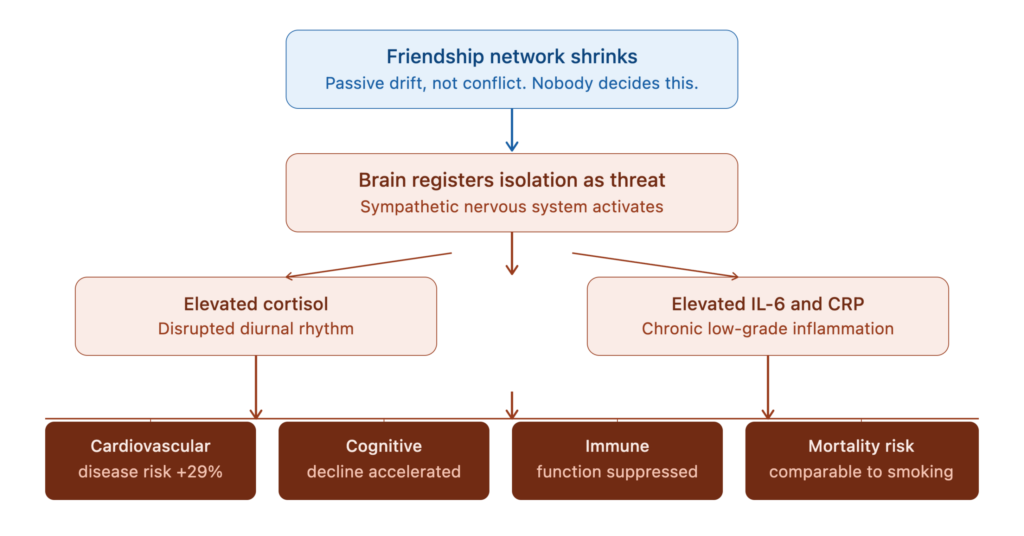
Social isolation activates the sympathetic nervous system the same way physical threat does. Elevated cortisol and inflammatory markers follow. The downstream consequences, cardiovascular disease, cognitive decline, immune suppression, and increased mortality risk, are not psychological. They are physiological. Source: Porciello et al., Life 2023 — Social Isolation: A Narrative Review on the Dangerous Liaison between the Autonomic Nervous System and Inflammation. CC BY 4.0.
The male version is worse
Men average fewer close friendships than women at every age. The gap widens with age. A 2021 American Perspectives Survey found that 15 percent of American men reported having no close friends, up from 3 percent in 1990. The men most socially isolated are often unaware of their isolation because their primary social contact is their spouse, and that contact feels sufficient until it is no longer there.
Male friendship operates predominantly through shared activity rather than direct emotional disclosure. Men report feeling closest to friends when doing something together rather than talking about it. This is not a deficiency. It is a different mode. The practical problem is that midlife eliminates many of the shared activities that male friendship runs through: sports teams, shared commutes, proximity. Without the activity, the friendship often lacks another vehicle.
The Livium recipe
Tool. Recurring, scheduled contact is the only tool that works at scale in midlife. The friendship research is consistent on this: frequency of contact matters more than depth of contact. A 30-minute weekly call with an old friend does more for loneliness metrics than one annual weekend together. The scheduling removes the friction of initiation, which is the primary barrier. For men specifically, an activity-based recurring commitment (a standing golf game, a running group, a weekly pickup basketball) provides the shared activity structure that male friendship runs on. A shared activity tracker worn by both parties creates a lightweight connection point and conversation starter that requires no emotional planning.
Behavior. Treat friendship maintenance as a health behavior, not a social nicety. This reframing matters because most adults deprioritize friendship in favor of work and family obligations precisely because it does not feel necessary in the way that exercise or sleep does. The data says it is necessary in exactly that way. Block 30 minutes per week. Use it to initiate contact, not wait for it. The person who initiates is not imposing; they are maintaining the asset. For adults who have let friendships go cold: a direct reach-out naming what happened (“I realized we haven’t talked in two years and that’s on me”) reactivates more friendships than people expect. Most dormant friendships are dormant because both people were waiting for the other to go first.
Threshold. If you cannot name three people you could call at 9 PM on a Wednesday with a genuine problem and expect them to engage, your friendship network is clinically thin by the research standards that predict health outcomes. That is the threshold. Not social anxiety or shyness. Just the number. If you are below it, adding one real friendship in the next year is a health intervention with better long-term outcome data than most supplements.
| Friendship quality metric | What the research shows | Practical target |
|---|---|---|
| Number of close friends | 3 to 5 predicts best health outcomes | Identify current number honestly |
| Contact frequency | Weekly contact reduces loneliness more than monthly deep conversations | Schedule recurring contact; do not wait for initiation |
| Activity versus disclosure | Both work; men benefit more from activity-anchored contact | Build recurring shared activity into the schedule |
| New friend formation after 40 | Possible but requires repeated unplanned interaction over time | Join recurring structured groups; proximity plus repetition is the formula |
Source: U.S. Surgeon General Advisory on the Healing Effects of Social Connection and Community (2023).
Plan of action
- Name three people you want to be closer to this year. Not new acquaintances. People you already know and have let drift. Write their names down. That list is the plan.
- Contact one of them this week with a specific ask, not a vague “we should catch up.” A specific date, a specific activity, a specific call time. Vague social intentions do not convert to actual contact. Specific ones do.
- Join one recurring structured group in the next 30 days. A sport, a class, a volunteer commitment, a professional group. Repeated unplanned proximity is how new adult friendships form. You cannot manufacture the depth of a 20-year friendship on purpose, but you can create the conditions for it.
- If loneliness is significant and persistent, a therapist is a legitimate resource. A structured journaling practice focused on social goals can also help identify the specific barriers that are hindering connection. The barrier is almost never the friendship itself. It is the friction of initiation, the belief that it would be awkward, or the assumption that the other person has moved on. Usually none of these are true.
Table of Content

Know your body better.
Trusted By Thousands Daily






FAQs
Is it normal to have fewer friends in your 40s than in your 20s?
Yes. Research consistently shows that friendship network size peaks in the mid-20s and declines steadily through midlife. This is statistically normal. Normal does not mean healthy. The same data that tracks the decline also tracks the health consequences. The fact that most of your peers are in the same situation does not change what the situation is doing to your physiology.
Can online friendships substitute for in-person ones?
Partially. Online and phone contact reduce loneliness and maintain the quality of existing friendships when in-person contact is not possible. It does not fully replicate the physiological effects of in-person presence: shared physical space, eye contact, and physical touch all activate social neurobiology that remote communication does not. For people with geographically dispersed social networks, online contact is better than no contact and meaningfully beneficial. It is not an equivalent substitute for in-person connection.
What if I genuinely prefer being alone?
Introversion is a real trait with a real neurobiological basis. Introverts genuinely find social interaction more draining and solitude more restorative than extroverts do. Research on friendship does not require a large social network. It requires a small number of high-quality close relationships, which introverts are as capable of maintaining as extroverts. The target is depth, not breadth. Three genuinely close relationships predict health outcomes as well as a large social network does.
Legal Disclaimer
The content published on Livium Health is for informational and educational purposes only. Nothing on this site constitutes medical advice, diagnosis, or treatment. Always consult a qualified healthcare provider before making decisions about your health, including changes to medications, supplements, diet, or exercise.
Livium Health is not a medical practice and does not have a patient-provider relationship with its readers. We do not sell supplements, medications, or treatments, and we have no financial relationship with the products or services we reference.
While we work to ensure the information we publish is accurate and up to date, health and medical guidance evolves. We make no guarantees about the completeness or currency of any content on this site. Reliance on any information provided by Livium Health is solely at your own risk.
If you are experiencing a medical emergency, call 911 or your local emergency services immediately.
We may receive compensation, free products, or affiliate commissions for products mentioned in this post. Opinions are our own.