The muscle-longevity connection: Why sarcopenia is the longevity crisis nobody is talking about
6 min read
Key takeaways
Adults lose three to eight percent of muscle mass per decade after 30, accelerating sharply after 60. This is sarcopenia: progressive, age-related loss of muscle mass, strength, and function. It is the primary driver of frailty, falls, metabolic dysfunction, and loss of independence in aging.
Muscle is not just structural tissue. It is the body’s largest metabolic organ, responsible for the majority of glucose disposal, a major site of amino acid storage, and a producer of myokines that regulate brain health, bone density, immune function, and systemic inflammation.
Sarcopenia is significantly preventable and partially reversible at any age with adequate protein intake and progressive resistance training. These are not optional for midlife adults who want functional independence at 80.
The protein requirement for muscle preservation and building after 50 is substantially higher than the RDA. Current evidence supports 1.6 to 2.2 grams per kilogram of body weight daily for adults pursuing active sarcopenia prevention.
The slow emergency nobody declares
The average 50-year-old has lost roughly 15 percent of the muscle mass they had at 25 and does not know it. The scale may not have changed much. The body composition has shifted. Fat has replaced muscle in the same body weight envelope. The metabolic consequences of this replacement are substantial: lower resting metabolic rate, reduced glucose disposal capacity, higher insulin resistance, and a body that is less able to protect itself in the fall that will eventually happen.
Hip fracture in an 80-year-old with sarcopenia carries a one-year mortality rate of approximately 20 to 30 percent in the research literature. Not from the fracture directly. From the frailty, the surgical stress, the post-operative complications, and the infection risk in a body with minimal physiological reserve. The fracture was an event. The sarcopenia was the decades-long setup. Building and maintaining muscle in the 40s and 50s is one of the highest-leverage longevity investments available because it takes ten to thirty years to pay off.
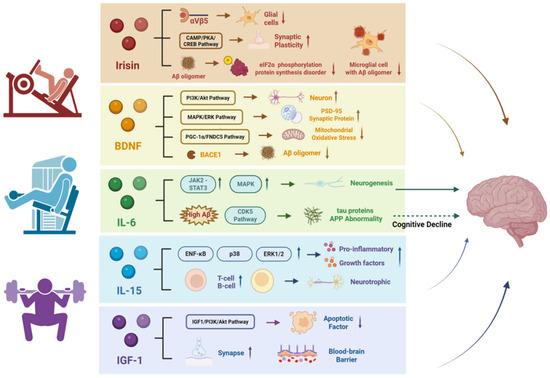
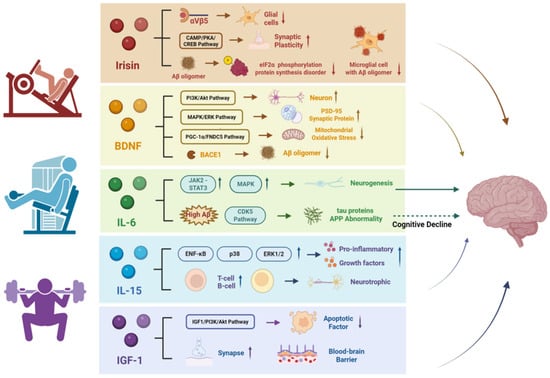
Grip strength predicts cognitive decline because muscle and brain share the same physiological reserve signals — myokines including irisin and BDNF produced by contracting muscle directly support hippocampal neuroplasticity. A weak grip reflects a body-wide deficit that the brain does not escape. Source: Tian et al., Biology 2026, 15(2), 154 — The Muscle–Brain Axis in Aging. CC BY 4.0.
What muscle does beyond holding up the skeleton
Glucose disposal. Skeletal muscle accounts for approximately 80 percent of insulin-stimulated glucose uptake. High muscle mass is protective against type 2 diabetes through this mechanism alone, independently of body fat. Low muscle mass in a person with normal body weight produces insulin resistance that their body composition does not predict by conventional measures.
Myokine production. Contracting muscle secretes myokines, hormone-like peptides that travel systemically and regulate multiple organ systems. IL-6 from contracting muscle reduces visceral fat and improves insulin sensitivity. Irisin, produced during exercise, promotes hippocampal neuroplasticity and bone formation. BDNF produced locally in muscle during contraction supports motor neuron health. Muscle is an endocrine organ that is continuously signaling the rest of the body, and a smaller muscle mass produces less of this signaling.
Amino acid reserve. Muscle protein is the body’s primary amino acid reservoir. During illness, surgery, or other physiological stress, the body mobilizes muscle protein to supply amino acids for immune function, wound healing, and acute phase protein production. Individuals with sarcopenia have a significantly reduced physiological reserve to draw on, which explains the higher complication and mortality rates from acute illness in sarcopenic compared to well-muscled adults at identical ages.
The Livium recipe
Tool. A DEXA (dual-energy X-ray absorptiometry) scan measures lean mass, fat mass, and bone density in a single 10-minute test costing $50 to $150 at direct-pay imaging centers. It provides the appendicular skeletal muscle mass index (ASMI) that is the clinical definition of sarcopenia when corrected for height. Knowing the baseline ASMI and body composition is the only way to confirm that a resistance training program is producing muscle gain rather than just strength adaptation without mass change.
Behavior. Progressive resistance training three to four times per week, covering all major muscle groups, with progressive overload (increasing load, reps, or volume over time). The specific protocol matters less than the progressive overload principle: the muscle must be challenged beyond its current capacity to adapt. Protein intake of 1.6 to 2.2 g/kg/day, distributed across three to four meals of at least 30 to 40 grams each to exceed the leucine threshold required for maximum muscle protein synthesis stimulation in older adults.
Threshold. DEXA retest at six months. In adults actively training with adequate protein, lean mass gain of one to two kilograms over six months is a realistic target. Strength gains (as measured by the lifts performed) typically appear first, within four to eight weeks, before significant mass change. The strength gains represent neural adaptation. The mass change requires sustained protein synthesis stimulus over months.
The supplement layer for muscle preservation
Momentous Essential Whey Protein provides 25 grams of whey isolate per serving, with the amino acid profile (particularly leucine, at approximately 2.7 grams per serving) required to maximally stimulate mTORC1-driven muscle protein synthesis in aging muscle. The leucine threshold for full mTOR activation in older muscle is higher than in young muscle, requiring at least 2 to 3 grams per serving. Thorne Creatine 5 g daily is the most evidence-supported performance supplement for muscle mass and strength, with dozens of RCTs confirming significant improvements in lean mass and strength in older adults specifically. Effect sizes in the 60-plus population are actually larger than in young adults.
NOW Foods HMB (beta-hydroxy-beta-methylbutyrate) 500 mg three times daily has published evidence for reducing muscle protein breakdown and preserving lean mass specifically in sarcopenic older adults and during periods of disuse (illness, injury, immobilization). It is not a replacement for creatine but additive in populations with significant anabolic resistance. Life Extension Muscle Strength and Restore provides myHMB plus vitamin D3 and other cofactors supporting muscle protein synthesis and muscle fiber maintenance in a single formula designed specifically for sarcopenia prevention.
Sarcopenia risk factors and interventions
Risk factor
Mechanism
Intervention
Inadequate protein intake
Insufficient substrate for muscle protein synthesis; anabolic resistance
1.6–2.2 g/kg/day; 30–40 g per meal minimum
Sedentary lifestyle
Absent mechanical stimulus removes mTOR activation signal
Progressive resistance training 3–4x/week
Low testosterone (M) / estrogen (F)
Sex hormones modulate muscle protein synthesis capacity
Hormone evaluation; TRT or HRT if indicated
Vitamin D deficiency
VDR in muscle cell nuclei regulates protein synthesis; deficiency impairs function
Optimize 25-OH vitamin D to 60–80 ng/mL
Chronic inflammation
TNF-alpha and IL-6 drive muscle protein catabolism
Source: Livium editorial synthesis based on NIA Exercise for Older Adults and Cruz-Jentoft et al., Age and Ageing (2019), EWGSOP2 sarcopenia definition.
Plan of action
Get a DEXA scan this year. Know the current muscle mass baseline before designing the intervention. The appendicular skeletal muscle mass index is the number to track.
Calculate current protein intake using a food tracking app for one week. Most adults eating a typical Western diet consume 0.8 to 1.0 g/kg/day. The target for active sarcopenia prevention is 1.6 to 2.2 g/kg/day. The gap is usually large.
Add creatine 5 grams daily starting this week regardless of training status. Creatine works through mechanisms independent of training stimulus and produces lean mass and strength benefits even in partially sedentary populations. It is the highest evidence-to-cost-ratio supplement in the longevity toolkit.
Begin or increase resistance training to a minimum of three sessions per week covering all major muscle groups. Any format works: free weights, machines, bodyweight, bands. Progressive overload over months is the non-negotiable variable.
No. Multiple RCTs show significant lean mass and strength gains in adults in their 60s, 70s, and even 80s from progressive resistance training with adequate protein. The rate of gain is slower than in younger adults, and the protein requirements per session are higher (requiring 40 grams per meal rather than 25 to 30 to achieve equivalent muscle protein synthesis stimulus), but the muscle-building machinery remains functional throughout life.
Does cardio cause muscle loss?+
Not with adequate protein intake. The concern about excessive cardio causing muscle catabolism is real at extreme volumes (marathon training on low protein) but not at the Zone 2 volumes recommended in this library. The combination of Zone 2 aerobic training and resistance training with adequate protein produces better health outcomes than either alone and does not require choosing between cardiovascular and muscle health.
Why does the RDA for protein seem so much lower than what is recommended here?+
The RDA of 0.8 g/kg/day was set to prevent protein deficiency in sedentary adults, not to optimize muscle mass maintenance in aging active adults. The protein research in older populations consistently shows that 0.8 g/kg/day is insufficient to prevent progressive muscle loss and that 1.6 to 2.2 g/kg/day produces measurable muscle preservation advantages. The gap between the RDA and the evidence-supported optimal intake is one of the clearest disconnects between population nutrition guidelines and aging-specific research.
Legal Disclaimer
The content published on Livium Health is for informational and educational purposes only. Nothing on this site constitutes medical advice, diagnosis, or treatment. Always consult a qualified healthcare provider before making decisions about your health, including changes to medications, supplements, diet, or exercise.
Livium Health is not a medical practice and does not have a patient-provider relationship with its readers. We do not sell supplements, medications, or treatments, and we have no financial relationship with the products or services we reference.
While we work to ensure the information we publish is accurate and up to date, health and medical guidance evolves. We make no guarantees about the completeness or currency of any content on this site. Reliance on any information provided by Livium Health is solely at your own risk.
If you are experiencing a medical emergency, call 911 or your local emergency services immediately.
We may receive compensation, free products, or affiliate commissions for products mentioned in this post. Opinions are our own.