
Share
Men's Health
Sleep
Women's Health
The other person in your bed might be the reason your sleep is broken
7 min read
Key takeaways
- Sharing a bed reduces sleep quality for both partners on average, but the effect is asymmetric. One partner almost always loses more than the other.
- Movement transfer, temperature conflict, noise, and schedule misalignment are four distinct problems that each require a different solution. Fixing the wrong one wastes money and patience.
- Sleeping in separate rooms is an evidence-backed option that many couples avoid for social reasons. The sleep data on sleep divorce is unambiguous. The relationship data is more nuanced.
- Most partner sleep disruption problems are solvable without separate rooms if the right environmental interventions are applied to the right problem.
The partner sleep problem nobody talks about in sleep optimization content
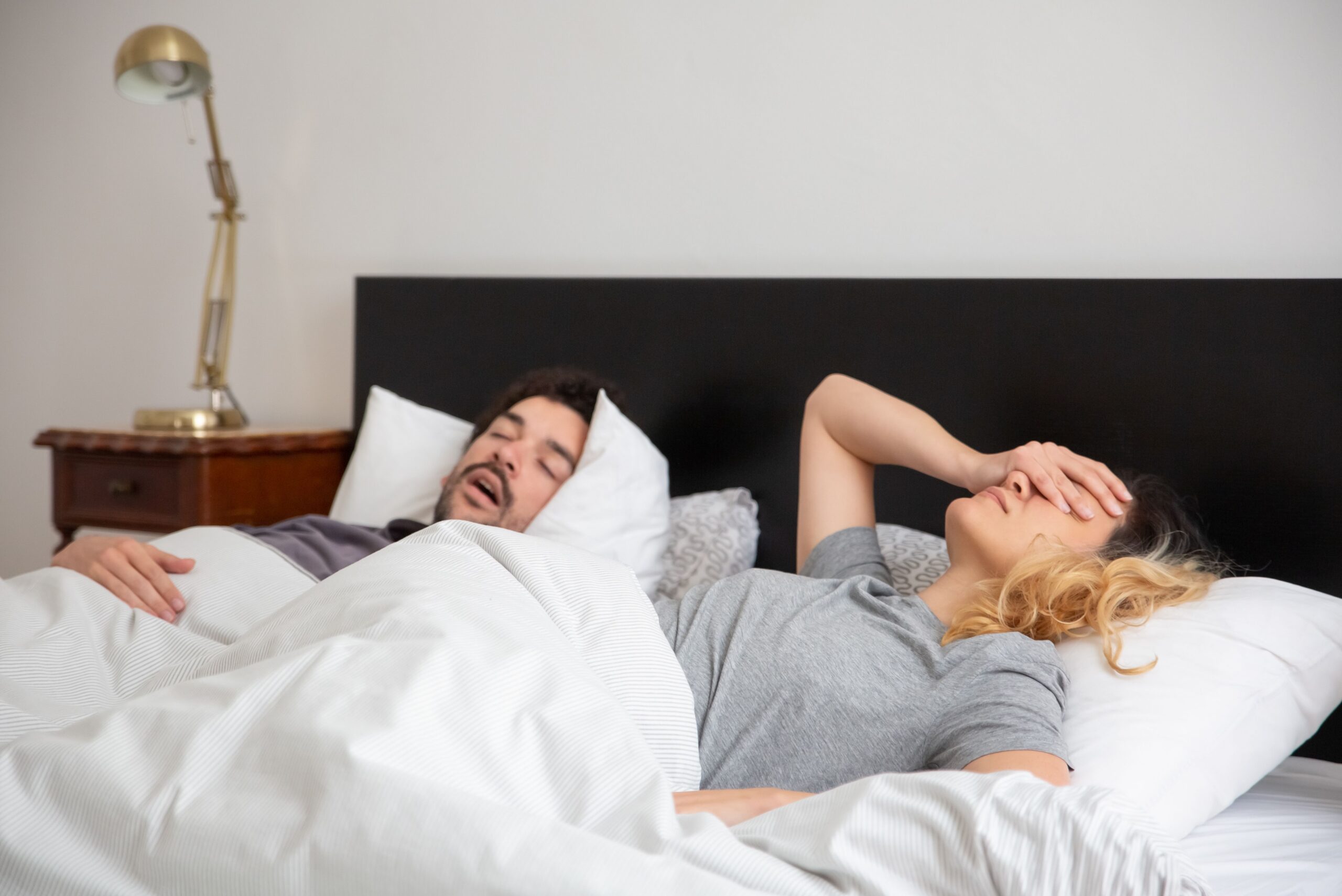
Most sleep improvement content assumes a solo sleeper. One bed. One person. One set of variables to optimize. In practice, roughly 60 percent of adults sleep with a partner, and a meaningful fraction of the sleep problems that midlife adults complain about trace directly to the other person in the bed rather than anything intrinsic to the complainer.
A 2013 study out of the University of Vienna found that women’s sleep was more disrupted by a bed partner than men’s, but both were measurably worse sharing than solo. A 2022 study in Frontiers in Psychiatry found that couples who reported poor partner sleep compatibility had significantly higher rates of insomnia symptoms, daytime fatigue, and relationship conflict. The sleep problem and the relationship problem amplify each other.
The good news: most of this is environmental, not interpersonal. The snoring, the movement, the temperature disagreement, the different bedtimes. All of it is addressable without a conversation that starts with “you are ruining my sleep.”
The four distinct problems
Movement transfer. A standard spring or memory foam mattress transmits motion from one side to the other. Every time one partner rolls over, adjusts position, or gets up for water, the other partner’s sleep is disrupted at a level that may not produce full waking but measurably fragments deep sleep. Wearable data often catches this as unexplained HRV suppression and reduced deep sleep on nights with multiple partner movement events.
Temperature conflict. Women’s core body temperature regulation shifts significantly during perimenopause and menopause, often producing night sweats that require a cooler sleep environment. Men in the same age range frequently want warmer conditions. A single-zone sleep environment cannot satisfy both. This is not a preference argument. It is a physiological argument with a specific solution.
Noise. Snoring is the most obvious, but it is not the only issue. One partner reading with audio, getting up for the bathroom, alarm sounds, movement sounds. The sleeping brain continues processing auditory input through all sleep stages. Noise events above approximately 40 decibels consistently produce arousal responses even without full waking. Most people who report being a light sleeper in a shared bed are not intrinsically light sleepers. They are normal sleepers in an acoustically unsuitable environment.
Schedule misalignment. A night owl and an early riser in the same bed means one person is going to bed before sleep pressure is adequate, and the other is staying awake past their biological window. Neither gets optimal sleep. The morning alarm for one partner becomes an unwanted wake signal for the other. This is the hardest of the four problems to solve without either separate rooms or a significant schedule adjustment by one person.
Salari et al., IJERPH 2023 — Environmental Factors and Sleep Quality in Adults. CC BY 4.0.
The solutions, matched to the problem
For temperature conflict: a dual-zone mattress cover is the most direct fix. The ChiliPad dual-zone sleep system allows each side of the bed to run at an independently set temperature. One side at 68 degrees, the other at 74 degrees. No negotiation required after setup. The clinical evidence on thermal regulation and deep sleep is strong; this is the same mechanism that pre-bed sauna and Eight Sleep use, applied per side.
For noise: a white noise machine that masks the acoustic peaks rather than requiring silence. The YogaSleep Dohm is the original mechanical white noise device with a consistent, non-looping sound that does not produce the auditory fatigue that digital looping machines sometimes cause. For the partner who wants to listen to audio without disturbing the other, Musicozy sleep headphones allow audio playback flat against the head without the discomfort of earbuds when side-sleeping.
For movement transfer: mattress choice matters more than most people realize. Memory foam reduces motion transfer significantly versus innerspring. For couples on an existing mattress they are not ready to replace, a dense mattress topper adds a motion-dampening layer without replacing the mattress. The effect is not total, but it is measurable. Partners who are light sleepers report meaningful improvement with this alone.
For snoring specifically: before any of the above, establish whether the snoring is habitual snoring or obstructive sleep apnea (OSA). These are different. Habitual snoring responds to positional interventions (side sleeping, wedge pillow) and sometimes nasal interventions (strips, dilators). OSA requires a home sleep test and medical management. A partner who regularly witnesses the other stopping breathing during sleep should treat that observation as a medical referral, not a sleep complaint.
The Livium recipe
Tool. Diagnose the primary source of disruption before spending money. Wear a sleep tracker for two weeks and annotate each morning with the specific disruption if you woke. Movement wakes, noise wakes, temperature wakes, and schedule-related early waking each produce distinct patterns on a wearable. Deep sleep percentage and HRV are the outcome metrics. Nights with more disruption events will show lower deep sleep and suppressed HRV versus nights with fewer events.
Behavior. Address the highest-frequency disruption first. For most couples, that is noise (snoring or movement sounds), followed by temperature. Fix one variable, track for two weeks, assess. Stacking all four interventions simultaneously makes it impossible to determine which one moved the marker.
Threshold. After addressing the primary disruption, the deep sleep percentage should return to 13 to 20 percent of total sleep time. HRV should trend toward personal baseline. If deep sleep remains suppressed despite environmental interventions, the next step is a home sleep test for the snoring partner to rule out OSA as the underlying driver.
The sleep divorce question
About 25 percent of couples sleep separately some or all of the time. The data on sleep quality outcomes from this arrangement is consistently positive. Both partners sleep better. The concern is usually relational: the physical separation is perceived as emotional distance or relationship deterioration.
The research on this is less alarming than the cultural assumption. A 2023 study at the University of Arizona found that couples who sleep separately report similar or better relationship satisfaction compared to couples who share a bed, once sleep quality is controlled for. The sleep-deprived partners in shared beds report worse relationship satisfaction, more conflict, and lower emotional regulation. The sleep separation is not the cause of relationship deterioration. In many cases, inadequate shared sleep is.
Sleep divorce is a practical solution to a physiological problem. It is worth a direct conversation if the environmental interventions do not resolve the disruption.
Partner sleep disruption: problem, mechanism, and solution
| Problem | Sleep impact | First intervention | If that fails |
|---|---|---|---|
| Snoring | Acoustic arousal events, fragmented deep sleep | White noise machine; nasal strips for snorer | Home sleep test to rule out OSA |
| Movement transfer | Micro-arousals from mattress vibration | Dense mattress topper; motion-isolating mattress | Separate mattresses on shared frame |
| Temperature conflict | Night sweats or overheating suppress deep sleep | Dual-zone mattress cover | Separate duvet covers (Scandinavian method) |
| Schedule mismatch | Sleep onset disruption; early waking | Sleep mask and white noise for earlier sleeper; separate alarms | Staggered bedtimes; separate rooms for sleep onset |
| Partner’s device use in bed | Light and audio exposure delay melatonin | SleepPhones headband; screen night mode | Devices-out-of-bedroom agreement |
Source: Livium editorial synthesis based on AASM Practice Guidelines and Troxel et al., Sleep Medicine Reviews (2010), Dyadic Perspectives on Sleep.
Plan of action
- Wear a sleep tracker for two weeks and log the specific disruption each morning. Diagnose before spending money on solutions.
- If temperature is the primary issue, a dual-zone ChiliPad solves it cleanly. Both partners get independent temperature control without negotiation.
- If noise is the primary issue, a YogaSleep Dohm masks acoustic peaks. For the partner who wants audio without disturbing the other, Musicozy sleep headphones lie flat against the head while sleeping on your side.
- If the snoring partner has witnessed apnea events (stopping breathing, gasping), that is not a sleep complaint. That is a home sleep test referral.
- If environmental interventions do not resolve the disruption after four weeks, the sleep separation conversation is worth having directly. The data supports it.
Table of Content

Know your body better.
Trusted By Thousands Daily








FAQs
Does co-sleeping have any benefits?
Yes. Studies show that co-sleeping leads to lower cortisol and higher oxytocin in both partners compared to solo sleeping, and that subjective sleep quality is often higher even when objective sleep metrics are worse. The emotional and physiological benefits of physical proximity are real. The goal is not to eliminate co-sleeping but to resolve the specific disruptions that undercut its benefits.
Is it normal for one partner to have much more disrupted sleep than the other?
Very. Women tend to be more sensitive to noise arousal than men, and perimenopausal and menopausal women have additional thermal and hormonal disruption that compounds partner-related disruption. An asymmetric impact is the norm, not the exception. The partner who sleeps through everything is not necessarily a better sleeper. They may simply be less arousable, which has its own health implications.
Is it bad for the relationship to sleep in separate rooms?
The data says no, and in many cases the opposite. Sleep-deprived partners report worse relationship satisfaction, more conflict, and reduced emotional regulation than couples who sleep separately and get adequate rest. The cultural assumption that sharing a bed signals relationship health has no research support. What the research does support is that both partners sleeping well produces better relationship outcomes than both partners sleeping badly together.
Legal Disclaimer
The content published on Livium Health is for informational and educational purposes only. Nothing on this site constitutes medical advice, diagnosis, or treatment. Always consult a qualified healthcare provider before making decisions about your health, including changes to medications, supplements, diet, or exercise.
Livium Health is not a medical practice and does not have a patient-provider relationship with its readers. We do not sell supplements, medications, or treatments, and we have no financial relationship with the products or services we reference.
While we work to ensure the information we publish is accurate and up to date, health and medical guidance evolves. We make no guarantees about the completeness or currency of any content on this site. Reliance on any information provided by Livium Health is solely at your own risk.
If you are experiencing a medical emergency, call 911 or your local emergency services immediately.
We may receive compensation, free products, or affiliate commissions for products mentioned in this post. Opinions are our own.