
Share
Men's Health
Sleep
Women's Health
The sleep debt math: How much damage a bad week actually does
6 min read

Key takeaways
- Six hours of sleep per night for two weeks produces the same cognitive impairment as two full nights of total sleep deprivation. The critical difference: people who are chronically sleep-restricted lose the ability to accurately assess their own impairment. You feel fine. You are not.
- Sleep debt is cumulative, and the cognitive damage is linear with accumulating deficit. Five nights of six-hour sleep is not a mild inconvenience. It is a measurable medical condition with documented effects on reaction time, working memory, emotional regulation, metabolic function, and immune competence.
- You cannot sleep off a week of debt over a weekend. Full cognitive recovery from chronic sleep restriction requires more recovery sleep than was lost and takes longer than most people expect. Some aspects of immune and metabolic function take weeks to normalize.
- After 40, the cognitive cost of sleep debt is higher, and the recovery is slower. Slow-wave sleep declines with age, meaning each night of restricted sleep sacrifices a disproportionately larger fraction of the most restorative sleep stage.
You feel fine. That is the problem
The most dangerous thing about chronic sleep restriction is that it impairs the very cognitive systems that assess impairment. After several nights of short sleep, people consistently rate their alertness as adequate, while objective tests show performance equivalent to that of someone who has been awake for 24 hours straight. The feeling of adaptation is false. The performance decline is real.
David Dinges’ landmark 2003 paper in SLEEP, which many sleep researchers consider the defining study of sleep restriction, ran subjects at either 4, 6, or 8 hours of sleep per night for 14 days. Subjects on 6-hour nights showed progressive, linear cognitive decline across the two weeks. By day 14, they performed as poorly as subjects who had been awake for 48 hours straight. Their self-reported sleepiness: mildly elevated. They had adapted to feeling impaired. They had not adapted to being impaired.
What actually happens during a bad week
Cognitive function. Reaction time, sustained attention, working memory, and executive function all decline in a dose-dependent manner with sleep restriction. At 6 hours per night, the decline is not linear; it accelerates. Day 1 of restricted sleep is manageable. Day 5 is a different animal. The prefrontal cortex, which governs planning, inhibition, and complex decision-making, is disproportionately sensitive to sleep loss.
Emotional regulation. Sleep-deprived brains show 60 percent greater amygdala reactivity to negative stimuli. The prefrontal cortex’s inhibitory control over emotional responses is degraded. You are more reactive, more irritable, and less able to regulate your response to frustration. You attribute this to the stressful week. It is partly the sleep.
Metabolic function. One week of sleep restriction to 5 hours per night increases insulin resistance by 25 percent in otherwise healthy adults. Ghrelin (appetite-stimulating) rises; leptin (satiety-signaling) falls. The combination produces increased appetite, preference for caloric food, and impaired glucose regulation. Weight gained during chronic sleep restriction is harder to lose because the hormonal environment that drives it remains disrupted.
Immune function. Sleep restriction reduces natural killer cell activity, reduces vaccine response efficacy, and increases inflammatory cytokine production. Adults sleeping 6 hours per night are four times more likely to develop a cold when experimentally exposed to a rhinovirus than those sleeping 7 or more hours, in controlled trial conditions (Cohen et al., JAMA Internal Medicine, 2009).
Cardiovascular function. A single night of sleep restriction to 6 hours increases systolic blood pressure the following day. Sustained sleep restriction is associated with elevated inflammatory markers and accelerated atherosclerotic risk. The American Heart Association added sleep duration as a cardiovascular health metric in 2022.
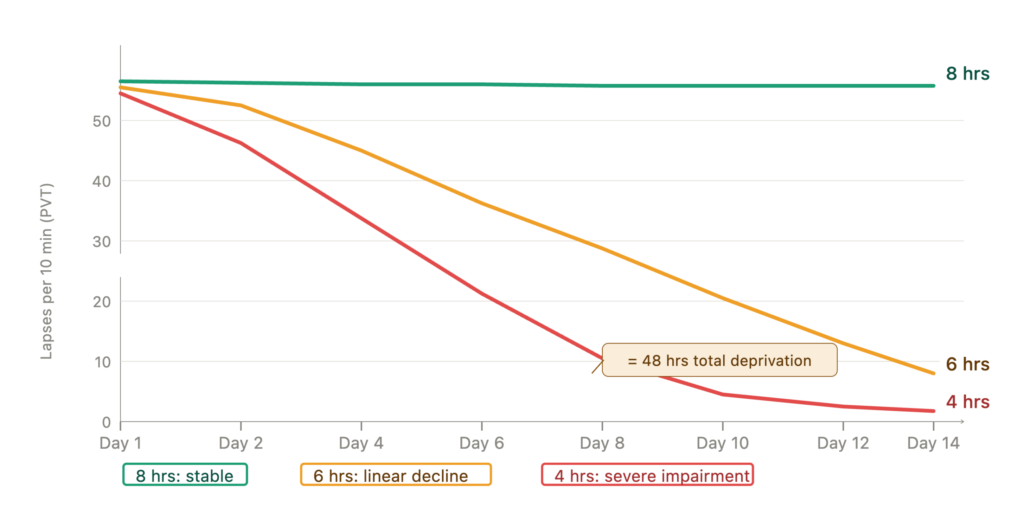
Six hours of sleep per night produces progressive, linear cognitive decline across 14 days. By day 14, performance on sustained attention testing is equivalent to 48 hours of total sleep deprivation. The critical detail: subjects consistently rated their own sleepiness as only mildly elevated throughout. Source: Van Dongen et al., SLEEP 2003 — The Cumulative Cost of Additional Wakefulness: Dose-Response Effects on Neurobehavioral Functions and Sleep Physiology from Chronic Sleep Restriction and Total Sleep Deprivation.
The weekend recovery myth
Sleeping 10 hours on Saturday does not reverse a week of 6-hour nights. A 2019 study in Current Biology (Depner et al.) found that a recovery weekend following five nights of restricted sleep reversed some metabolic markers but did not restore insulin sensitivity or return weight-gain trajectory to the pre-restriction baseline. Cardiovascular and immune markers take longer still.
Cognitive function recovers faster than metabolic and immune function, but even here, full recovery from two weeks of 6-hour nights requires more than one or two extended recovery nights. The subjective feeling of recovery arrives sooner than objective recovery. You feel fine again by Monday. The metabolic picture has not followed.
Weekend catch-up sleep also costs something: sleeping in on weekends shifts the circadian clock later, which makes Monday morning harder and sets up the same restriction cycle the following week. Social jet lag, the mismatch between weekday and weekend sleep timing, is independently associated with metabolic dysfunction and cardiovascular risk.
The Livium recipe
Tool. A wearable sleep tracker that reports nightly sleep duration and a breakdown of sleep stages gives you the data to see what a bad week is actually doing before the cumulative deficit becomes severe. The objective number is more reliable than subjective assessment, particularly once restriction has begun. For adults whose sleep restriction is driven by late-night work or screen use, a smart plug set to a timer that cuts power to devices at a scheduled time is an inelegant but effective behavioral intervention.
Behavior. The minimum effective dose is 7 hours per night, consistently. Not averaged across the week, per night. A 5-hour Tuesday offset by a 9-hour Saturday does not produce the same outcome as 7 hours every night. Consistency matters as much as quantity. Protect the first and last hour of the sleep window from screen use: the pre-sleep period determines sleep onset latency and the post-sleep period (alarm snoozing, immediate phone use) fragments the final REM cycle. Both matter. A 10-minute nap before 3 PM clears adenosine and improves afternoon cognitive performance; a contoured sleep mask blocks light and deepens the nap when working in a bright environment without disrupting the nighttime sleep drive; it does not count as recovery sleep, but it blunts the daily performance cost of mild restriction.
Threshold. If you are consistently sleeping less than 7 hours on more than two nights per week, treat this as a health issue, not a schedule issue. The schedule is producing a measurable medical condition. Track your sleep duration for two weeks with a wearable and calculate your weekly average. Below 49 hours total for the week (7 hours times 7 nights) is the threshold that predicts meaningful cognitive and metabolic consequences in the research. That number is more specific than feeling tired.
| Sleep duration (nightly) | Cognitive impairment by day 14 | Recovery time (cognitive) | Metabolic recovery |
|---|---|---|---|
| 8 hours | None | N/A | N/A |
| 6 hours | Equivalent to 48 hrs total deprivation | 3–5 recovery nights minimum | Weeks; not weekend-recoverable |
| 4 hours | Severe; equivalent to days of total deprivation | Extended; more than a week | Significantly extended; months possible |
Source: Dinges et al., SLEEP 2003 and NHLBI Sleep Deprivation overview.
Plan of action
- Track your sleep for two weeks with a wearable. Calculate your weekly total. If it is below 49 hours, you are running a deficit with documented consequences. The number is more honest than how you feel.
- Protect sleep duration the same way you protect a meeting you cannot miss. This means deciding the night before what is actually optional. The answer is almost always more than you think.
- Stop weekend sleeping-in as a recovery strategy. The mismatch it creates with Monday’s schedule (social jet lag) sets up the following week’s restriction. Extend sleep duration on weekends by going to bed earlier rather than waking later. Keep the wake time within 45 minutes of weekday target.
- After a genuinely bad week (four or five nights of short sleep), add a magnesium glycinate supplement at bedtime for the following two weeks. Magnesium supports slow-wave sleep quality, which is the most disproportionately lost stage during restriction and the most important for cognitive recovery.
Table of Content

Know your body better.
Trusted By Thousands Daily







FAQs
Is 7 hours enough or do I need 8?
The research consistently shows that 7 hours is adequate for most adults, and that 8 hours provides no additional benefit over 7 for most cognitive and health outcomes. The important caveat: a small percentage of adults (roughly 3 percent) have a genetic variant (DEC2) that allows them to function on 6 hours without impairment. This is not you unless you have had genetic testing that confirms it. The self-reported “I just don’t need much sleep” population is overwhelmingly chronically impaired adults who have adapted to their impairment.
Does sleep quality matter as much as quantity?
Both matter, and they interact. Eight hours of fragmented sleep (from sleep apnea, noise, a restless partner, alcohol) produces worse outcomes than 7 hours of consolidated, architecture-normal sleep. Slow-wave sleep, specifically, is the most restorative phase and the most sensitive to disruption from alcohol, caffeine, and aging. If your wearable shows 8 hours of sleep but very little deep sleep, the quantity number is misleading.
What about polyphasic sleep? Could napping compensate for short nights?
Brief naps (10 to 20 minutes) taken before 3 PM reduce the cognitive cost of mild sleep restriction without incurring sleep debt. They do not replace lost slow-wave sleep, which is primarily consolidated in the first half of the night. Longer naps (more than 30 minutes) enter slow-wave sleep and produce sleep inertia on waking, and can reduce nighttime sleep pressure. A well-timed short nap is a useful adjunct; it is not a compensatory strategy for chronically short nights.
Legal Disclaimer
The content published on Livium Health is for informational and educational purposes only. Nothing on this site constitutes medical advice, diagnosis, or treatment. Always consult a qualified healthcare provider before making decisions about your health, including changes to medications, supplements, diet, or exercise.
Livium Health is not a medical practice and does not have a patient-provider relationship with its readers. We do not sell supplements, medications, or treatments, and we have no financial relationship with the products or services we reference.
While we work to ensure the information we publish is accurate and up to date, health and medical guidance evolves. We make no guarantees about the completeness or currency of any content on this site. Reliance on any information provided by Livium Health is solely at your own risk.
If you are experiencing a medical emergency, call 911 or your local emergency services immediately.
We may receive compensation, free products, or affiliate commissions for products mentioned in this post. Opinions are our own.